Saturday, March 18, 2006

10 Golf Courses to Study Golf Architecture – Part I

I thought it would be interesting to see which course have had the most influence on my design ideas and why. What I’m also providing is my list of must see course for any budding golf architect.


1. St. Andrew’s (nature) – the contours make the course

If you could only study one course it would be St. Andrew’s. There are too many lessons to explain, but the one that is most important is the value of a contour on and off the green. St. Andrew’s features some of the boldest undulations on any putting surface, and positional play is important to accessing many of the pins. It shows how great greens can dictate strategy right back to the tee. The wonderful knolls, knuckles, rolls, humps, and hollows found around the greens require additional creativity to deal with. They take a player’s full imagination to overcome and there is nothing more fun than that.


2. Pinehurst #2 (Ross) – the difficulty of short grass

Whether Ross created the fall away greens and chipping areas is a moot point, all that matters is what effect it has on play. Short grass can be a more effective hazard that a bunker, it’s easier for a weaker player, but far more daunting for a better player. The advantage to a weaker player is they can play to their strengths, the disadvantage to a good player is they are faced with too many options. Bad decisions are often a bigger factor than poor execution. They may not need to be a severe as Pinehurst’s greens, but the effect is still the same.


3. Muirfield (H.S. Colt) – adaptable to all conditions and players

The beauty of Muirfield is how well it adapts to all types of conditions and players. H.S. Colt designed a course with two loops in the opposite direction ensuring that the wind would be encountered on all sides and that the wind would never be the same for more than three holes in a row. The bunkering completes this masterpiece by the way its placed. There is room off the tee on most holes, and the player is invited to play a shorter line; but the more aggressive the player gets, the more difficult the course plays. Colt has bunkered in a manner that the landing areas tighten the further the player tries to go. The player is left deciding whether to play safer or risk Colt’s penalty for being too aggressive.


4. San Francisco (Tillinghast) – scale and grandeur

I admire Tillinghast’s ability to think on a grand scale. This is likely the hardest of all the skills to explain or to aquire. San Francisco is as big and wide a golf course that I know, it features some of the most elaborate and bold bunkering that I have ever seen. The delight is how the architecture fits the property through Tillinghast’s use of additional clearing width and large open spaces. It takes a very clever architect to understand how to expand the scale of a golf course without overwhelming everything around it. This is one of the few cases where it works to perfection.
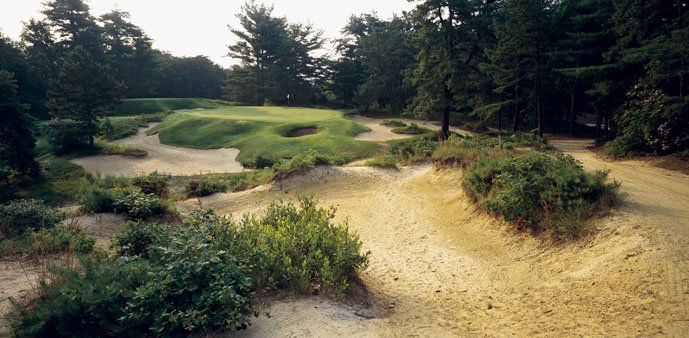


5. Pine Valley (Crump) – difficult does not mean length

Like St. Andrew’s there are too many great lessons to learn, so I will stick with one, yardage. Pine Valley proves that difficulty and length are not synonymous. The course is a relative short 6,600 yards from the tips, and an easy driving course too, and yet it is one of the hardest courses in the world. How? Through intimidation, penal hazards and a series of very difficult approach shots where a miss is punished harshly. Pine Valley has a better variety of hole lengths than any other course in the world. Crump gives you the opportunity to go for a par four and asks you to hit a long running approach into another. Variety is the spice of life and variety in yardages makes for the most interesting golf courses.

The Next 5 Worth Studying: http://thecaddyshack.blogspot.com/2006/03/10-golf-courses-to-study-golf.html

Friday, March 17, 2006

10 Golf Courses to Study Golf Architecture – Part II


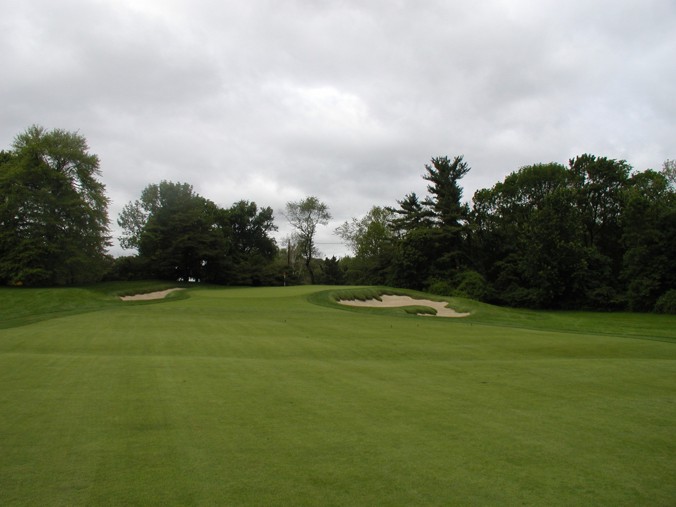
6. Merion (Hugh Wilson) – greatness on a small property

Merion may be the best routing in golf. On such a small property Hugh Wilson was able to find a flawless layout. The fun of the golf course routing is that it has a number of unconventional aspects to it: all par fives are in the first four holes, there is a long run of shorter holes from 7 through to 13, all climaxed by a grinding finishing 5. It works so well for two reasons; the first is that Wilson has simply used the best available holes and not been influenced by convention. The second is the rhythm of the course, it works almost like a three act play. The player is given a firm introduction to the course and it’s challenges in the opening 6, he is given an opportunity to try and be much more aggressive or to even score if he dares for the next 7, and the final act is survival. Merion gives the player all they can handle in the final 5 to see how good they really are.


7. Royal County Down (Morris, Coombe and Colt) – sense of place

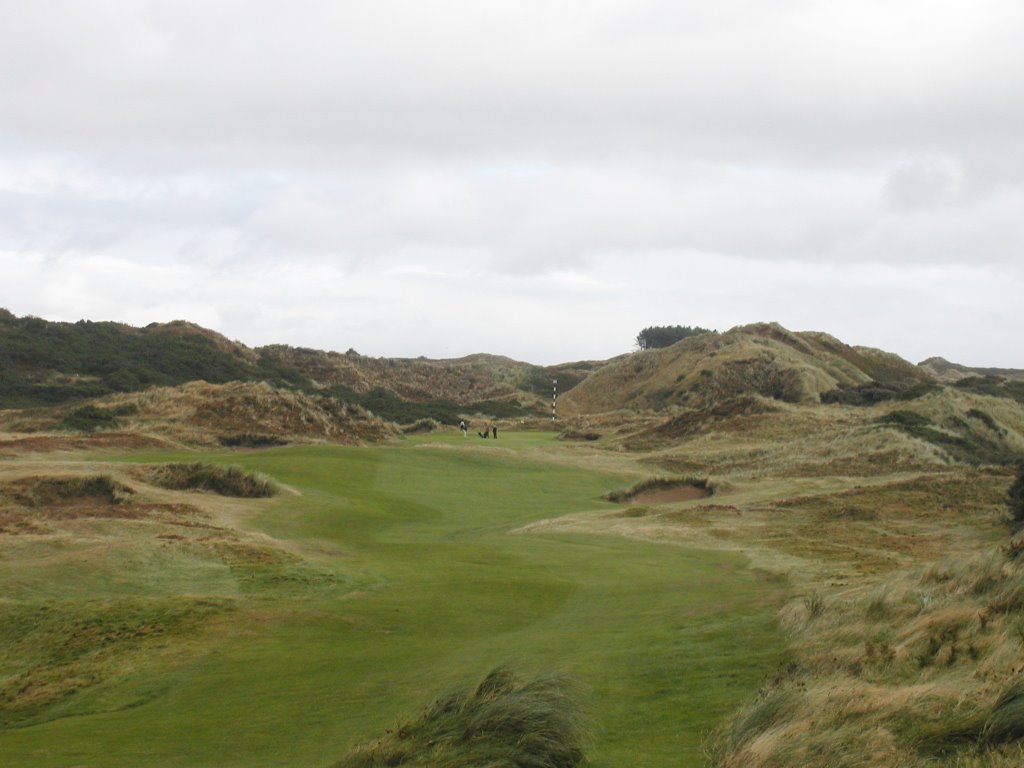
Royal County Down has bearded bunkers, brilliant purple heather, dark green gorse, magnificent golden dunes, the slate grey sea, spectacular deep purple mountains and a beautiful red brick hotel fronting the town itself. The architecture is great on it’s own, but the surroundings simply add to the experience and make Royal County Down one of the finest places to be anywhere. If you can combine great architecture into the right surroundings, you have magic. These are the courses that stay with us the rest of our lives.
The lesson is to find the right site first.


8. National Golf links of America (MacDonald) – understanding strategies of the great holes

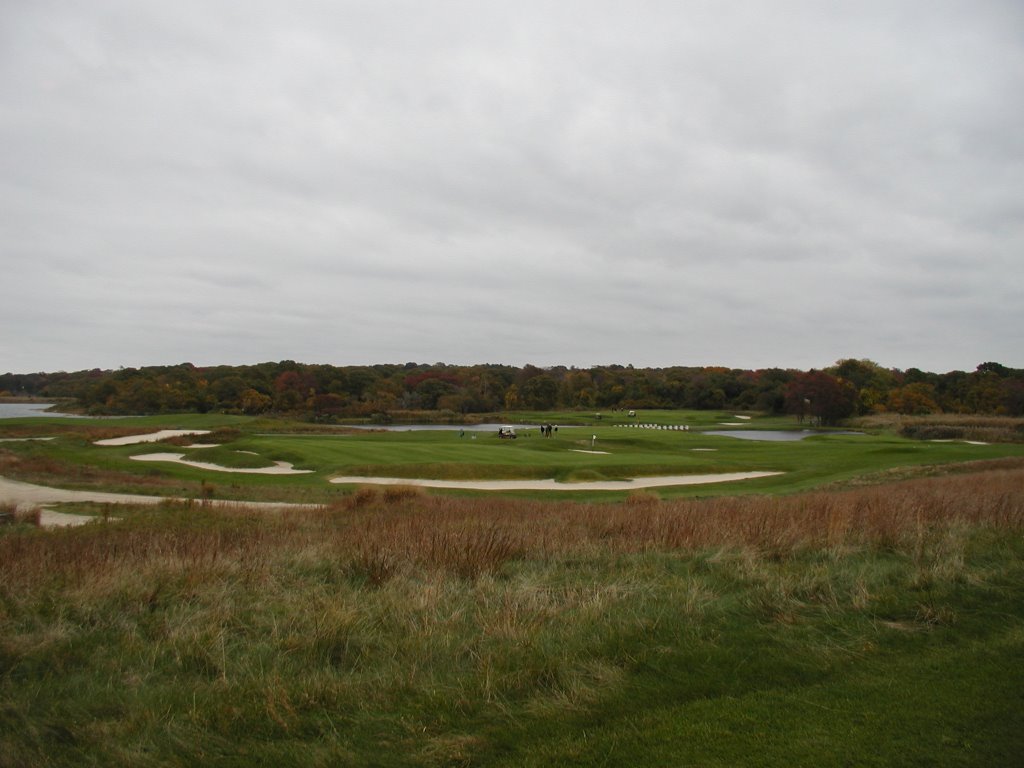
Many people believe there are no new ideas to bring to the game, that everything has been done, and the newness is more the ability of the architect to adapt old ideas to new situations. Charles Blair MacDonald (a Canadian!) adapted the great holes and strategies to create the National Golf Links of America. The lesson is simple, to be a great architect you must study and understand the ideas of the great holes before you can design them yourself. MacDonald’s adaptations are some of the finest, and some of his more innovative uses of them are well worth studying too.


9. Cypress Point (MacKenzie) – blending in and standing out

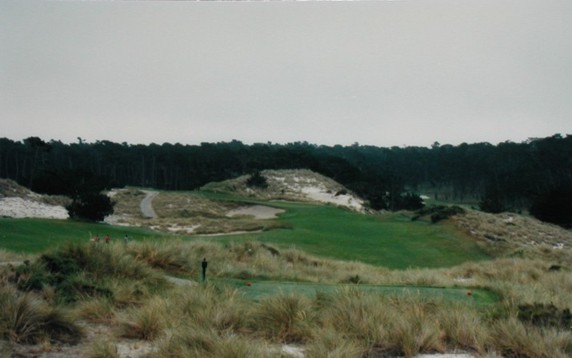
If you polled the architects Alister MacKenzie would likely be chosen as the greatest architect in history. He had a wonderful knack of incorporating natural features, and in particular natural hazards, into the golf course. At Cypress Point his bunkers were the key. The blended naturally right into the dunes, they contrasted wonderfully while mimicking the tree tops, and they added an elegant flair to the ocean side holes without competing with all the natural beauty. The artistry of his bunkers is breathtaking, yet for all their character and movement, they still magically blend comfortably into the surroundings.


10. Riviera (Thomas) – asking the player to work the ball

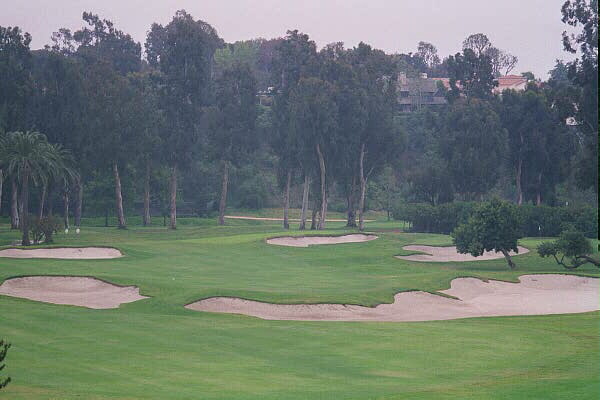
George Thomas probably combined strategy and beauty as well as any architect. He was a master strategist, who rewarded a player for positional play, but liked to make the player work to get the ball into position. There is no course quite like Riviera, where a player is continuously encouraged to hit either a draw or fade off the tee. Where the course excels further is the continuous balance back and forth so that no player has an advantage; many of the holes call for fade from the tee and then the draw on the approach, the next hole will often ask for the exact opposite strategy so no player can gain an advantage. He expertly used a combination of Eucalyptus trees, bunkers, slopes of the greens, and the baranca to make the player shape their shots. Riviera is a remarkably well balanced test of shot-making.

5 Modern Ones Worth Studying: http://thecaddyshack.blogspot.com/2006/03/5-modern-courses-worthy-of-study.html

Wednesday, March 15, 2006

Mike Stranz’s Shore Course


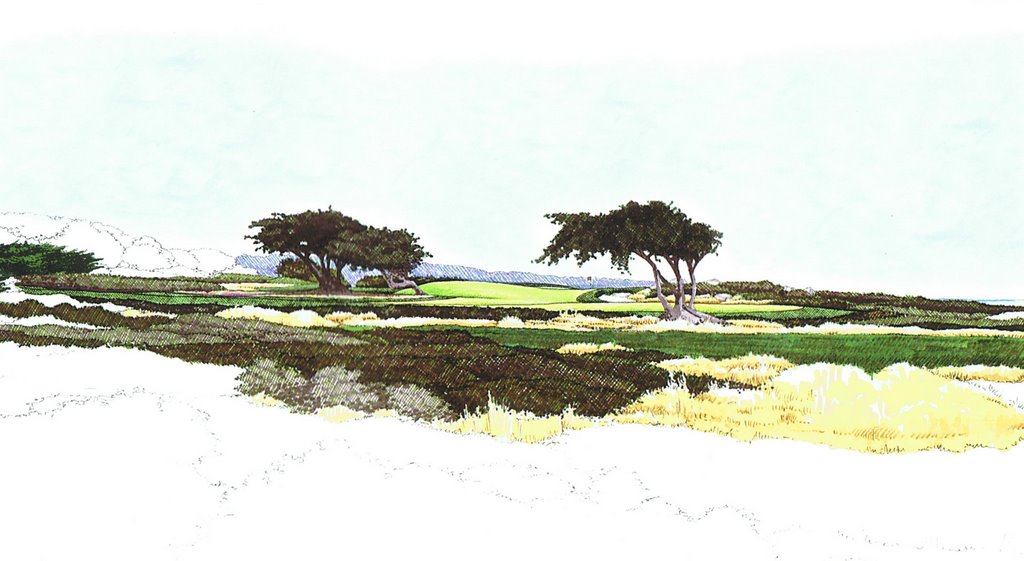
Mike's illustration of the 9th hole


“I hope to carefully shape this new course so she will bend and sweep with the natural terrain of the rocks, trees, grasses and ocean. My dream is that she will appear as she has been dancing among the Cypress on this coastline forever, and now she is the new, wonderful discovery of just a lucky few people.” Mike Stranz describing what he wanted to do at the Shore Course.


Mike's illustration of the 11th


Last year I went out to see the Shore Course at Monterey Peninsula with two other architects, Scot Sherman and Art Schaupeter. This was the course that Mike Stranz had won the commission with some of the most impressive sketches I have ever seen – it was a complete rebuild. This was to be my first chance to finally see a Mike Stranz course, the guy that many called a radical, an architect that drew praise and criticism in equal measures.

I know Mike’s favorite quote is by Alister Mackenzie “A first class hole must have the subtleties and strategic problems which are difficult to understand, and are therefore extremely likely to be condemned at first sight even by the best of players”


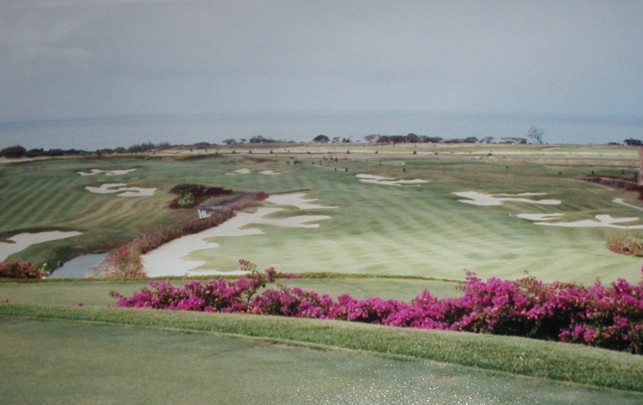
The completed 11th hole


Defenders of Mike like to point out that his courses are visually intimidating, but have great playability hidden in the course and that his application of width and optional routes does reduce the perceived difficulty. Mike has commented that many players try to play from the wrong set of tees and also try to play beyond themselves. I wanted to form my own opinion.

I did expect to be overwhelmed with his obvious creativity, but was curious to see if I cared for the level of difficulty he was reputed to build in. The course was as provocative and attractive as I expected, but it was also very understated and very playable. All three of us were very impressed with the flow of the course. It fit the land. It seemed to hug the natural features and it embraced its surroundings instead of competing with them. It seemed to dance among the Cypress on this coastline forever.


The 12th fairway shows the sweep of the fairway and how well the course fits into the site


The other part of the course we all enjoyed was how he created the strategies. He used the natural looking bunkers to create wonderful horizontal sweeps in the fairway which enticed you into a game of risk and reward all day. He used bold bunkering and green contours to reward you for careful placement. He wound the course back and forth to bring the strong winds into the game, but gave you room and optional routes to deal with the inherent difficulties. Simply a well conceived and wel thought out piece of architecture.

The Shore course is a must play for a young designer like myself. Mike left so many wonderful and simple lessons on how to use that site to get the most out of it – and he did. It makes a wonderful testimonial to the artist that was lost with his tragic passing.

(I can't wait to see Tobacco Road in two weeks)

Tuesday, March 14, 2006

The Central Bunker


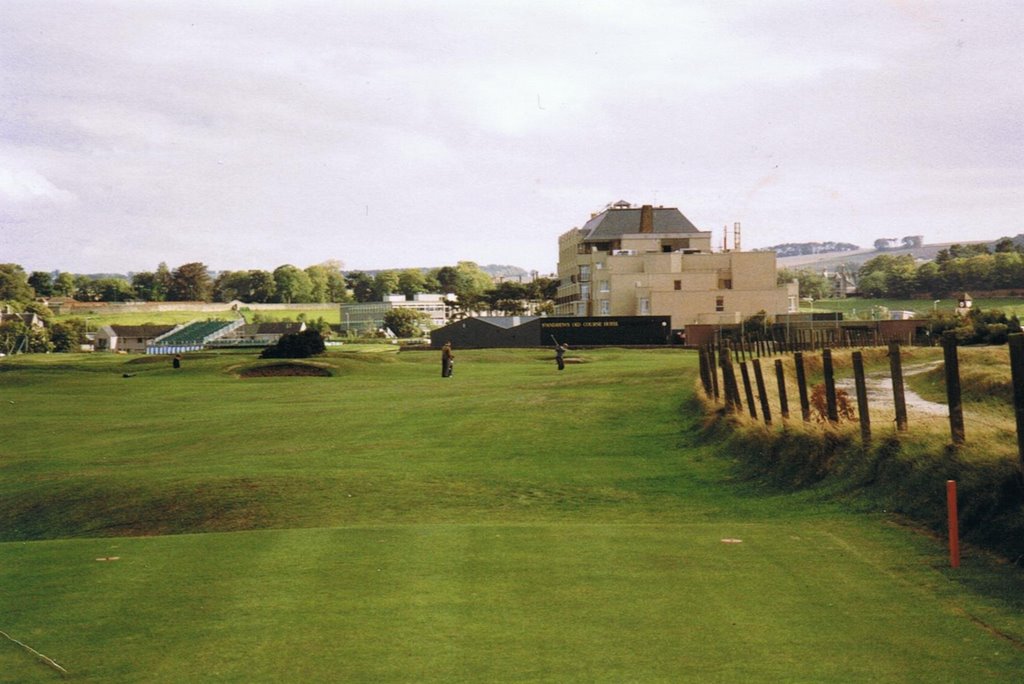
The famous 16th at St. Andrew's.


A bunker placed in the centre of a landing area may be an immensely controversial choice, but it is a technique that should be used more. Let’s study some great examples to understand why.
The principal’s nose on the 16th at St. Andrew’s may be the first and earliest example of a central bunker. The weakest players are well short of this hazard and don’t give it much thought; in fact many just take dead aim right at it. The average player will usually bail well to the left to avoid the cluster and reduce the risk, whereas the best players must challenge the hazard to achieve the ideal approach to the green. The green is definitely best approached from right of the cluster, which also involves flirting with the out of bounds. The bunker makes this a hole full of decision making and creates an unusual and excellent example of risk and reward from the tee.


The 4th at Woking.


The 4th at Woking was originally a very mundane hole until Paton placed two bunkers right in the middle of the fairway at the 230 yard mark. Golfers could play short of the hazards and face a tricky approach shot over a difficult greenside bunker, or they could take the aggressive approach of driving between the bunkers and the out of bounds, but be left with a straightforward little pitch to the green. The idea was so bold that it was met with a huge uproar in the club, but it was so clever that Tom Simpson was inspired by this great hole.


The Shoe bunker is in the centre of the picture


There are lots of other great examples to learn from such as Braid’s Bunker on the 2nd at Carnoustie, probably the most intimidating example of all of them. The 5th at Friar’s Head, a drivable par four where the bunker is 290 yards from the tee right in line with the green. The Shoe Bunker on the 2nd at Pacific Dunes, where a player has to decide whether to try skirt it or fly it. The long par five13th at Rustic Canyon has a central bunker with lots of room left or right, but somehow many end up stymied in the little central bunker.

I think the reason this is not used very often is the “F” word, fairness. Most players feel that they should always be rewarded for a straight drive and this seems to contradict with their beliefs. What they fail to realize is that the central bunker is placed primarily for decision making. Most players feel that it is there god given right to hit driver all day. Although this doesn’t take the driver out of their hands - they often choose another club because of the risks associated with flirting with the hazard - and they label this a weakness of the hole. The only weakness was in their courage. If we still played match play instead of stroke play, this hole type of hole would be more popular, but once again fairness influences architecture because we perfer stoke play. Admittedly this hazard must be used sparingly to work well, but with careful placement, this is an idea has produced some classic holes.

Saturday, March 11, 2006

Too Many High End Public Courses - a day at the golf show


Copper Creek's success spawned a series of $150 green fee courses, but many overlooked its key ingredient, location.


I went down to the golf show at the Convention Centre in Toronto yesterday. The golf show is about selling equipment and promoting places to play. As an architect, I do not go down there to promote myself or look for work; it’s more of a chance to see good friends and hangout with a lot of people from the golf industry.
Three interesting things came up during the day.

The NGCOA is promoting Take a Kid to the Course Week from July 3rd to July 9th. Any paying adult can take a child, under the age of 16 to one of 500 participating golf courses, and the child can play for free. This also includes clinics, rentals, tournaments and a prize draw. I commend the National Golf Course Owners Association of Canada for doing something to promote the game. I, for one, will be participating to support the program.

The second thing that came up in conversation was the possibility of having the Canadian government recognize Stanley Thompson as a person of national significance. This would have a far reaching implication on preservation of his work.

Finally, the talk of the show was the number of high end courses around the greater Toronto area. There are definitely too many already, and more coming into the market. Many new ones are built in markets where the local population will not support the green fee. All the Niagara courses are competing for the “assumed” Casino traffic (and the Buffalo region which is in a horrible economic slump), yet the spin off golfers from the Casinos were not there to support the Legends complex in the first place. I’m not sure where they will attract the players from, since all are built on flat sites which traditionally don’t attract players from outside the community. A Hamilton area course wants a 150 dollar green fee from a community that is quite blue collar and a region that offers a lot of good options at less than half the price. If the parking lot is often nearly empty, that is not a good business model. Even more perplexing is a course in Bellville charging a very high green fee when you have courses like Timber Ridge near by offering excellent value. People will drive for a better value. I personally can not figure where these courses got their financial model from, beyond copying the existing high end courses of Toronto. How could they possibly assume they could export it to other smaller communities, with out some adjustment for local economics?

There is a market, and there is a price point that will work in each community. You must start with that price point and figure out what you can build first. If you can afford the land, the build and the amenities, you will have a business that will work. If the course is exceptional, then you will draw from further away and get a better return. But if the course was expensive to build, and is considered only average, you will have trouble carrying your costs. Even people with exceptionally deep pockets will only pay for so long before they have to walk away. They didn’t get their money in the first place from this style of investing.

It will be interesting to watch the year unfold. I was around for the last similar cycle and this high end public course build out matches the private course bloom of the late 80’s. Clublink was born from that period, will Clublink or a new entity be an accumulator once again. The smart money went to the sidelines a few years ago saying that it could just acquire these courses with a little patience. It will be interesting to see if that is the case.

Friday, March 10, 2006

Target Bunkers - are basicly useless


Walter Travis opinioned that “The primary idea of a hazard is to punish to the extent of one stroke, a poorly played shot, and to make the recovery exceedingly difficult, and even by the virtue of the following shot being extraordinarily good. If the end is not attained, the existing hazard fails to fill its functions.”

Donald Ross stated that “Hazards and bunkers are placed so as to force a man to use judgment and to exercise mental control in making the correct recovery."

It is clear that these men see the placement of hazards as the key to testing the abilities of the player and to add interest to the game. There is no mention of alignment or definition.

So how did we end up with target bunkers, since it certainly offers no strategic value and only penalizes the most wayward of player?

Robert Trent Jones began the practice of bunkering the inside and outside of a dogleg to require absolute precision of driving. Architects in turn were drawn to the definition that this created and set about using it within their own design philosophy. Architects adapted this to their own personal style, which was usually based on a more playable model than Jones. As the bunkers were moved further away from the landing zone we ended up with bunkers that were out of play and could be aimed at. Hence the target bunker was born. Players got used to this luxury and architects began to routinely add in the bunkers because of their popularity.

Is the target bunker good for architecture?

I would argue that they are not. I think this has lead to a style of architecture that has gone beyond providing challenge, interest and options - instead it has evolved to offering clearly laid out tasks defined by the hazards. The target bunkers are their to make direction and placement absolutely clear from the tee. There should be more mystery and discovery to finding the correct line on a hole. The bunkers on the inside of the hole are the ones that define the challenge and create the coveted risk and reward scenarios. The only real use for a target bunker is to provide a line when there is no other feature available for a player to focus on – with trees, long grass and landforms - this is a rare event on a modern course. Target bunkers are an unnecessary addition to the game that cost too much to build and too much maintain.

I believe architects should use fewer bunkers much more effectively. They can accomplish their strategic intent and still get the definition they crave with more careful placement in the field.

Thursday, March 09, 2006

Stanley Thompson's Best 18


7th at Capilano


Stanley Thompson is being honoured by the RCGA this spring and it got me thinking about what are his best holes. I thought it best that we use his writings to determine what he felt was required for the best 18 holes and then go out and find the best examples of these holes.

“Every shot in the game should be planned and the holes should be so arranged that each one is different from the following one. There should be three or four short holes - five is perhaps one too many, as the remaining holes are apt to be unbalanced. They should be interspersed - not, however, near the beginning or the end. In the former case they tend to congest the course, while in the latter the player who happens to be down is discriminated against. There should be six or seven good two-shotters, with alternate tees for the lengthening or shortening of the holes as the ground is hard or soft or the direction of the wind, to preserve their values. The rest should be apportioned between pitch and iron shots. Beware of three-shotters, unless there is some special natural feature demanding them. The starting holes should be comparatively easy, so as not to congest the course; the finishing ones should be long and difficult, for they are often the deciding ones in a match and no one should win a game on an easy hole. The fewer the blind holes the better. The bunkers around the greens should always be visible when within striking distance. A wider margin will naturally be given for a brassie shot than a mashie, but in no case should the bunkers be unfair. One should be able to get out with one shot without Herculean effort. “ Stanley Thompson

The short par three – 15th at Jasper Park (The Bad Baby)
It looks so easy, till you play it, because the size of the green makes missing the green devastating.

The mid length par three – 8th at Banff Springs (Devil’s Cauldron)
Set on a glacial lake, hard up against the mountain, it's simply the finest single hole in Canada.

The long par three – 15th at Catarqui
This tough uphill par three was made an even greater test when Thompson created a 3' rise in front of the green, so that only the best shot was rewarded.

The very long par three – 8th at Uplands
Don't miss left, right, long or short because your dead, at 225 yards, the toughest great par three he ever built.

The short drivable par four – 4th at Highland Links
The green sits such a short distance from the tee on a tiny plateau, it just entices you to do the wrong thing....go for the green.

The drive and pitch par four – 11th at Thornhill Golf Club
This is the hole that gave Byron Nelson fits when he won the last of his historic 11 straight victories in 1940. The hole rewards precision rather than brawn, because of the way the hole and the green runs away from play.

The drive and mid iron par four - 12th at St. George’s
Stanley used the most intimidating bunkers he ever created to make you play the hole the way he wanted you to.

A comparatively easy starter – 1st at Banff Springs (original routing)
A nice wide open opener with a beautiful view and no bunkers invites the player onto Banff

A good two-shotter par four – 13th at Highland Links
Stanley's use of the incredible knob in front of the green has created a situation where the ground maybe the only prudent option for an approach.

A good two-shotter par four – 14th at St. George’s
The second shot to a green squeezed between the hillside and the creek makes this the hardest single shot a s St. George's


2nd green at Highland GL


A good two-shotter par four – 2nd at Highland Links
Arguable the best par four Thompson built. The risk and reward from the tee and the wonderful elevated approach into a green framed by the sea, pale in comparison to the a spectacular green contours that set this one off by itself.

A good two-shotter par four – 7th at Capilano
A very difficult drive skirting by one of Thompson’s greatest bunkers sets you up for a difficult approach to a small plateau green. Missing left looks like the best option but Thompson has fooled you, there is no recovery from the hollow left of the green.

A good two-shotter par four – 2nd at St. George’s
A difficult tee shot that requires taking an aggressive line for position, followed by a tough long iron into a deep but narrow green. Only the two best find this green in regulation.

A long difficult finisher – 18th at Jasper Park
Alister Mackenzie described the hole as one of the finest in golf.

The short par five – 8h at St. Thomas
The tee shot involves risking the tight fairway bunkering to find the slot in the fairway. The approach is to a plateau green that invites the gamble, but heavily penalizes any miss with an impossible recovery.

The mid length par five – 15th at Highland Links
The most interesting fairway contours in golf, they make the hole great. Add in a clever diagonal bunkering scheme and a view to the ocean; add it up and you have the best par five in Canada.

The strong par five – 18th at Capilano
A testing uphill tee shot between lots of bunkers, and then the choice of trying to play aggressively to the small upper fairway, or safe to the lower fairway. The pitch from below is semi-blind and full of danger, the upper pitch is wide open and without trouble. A classic risk reward second shot makes this hole special.

The unreachable par five “because of the land” – 7th at Highland Links
“Killer” is so hard that I know few that have even made par. A tight tee shot, followed by a second shot skirting bunkers, followed by a delicate pitch to a severely sloping green, all from rumpled stances. A great test of anyone’s ability.

Wednesday, March 08, 2006

Rustic Canyon – a great model for future public courses


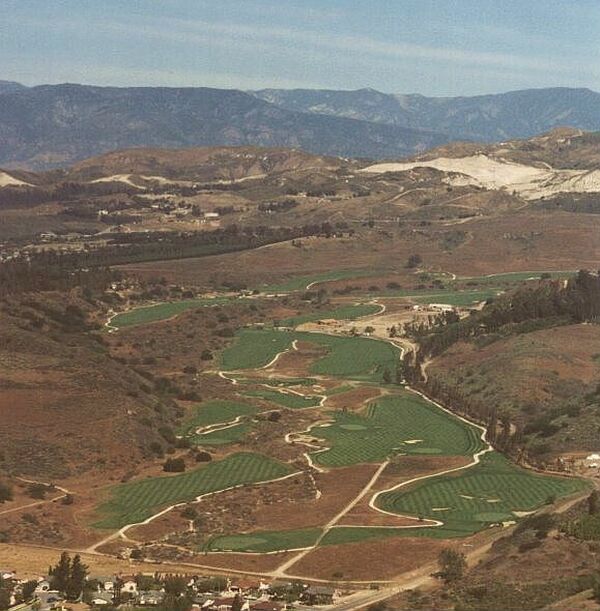
A look at the course from the air, notice the width and use of central hazards.


Rustic Canyon in Moorpark California is a golf course so good that it draws people from around the country to come and seek it out. Many would assume that a course this popular must be a big budget course done by a large firm. The course was in fact built by a small team of dedicated young architects for a very modest budget.

What makes it so good?

The course echoes the strategies and spirit of St. Andrew’s better than almost any other course designed in recent times. The green’s are very complex and involve strict placement off the tee to ensure access to pin positions. The turf beyond the greens is kept intentionally short to make the ground game the game of choice. This brings in an element of chance and luck rarely seen on other modern courses. The bunkering is present, but like St. Andrew’s, the player feels they have lots of room to play safe away from most bunkering. The fairways are wide, with an immense amount of options, but often the most dangerous route is the one that opens up the green. Gil Hanse, Jim Wagner and Geoff Shackelford have managed to bring the spirit of Scottish golf into a California Canyon.


A great setting that follows the natural contour in the Canyon


Why is it such a good model?

The golf course design follows the land, with little shaping beyond the tees, bunkers and green sites. This means they were able to build it for a modest budget, and the course only needs a modest green fee to make a return. Since the course is well designed, it is popular with all types of players. From a beginner to scratch handicap, each player is given a different test to fit the limits of their skill. Because it is so well liked, the course is busy, which guarantees the course will generate income for the community or ownership.

There is a lot to learn from Rustic Canyon.

Questions and Answers with Geoff Shackelford about Rustic Canyon


I asked Geoff Shackelford to answer a few questions on how it was done. I wanted to post the comments as I got them – I thought you could learn and understand more with the complete set of questions unedited.


I.A.: What was your goal with the project?

GS: Well my personal goal was to learn everything I could about a project from start to finish and Gil Hanse was kind enough to let me get my feet wet.

I.A.: Do you think that Rustic Canyon best illustrates the future for golf development?

GS: For the most part yes. There are elements of the project that are not necessary (wall to wall cart paths), that could save a lot of money for someone. And the operation is by no means a model. The place survives in spite of the operation actually, which says a lot about the conditioning, environment and hopefully the design.

I.A.: What design ideas do you think are most important to making this model work

GS: Width, width and more width. That instilled the fun. And sandy soil. That helps on the construction end (saving money on drainage) and on the maintenance end, not to mention makes for fun golf if the course is setup properly.

I.A.: What would you like to have done differently?

GS: More smaller bunkers. We built a few little pits, a couple of blind ones and they get so much attention even though the odds of hitting in them are slim. They tantalize good players but rarely upset the average joe's thinking. I love that, and it's great from a playability standpoint. Heightens strategy,but reduces the number of penalties for the majority of players.

I.A.: What was your target green fee?

GS: 30 to 60 dollars.

I.A.: What was the target budget to make the model work?

GS: In an area with nine million people within 45 or so minutes of the course, there was room to spend a bit more and still make it because golf is year-round here. The golf course budget was $4 million, and we came in at $3 million, and it should have been less but the cart paths and the construction supervisor wasted hundreds of thousands.

I.A.: Could you explain the financial model for other regions to copy?

GS: I'm not the one to ask about models, all I can say it, find sandy soil and an architect that is sensible and you'll do fine.

I.A.: Was the width to help speed of play or for creating options?

GS: Both. But I can't see how the course would have been narrower in any scenario, say as an upscale daily fee or a private course. It was just what felt right for the land, and it's the type of golf Gil and Jim and I like.

I.A.: The greens are magnificent was that the plan from day one?

GS: Well of course the plan was to make them magnificent, but how they actually come out is a mystery. Gil did most of them and create the shell in remarkably little time (#13 was a day and a half...my favorite). That said, a lot of thought and discussion and debate went into the concepts behind them. I don't know how Gil feels, but I believe the best ones out there are those where we really talked about the idea behind the hole and figured out the concept going in, so that when he got on the bulldozer, things just clicked. Of course, then there's #10, where I, a total hack on the bulldozer, just started making a hole that Gil refined into the green we have today. There was a concept there, but still, there was some fortune there too that it worked out.

I.A.: There are very few bunkers, was that due to the natural areas, playability or maintenance, or none of…?

GS: Looking back I wish we had even fewer. Mostly because the land was so good and there were so many natural hazards, that we chose to emphasize those features. As I said early, maybe more small pits would have added some fun and intrigue, but overall we really haven't wanted to do much to refine the strategy behind the holes.

I.A.: Any other thoughts about the project?

GS: Well it was great fun and eye opening for me in so many ways. Environmentally, we had a lot of issues to deal with and came out okay. I believe that stemmed from working to avoid the sensitive areas and being honest about what we were doing. I think a lot of projects get into trouble by trying to force holes into areas they just shouldn't go either because of impact on wildlife or because wetlands were really meant to be just that, places for water to go.

But ultimately the success of the place all goes back to fun. The operation is dreadful, but the super holds his end together and the golfers ultimately don't care that the carts are dirty or the place has no bathrooms on the course (well, that is embarrassing). The fun of playing the course keeps it attractive to most golfers and that's neat to see.

Saturday, March 04, 2006

What's in a Hole Name?


Het Girdle, a well named par 3


Why is the 10th hole at Carnoustie named South America? What about Het Girdle at Gleneagles, Killecrankie at Highland Golf Links, or even Heich o’ Feisch at Osprey Valley?

Het Girdle describes the hot surface of a skillet than sends a drop of water speeding off the side. The 5th at Gleneagles is the best table top green I know, and a missed shot is severely punished with the deep bunkers surrounding the plateau green. The name perfectly describes playing the hole. Killiecrankie (or Killer to the locals) is described as a long and narrow passage through a valley. If you’ve been to Highland Golf links in Nova Scotia, you will know this perfectly describes the setting of the hole. The 4th at Osprey Valley – Heathlands was named by me and it means the height of trouble. I used the name to describe the very delicate little pitch into the 4th green and what would happen with a mis-placed the approach. I have named every hole that I have worked on – some clubs, like Osprey Valley have made them part of the course and the card - others like Ballantrae chose not to. Golfers remember great holes, but when a name like Pandemonium or Purgatory is attached they become even easier to remember.

Hole names are one of the unique charms of golf. When well done, they help describe the situation, shot or setting of the hole more eloquently than a simple hole number. A clever name like Too Soon for Scarboro’s treacherous par 3 2nd hole simply speaks for itself. A.W. Tillinghast and Stanley Thompson both professed to be huge fans of hole names and often named their holes. James Braid even went so far as to name a hole Braid’s Brawest – just to let players know which was his favorite.

The most famous hole name of all must be The Postage Stamp. The hole was actually called Ailsa for the crag in the ocean beyond, but Willie Park described the hole as “a pitching surface skimmed down to the size of a postage stamp” and the name stuck. So how did we get South America?

At the turn of the century a young lad from Carnoustie decided that he was going to spread the word of golf to the south of America. After a party held in his honor, he decided to start out on his trek that night. Obviously the party involved lots of drinking because he was found fast asleep at the 10th hole of Carnoustie the next morning. Hence the name South America, and golf is a richer sport for it.

Friday, March 03, 2006

Kawartha Golf and Country Club - Stanley Thompson 1931


The 18 hole with the 12th in th background, the photo is from the early 1930's.


Yesterday was a big day for me, Lorne’s article, I got a cheque, and Kawartha Golf & Country Club gave me the go ahead to complete the remainder of the large projects. After this stage - only drainage, tees and the practice facilities remain.

Kawartha was designed by Stanley Thompson in 1931 for the General Electric Corporation “and their friends”. This commission was right after some of his most important courses were completed - Royal York (now St. George’s) being the most recent - and his stature was riding high. The interesting thing about 1931 was that I was the first quiet year for Thompson and this was his only major commission. The remaining work we know about were two renovations and a miniature golf course. We know he had lots of time available to be on site, and his best men were all likely at Kawartha. Kawartha was opened in 1932.


The 18th today after restoration. The back right bunker is 10' deep!


I was commissioned to do a master Plan for Kawartha a couple of years ago and it primarily focused on restoration of the golf course. For me personally this came at a perfect time, right after working with St. George’s, and I was well prepared for the work. Kawartha has been one of the finest clients I have ever had, they have directed me when needed, but mostly trusted me throughout. I care deeply about getting Kawartha right, I owe it to the club.

The first year was a bunker renovation and restoration program. The only reason I say renovation as well, is that I had to make decisions on some of the holes where I had no photos. This was not ideal, but I used what I found on site and in the ground as a guide. The contractor Donnie Robb was as patient and helpful as he was talented in his recreation of Thompson’s grandeur. I have enclosed photos of this work.


The 14th, with the "octopus bunker" on the left, and one of my favourites on the right.


This years work is to fix the only two holes that were altered. The 5th green will be rebuilt and returned back to the style of the original green. The contours and the size will once again match the rest of the course. The third hole which had the fairway completely moved and changed to create a dogleg (and add difficulty and length?) will be returned back to the original corridor. The containment mounding will removed and the option to go directly at the green will be returned. The hole will once again be a risk and reward short par four.

My intent is to write more profiles of the places where I’m working and detail what I am doing in the field. I’ve been leaving all my field drawings with contractors for years, I will try photo them to post them as I go.

Thursday, March 02, 2006

Article by Lorne Rubenstein....on me!

A hole that was fun and challenging to play at only 350 yards. The central bunker is 280 off the tee creating a tough decision. The mound hiding the left pin instead of a bunker creates options.
A great hole by Bill Coore

I have always had a deep respect for the opinions and knowledge of Lorne Rubenstein, undoubtedly Canada’s leading golf authority. Beyond writing, he has a passion for the game itself, and that comes across in his writings. I have had the pleasure of talking with Lorne on a couple of occasions and have enjoyed his views on golf architecture and the design business. Needless to say it was a surprise and thrill when Lorne called a couple of days ago, but to be honest, I did not expect him to be interested enough to write a story about me. So, to say the least I was thrilled.

And here is the story…..

http://www3.sympatico.ca/iandrew/Lorne.JPG

Fun is part of making the game interesting. Unusual stances, options along the ground, the need to use the contours to feed an approach; these are all fun shots to hit! But how often does any architect ask you to try make that shot? Not too often. That’s why I went out to see the work of Doak, Coore and Hanse, architects that were trying to reintroduce these shots to their courses. Those are the 20 courses I was referring to in my discussions with Lorne. I’ve probably seen 300 classic courses in my travels throughout the world now, and that has loaded me up with so many ideas on how to take advantage of different sites. I can’t wait for the opportunity, and I’m confident that my courses will be really well received.

The Architect’s role is not simply to make the golf course difficult; it is to make the game interesting.

Monday, February 27, 2006

The Breather Hole


The 11th at Highland Golf Links in the first few years

There is no question that the 11th at Highland Golf Links in Nova Scotia is intended as a breather hole. The first 10 holes at Highland run up and down the landscape like an out of control roller coaster slicing wildly through rolling wooded terrain. The 11th completely contrasts , built on the flat valley bottom almost like the high flat section on the roller coaster ride that sets you up for the next big drop.

The hole was designed as medium length par four – bunkered only for alignment – its fairway the widest on the course with an unusually flat and wide-open green. So how could this hole have architectural merit if it was so easy and inviting? The key is what the hole offers the player. The 11th is a chance to catch your breath, hopefully make a par, and prepare for the next dizzying run of holes over Highland's rumpled terrain. More importantly it offers the best view of the surrounding mountains on the course. Thompson let the player relax and enjoy the views of this magnificent hidden valley, giving them time to savour this special place.

Roller coaster designers know they must space their thrills with breaks to maximize the enjoyment of the ride. Architects from the golden era used the breather hole between dramatic sections to relax players before taking them through a second difficult or dramatic section. A well-designed breather hole also builds anticipation for the next section. Breather holes represent another design technique that modern architecture has overlooked, to the detriment of the game.


The awesome 2nd hole at Highland Links, showing the dramatic nature of most of the course

Sunday, February 26, 2006

The Best Course in Canada - that No Longer Exists


Jericho Golf & Country Club

The course featured a seven seaside holes looking out onto English Bay, and 11 holes cut through tree lined rolling terrain, all with dramatic views of Vancouver and Vancouver Island. The upper holes were described to have such drama that very few traps were required, and the seaside holes were rough and raw with open areas of hazard. The setting and mixture of holes made up what could be arguably the biggest loss in Canadian Golf.

It disappeared to become a naval base in 1942, likely because it was in an excellent location, and it offered the land required without expropriating houses.

Every BC course including the “new” Capilano Golf & Country Club were all compared to how they stacked up against Jericho. The architecture likely did not live up to Thompson, Alison or Park, but the setting was far better than almost any course in Canada.

The course would definitely make the top 25 list for Canada, and may have been even higher. The course would have looked and played like Capilano in the upper holes and had a similar feel to the Oceanside holes at Victoria Golf Club.

Saturday, February 25, 2006

Golf is too expensive, but it doesn't have to be!


What would happen if nobody new wanted to play because they had decided that golf takes too long and is far too expensive?

Public golf in Toronto has gone from an average of $40 a round in the mid 90's to an average of $80 today. The construction budget of the first course I worked on with Carrick was 3 million, and the last one was 10 million (please note this was a much tougher build). I've watched the guys I play hockey with go from avid golfers playing 20-30 times a year to becoming occasional players in the last 5 years. Why? "Too expensive and I've found a new hobby that takes less time away from home" Golf needs to realize that the massive build out of strictly high end courses that occurred in Toronto over the last 5 years is not good for the game. It drove the prices up - and they players away.

But if the course is built for a reasonable budget and is well designed - it will become a very successful project. If the course was built for a large budget and fails to attract players - someone loses their whole investment.

In future posts I will detail one alternative model for building an affordable golf course. I will discuss this using a project called Rustic Canyon, which is both affordable and outstanding.

“It is generally agreed that intense importance should be attached to utilizing every feature in the ground, so far as it is compatible with a satisfactory framework. To depend to the maximum extent upon nature, and to the minimum upon art, makes for interesting golf and moderate expenditure.”

H.S. Colt, Some Essays on Golf-Architecture, 1920

Friday, February 24, 2006

Is faster really better?

Or............How Johnny Miller ruined golf.


The greens at Country Club of Scranton are some of the finest in golf, if the greens get any faster, they will lose many of the great pin positions that make the club special.

In 1980, the Metropolitan Golf Association did a stimpmeter survey of the local courses to determine the speed of the greens. A fast green measured 8.5 feet, medium was 7.5, and 6.6 was considered slow. Today, the average fast speed is approximately 10.5 feet, an increase of approximately 2 feet in the last twenty years. In the world of income taxes, this type of increase is called “bracket creep”. In golf, I would call it “speed creep.”

My question is: Do faster green speeds automatically result in better golf? We live in an age where golfers throw around green speed numbers as if they were weather forecasts. Every self-appointed Carnac has a real or imagined number that they freely throw out to impress their friends. My beef is that the majority of “experts” who so freely share their “wisdom” are not truly aware of how green speed is measured and how easily it can be done incorrectly. Recently I played in a club tournament, and one member proudly boasted that “his” greens were “14 today.” Were they recently paved, perhaps?

So, what do these numbers really mean? In the movie Spinal Tap, guitarist Nigel Tuffel explains why his band is the loudest in the world, “Our speakers go to 11, that’s much louder than 10.” Of course, the joke is that band members painted the eleven onto their Marshall speakers; the volume could not measure any higher than the original ten. The point I’m trying to make here is that eventually, numbers lose their relevance. Getting back to green speed, I was once asked by a greens chairman what was the difference between ten and eleven . My response? “All I know is that eleven is a larger number.”

Unfortunately, a phenomenon has taken over North American golf called “the trickle- down effect”. The club with the fastest greens becomes the standard for what all clubs consider the “correct” green speed. While large flat greens can handle speed, courses with rolling greens become unplayable under the same conditions. Often, the course that becomes known for its faster greens actually has major back to front slope. The misconception is that the turf , not the slope, is creating the speed. Despite this, the club with the perceived fastest greens has set the bar, and now all other clubs strive to hit this maniacal target. The problem is that most clubs usually ignore the true speed limit of their own course. Remember, every time you raise the speed, you lose area which can be fairly pinned.

How do we know what the speed limit is? If the pin is almost always in the same locations and the turf is under stress, your greens are too fast. Also, fun and challenging pin locations, that make a particular green unique, are now unusable. The speed limit of a green is determined by selecting the most severe pinning location and determining a fair speed for that location. One single pin location cannot set the standard, but a consensus of the most difficult pins will lead to a speed threshold for the greens. This threshold, not comparisons with other golf courses with faster greens, should be how a club decides how fast it can go. Please note that the club’s primary “event” is not my focus, the day to day speed is my concern.

Fast green speeds are said to identify the elite player by putting a premium on focus and skill. The question I ask is: Do we need to do this on a day to day basis? In my experience, excessively fast greens can identify a superintendent who is pushing the envelope. Hugh Kirkpatrick, a respected golf superintendent from Westmount Golf & Country Club in Kitchener had my favourite line on green speed: “They always run fastest just before they die.” In the movie Top Gun, the pilot Maverick says to his navigator, Goose, “I feel the need for speed.” To me, Maverick is like a greens chairman who is cocky and out of control and Goose represents the superintendent -- more experienced but with less influence. We all know what happens in the movie when Maverick makes an error. Goose pays the concequences.

Where am I going with this little soap box rant, and what’s the connection with Johnny Miller?

In my experience over the last year, which includes dealing with 50 courses and 100 greens chairmen, I have been constantly questioned about why the greens are so slow. My answer to them is another question: Are the greens healthy.? The answer is usually yes. When I explain that you need firm, dry greens to have fast greens, most chairmen quickly realise that often the last season has been one of the wettest years in a long time. This, obviously, could have hindered the superintendents’ ability to deliver healthy and fast greens. However, one greens chairman required further convincing, so we went out to the putting green for a test. Stealing an idea from Ian Bowen, I asked the amateur agronomist to putt 3 balls at a cup 10 feet away. I then poured a bucket of water in between the him and the cup, and waited for the green to absorb the water. He hit his next putt well short and the point was clearly made.

Most greens that I have renovated have pinning areas too small to handle the traffic. Occasionally, a green with dramatic contouring becomes almost unpinnable with a change in green speed. I don’t like to rebuild greens with great contours; I would rather preserve them. Greens that have more contour may need to be slower but they require more creativity and challenge a golfer’s skill. Conversely, greens that have more speed may need to be flatter, which demands less imagination from the player. I want the push for speed to stop before putting gets boring.

One club, notorious for its fast greens, maintained their speed most of last year. The greens were fast, but became thin and weak during stressful periods. Before you blame the superintendent, he had suggested that they need to ease off. The majority of membership finally overruled those who were demanding fast greens and told the club that healthy greens were more important; if the greens had to be slower to recapture the turf, so be it. I hope this is a coming trend, but I can’t say I’m confident.

In my experience, members who are obsessed with green speed are junkies who can never get enough speed. I suggest they be banished to putt in the parking lot. After all, it is currently stimping at 14.

You’re still waiting to see what Johnny Miller has to do with all this, aren’t you. Well, Johnny Miller has a reputation as a bit of a know-it-all. He loves to throw around statistics and numbers all the time. He loves to tells us the greens are stimping at 14 in the latest PGA tournament. The average golfer would not know what stimpmeter was without him. So what’s my beef with Johnny? People assume that everything they hear on TV must be true. The result is that Johnny Miller has helped to create a legion of misinformed greens committee members. Thanks, Johnny.

Why the Caddy logo?


I assume many of you who that have visited my web site www.andrewgolf.com are wondering, what's up with the logo? Well it's nearly 20 years old now and it was inspired by another illustration of a caddy. At the time I was looking for a "clever" logo to go on my thesis at Guelph - I think I was trying to be funny at the time. The thesis was about recovering a landfill for a golf course - and idea that is wonderful in theory - but carries so many serious complications.

Well I guess I grew attached to the logo, so when I was looking for a logo for my new company that somehow described me, I realized I already had what I wanted. With a quick revision to the face the caddy became me. So why the caddy?

The caddy represents my start, which was originally caddying for my father, a long time ago. It also represents my belief that the greatness of the game is rooted in its past , and finally the logo is supposed to be fun - a golf course design element that I feel is greatly overlooked.

Thursday, February 23, 2006

Our Last Father and Son Trip (a tribute to my father)

At dinner in Portrush, my dad offered the simple statement, "This will be my last golf trip"
My father is the reason I play golf, and more importantly the reason I became a golf course architect. As early as age 13, (which he confirmed again this week) I wanted to be a golf course architect. My father taught me how to play – not easy for a man who averaged 150 days away from home each year. More importantly, he taught me about the game itself. His passion became my passion, a gift from father to son.


My father and I together at the 5th green at Royal Portrush in Ireland.

When he realized that my obsession with golf design was more than a passing interest, he bought me architecture books to begin my education. But that still was not enough for me. So he began to plan family vacations around particular golf courses. Mom never figured out that a family trip to Nova Scotia was planned so that Dad and I could see Thompson’s great Highland Links. But she caught on to us when we went to Pinehurst. She realized that golf would become an intricate part of family holidays in the future.

What she did not realize was that Dad and I were about venture out on our own, leaving her behind (well in London with her sister, actually) as we toured the great links of England and Scotland. For my father, this trip was a return to see old favorites. For me, it was a pilgrimage. And a logical next step in Dad’s plans to educate me about great golf design.
In Scotland, I fell in love with a version of golf that was far superior to anything I had seen before. I personally don’t feel an architect is completely educated without seeing those great links. This was also the trip where I insisted on paying my own way and discovered that golf travel is expensive.

A few years later, it was my turn to treat Dad. We headed off to Pebble Beach, where I surprised him with a round at Cypress Point (still his favorite day of golf ever – must have been that O’Meara fellow that joined us). It was then when we hatched the idea of heading to Ireland. Ireland was to be our next golf journey, and the final leg of our series of trips together.
When I began working with architect Doug Carrick in 1989, Dad and I began to talk seriously of going to Ireland, but then I got married and bought a house. I decided to take a few years to get established. We talked about it again, but soon Cindy was pregnant, and I was too afraid to go before Cameron was born.

We were finally planning the trip in the late 90’s when my Dad got skin cancer for the first time. He had to have a large skin graft that restricted his movement and was unable to play for a full year. Fine, I thought, we’ll go next year. Dad was treated and was fine, but strangely (to me) chose not to play. It was the first year we had not played together since I was 14 years old.
The following year he had a second brush with skin cancer that required more surgery. I waited for him to recover, and get a clean bill of health. He didn’t play that year either.
I mentioned to him that I had an offer for him to play Cypress Point the next year. I thought that would entice him, but he told me he was not interested. He thought I should go without him. I was stunned about how uninterested he was with golf, and couldn’t bring myself to go there without him. (I wrote a thread on his disinterest in golf many years ago to which a couple of you sent wonderful responses). The trips had always been about us being together, with golf as the perfect backdrop. I waited another year before he began to play again – much to my great relief. We played at a series of courses that Carrick Design had built or had done renovations on, with a late season round at the first course that I could say that I built. He immediately recognized homage to Pinehurst #2 (public course with wide fairways and heavily contoured greens), and it amused him to know that the trip we had made those years ago had that much effect on me. It was a wonderful moment for both of us.

I have recently started teaching my oldest son the game because he has asked to play. I always feared introducing him to golf, afraid that my own desires to experience a similar father and son relationship based around golf would pressure him. Carrying that expectation would be an unfair burden upon him, I believed. But once he asked, I arranged for Cameron’s first game of golf to be with his grandfather and I. We were in Florida at a small public course. It was fun for my father to realize that the game was being passing down through three generations – that golf was something he shared not only with me, but also with his grandson. My father gave my son the same basic lessons he had given to me, and got Cameron to strike the ball surprisingly well. I just watched with a large smile on my face.

Recently, I brought up Ireland again with Dad, and the planning began years after we were supposed to go. There were times during those years that I was filled with regret, afraid we had lost our last chance to go, especially after reading Dodson’s wonderful book "Final Rounds."
Then, after weeks of planning and scheduling, the time had come for me to leave. My parents were in London visiting family, and Dad and I were to connect at the airport in Dublin. Dad was 77 and I was 3 days past my 40th birthday. We had 10 rounds arranged over 7 days - it was up to him how much we played. I left for the Toronto airport on a Friday evening with tickets I had purchased over the internet (off the Air Canada website) months before, only to be told that the plane was oversold my 43 seats and that my ticket – being an internet sale – was valued at less than other tickets. I was number 34 on the stand by list. It was the last plane to Dublin for 2 days.

Devastated, I explained to the attendant about my plans and how my elderly father would be waiting for me at the airport in Dublin, and how I had no way to reach him. The attendant, though sympathetic, could not do anything to help me.
To this day I am not certain what happened, but somehow the stars aligned and I was permitted to board even though only 20 people of those 43 who were waiting were seated.
I won’t give details about anyone’s golf because ultimately, that didn’t really matter. It was the experience of spending that time with my Dad that made the trip special. But I will say with pride that my father had the lowest final round at Royal County Down (a perfect end to our travels), and had more deliberation in his stride than I had seen in years. He played 9 of the 10 rounds too!

A week together in Ireland allowed us to reflect on all our trips together, his life, and the game of golf itself. There is no other game that can be enjoyed through the generations like golf.
Ireland will be our last golf trip together. I thought writing that would make me sad, but it does not, because we made it! We made it to Ireland.