Wednesday, October 04, 2006

Badger Experts and Bird Psychologists


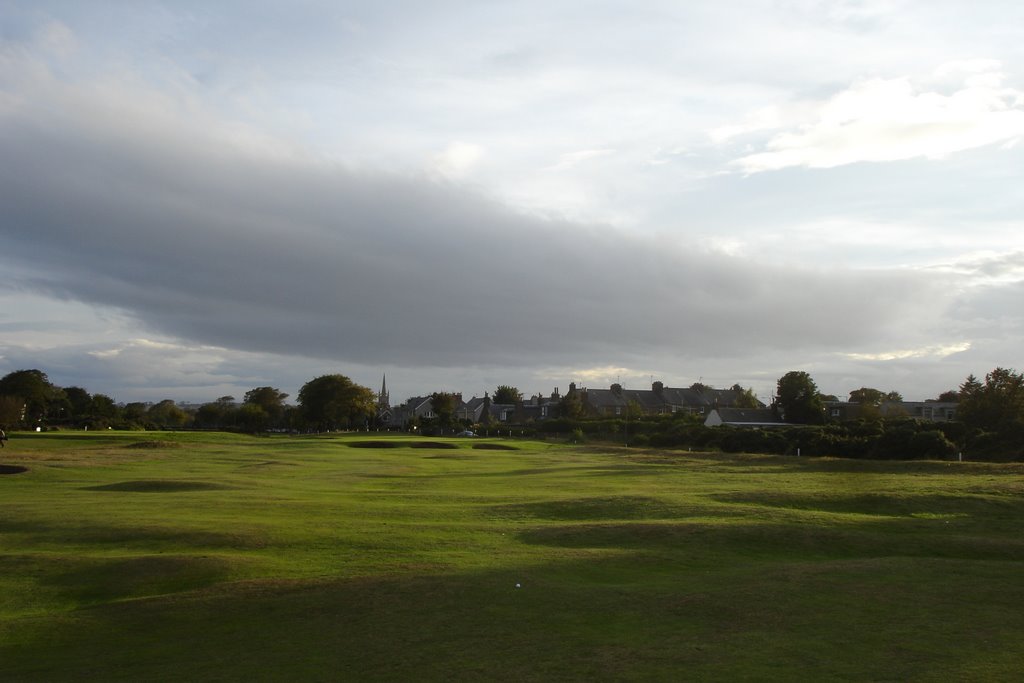
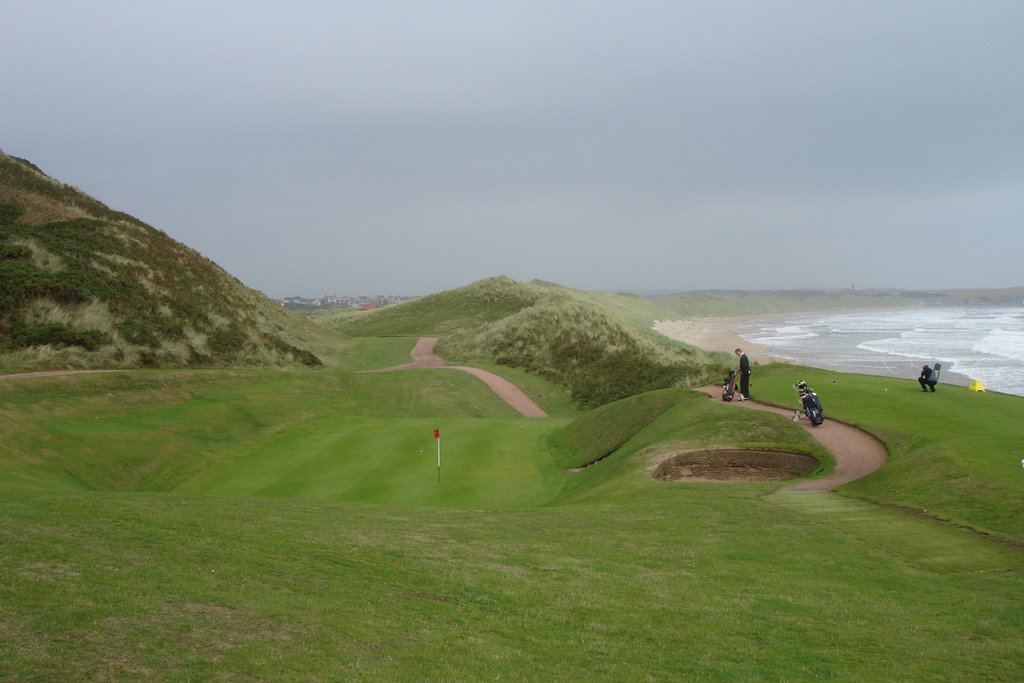
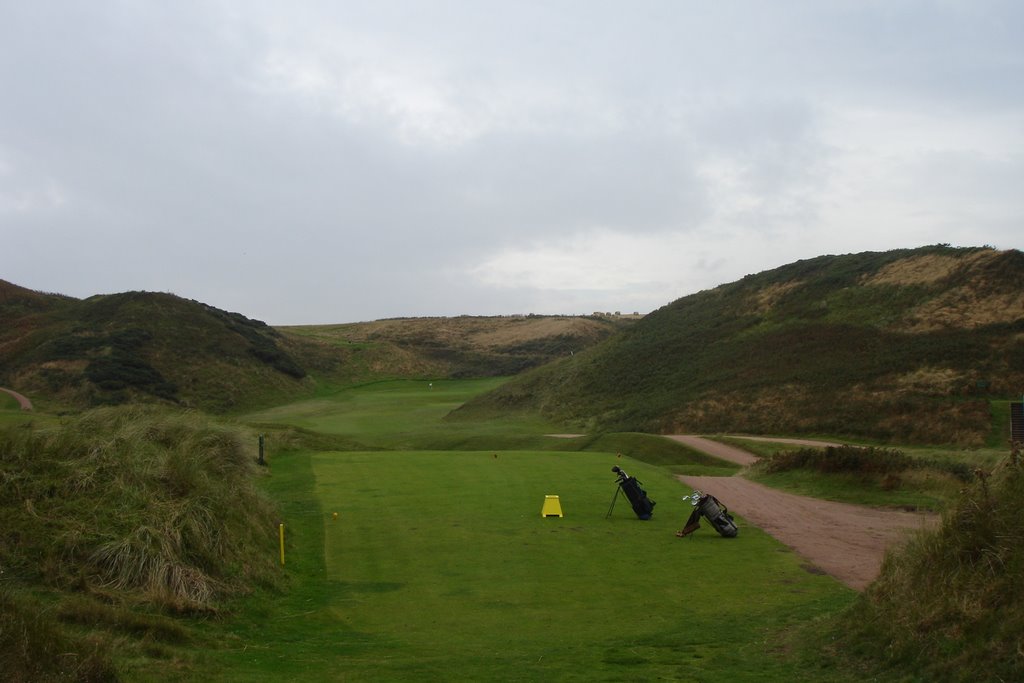
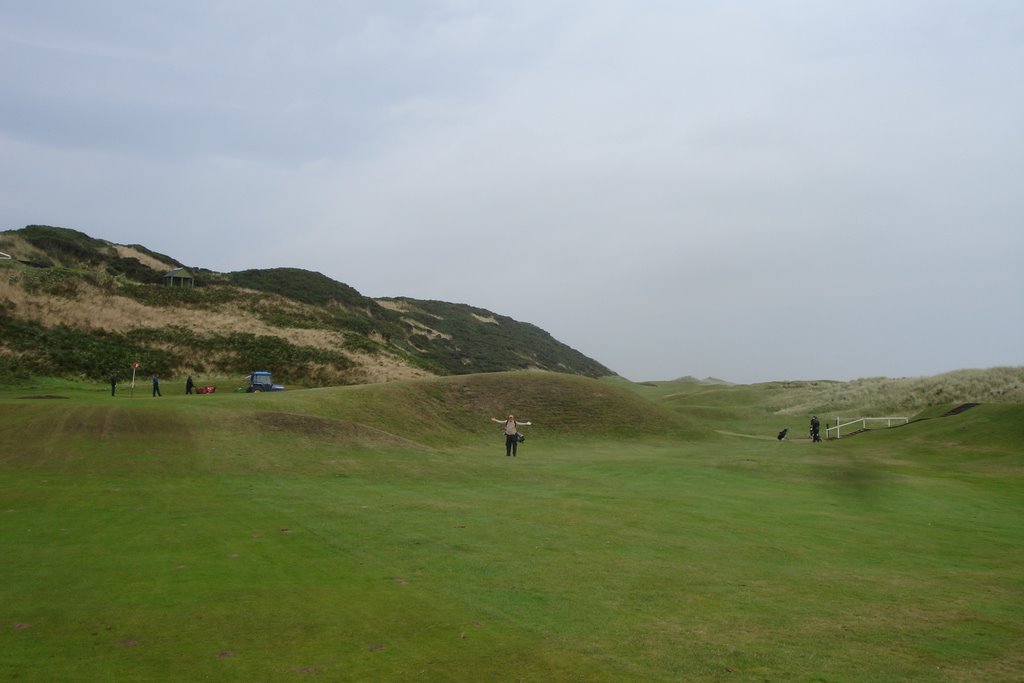
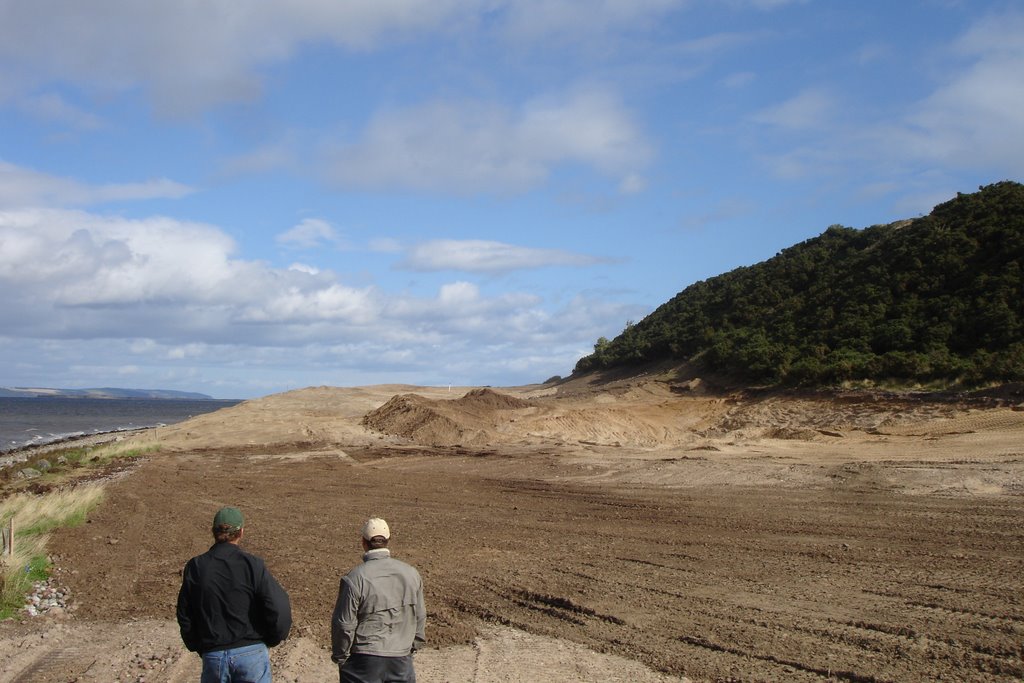
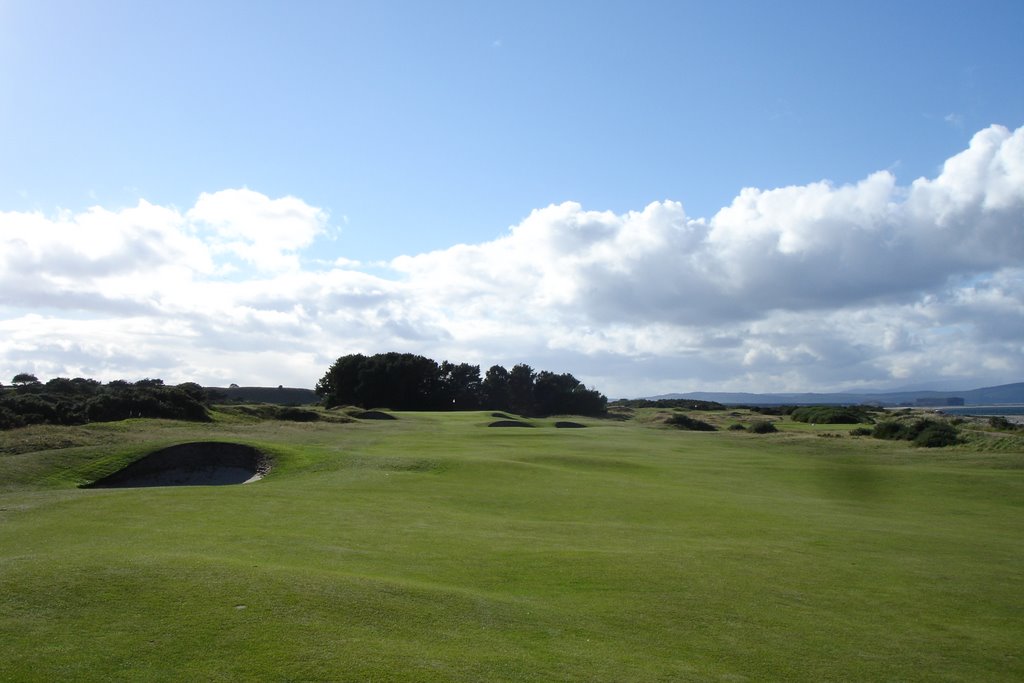
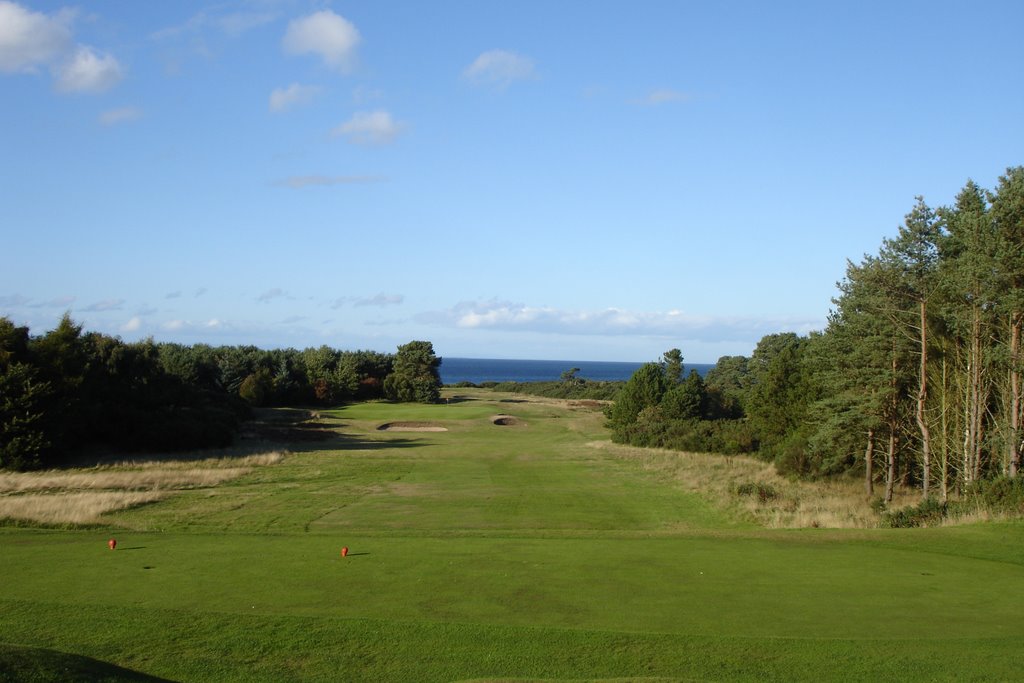
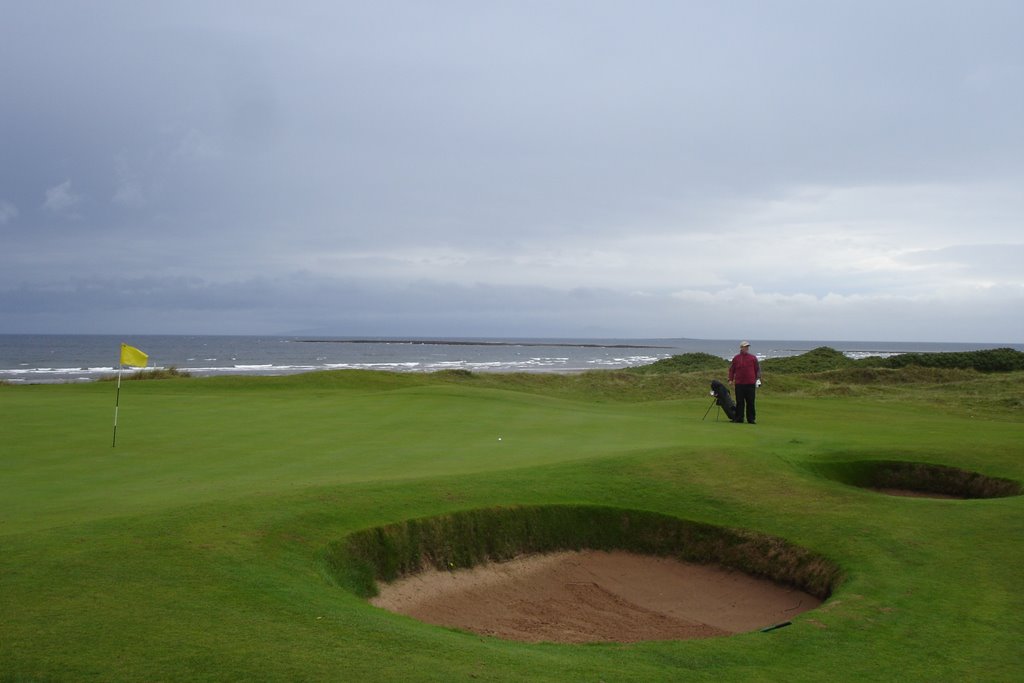
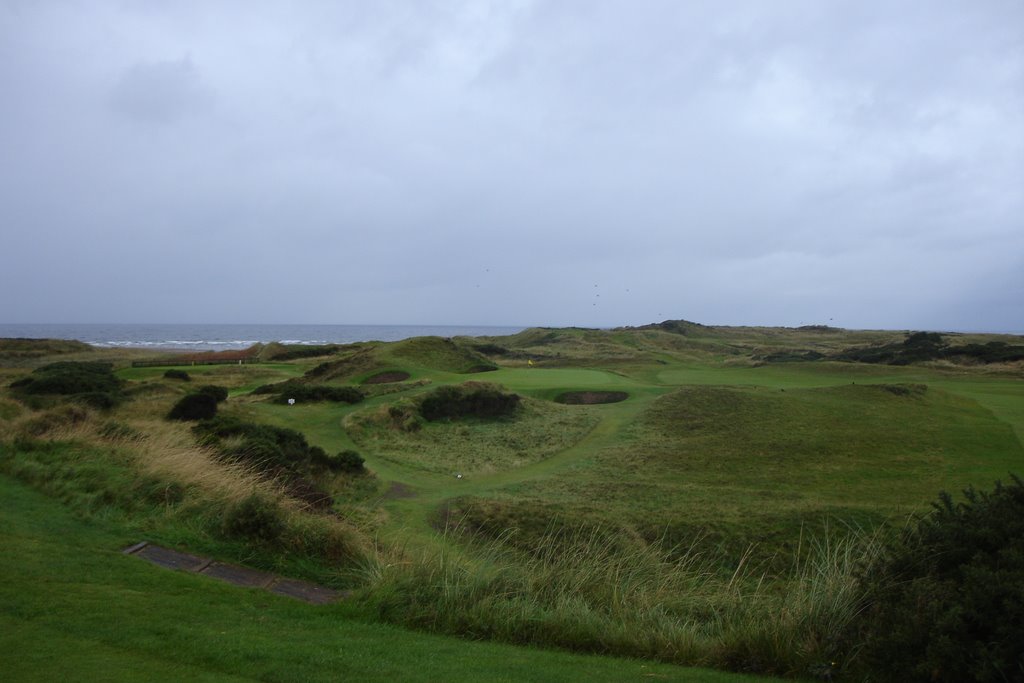
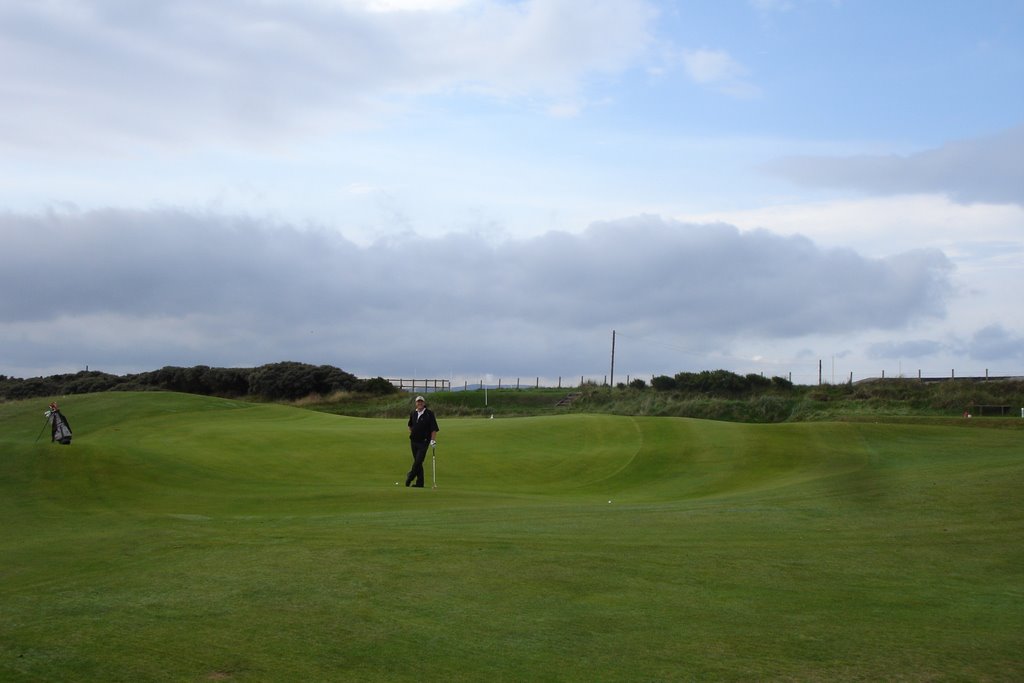
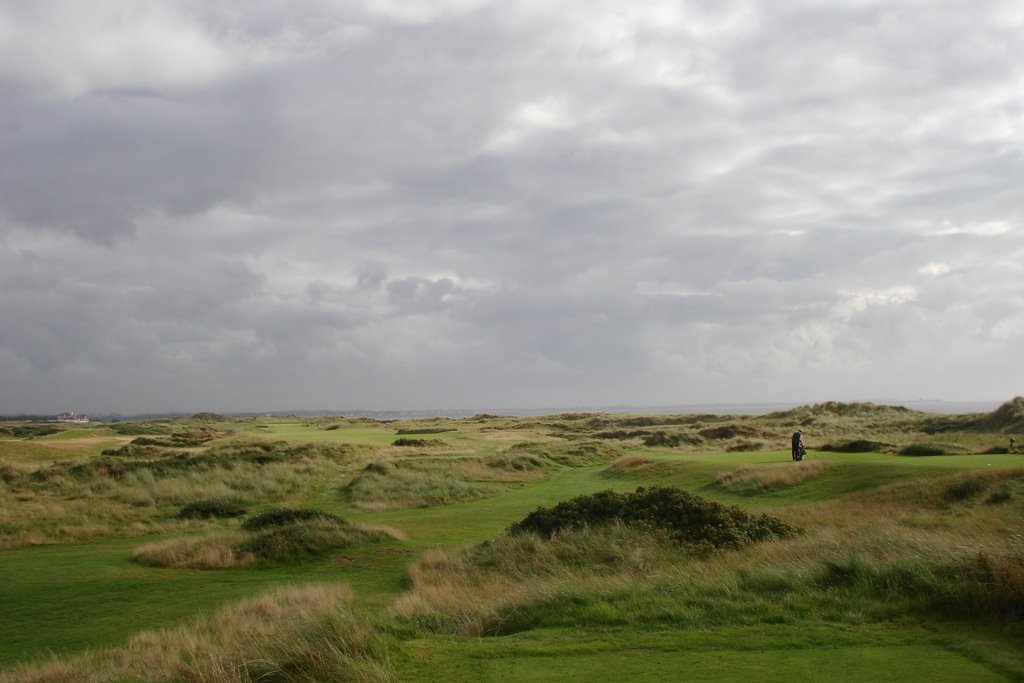
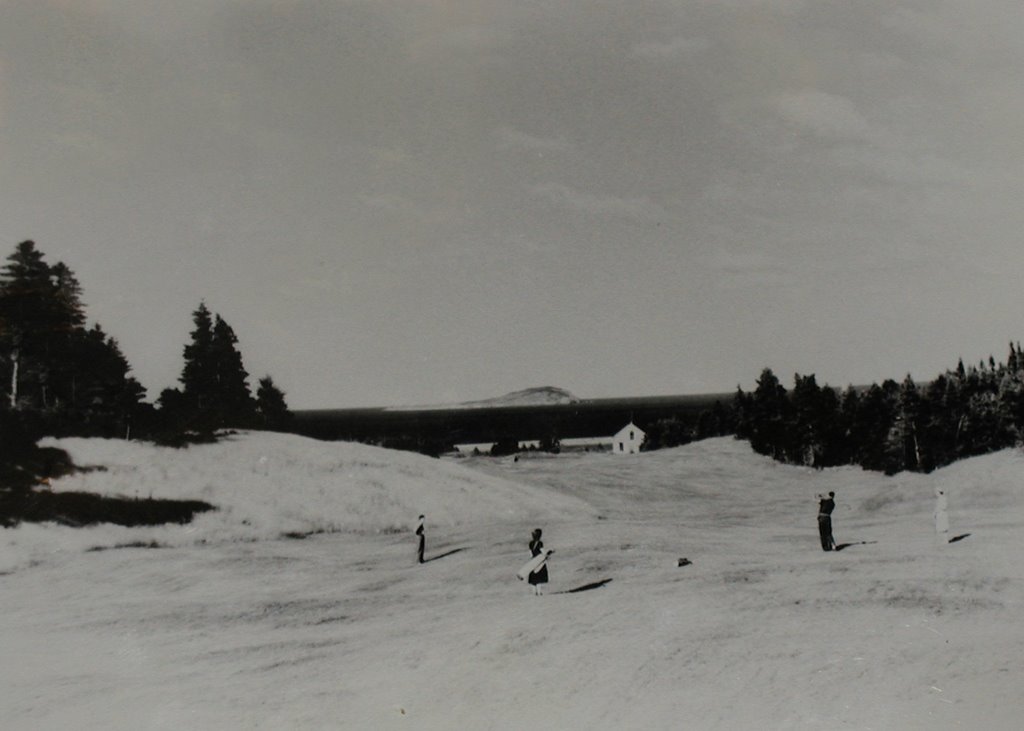
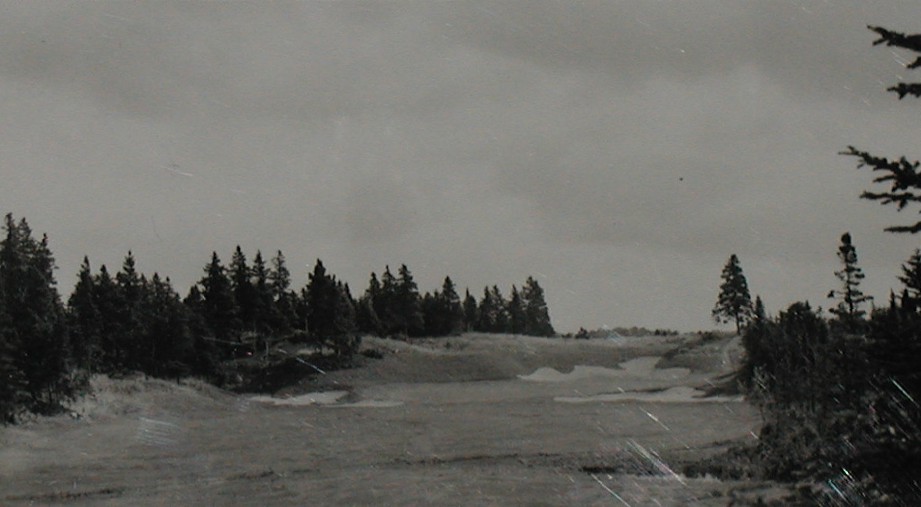
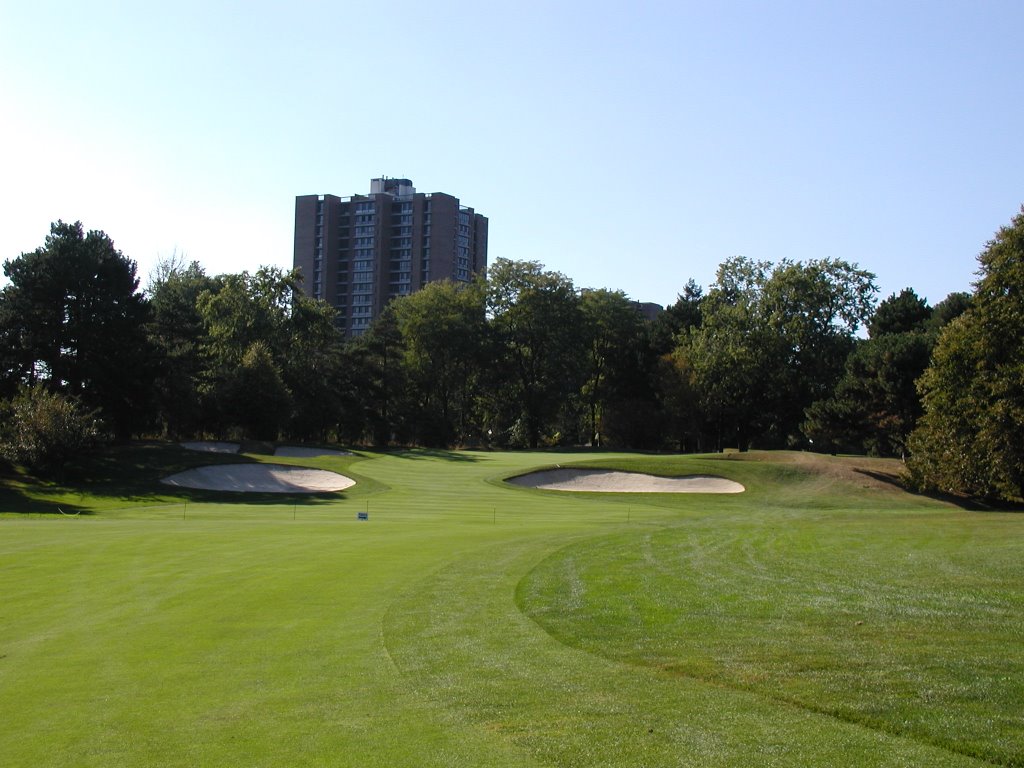
Castlestewart construction on a windy day.


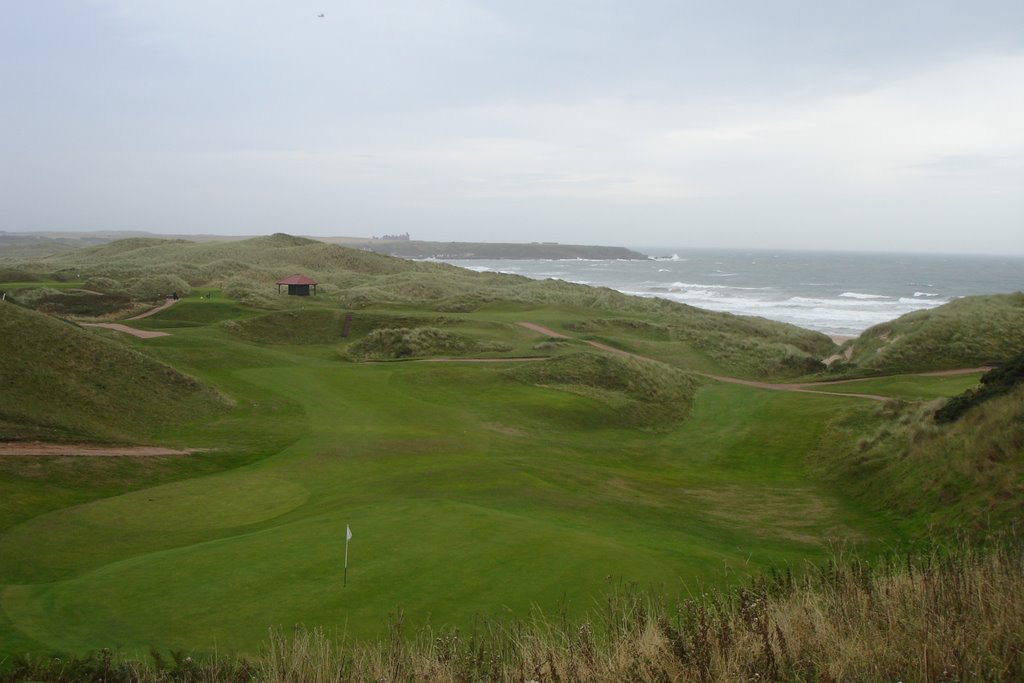
When I went around the Castlestewart with Gil, we were walking up the 10th hole when he mentioned the badger den near by in the gorse of the sea cliff. This became the start of a very typical conversation between architects. “So what were the craziest environmental requirements on this project?”

Before I continue you will find that most current architects agree with the environmentalists that there are places where holes should not be built and there are locations where courses should never be proposed. I believe in the preservation of natural ecosystems and that we should work to fit our holes within the landscape rather than rebuild the entire site and destroy natural habitat. Generally I have a great deal of respect for the people whose job it is to protect the natural environment. What I don’t get is the ones that start any meeting with, “You realize I’m fundamentally opposed to golf because it destroys the environment” There is enough evidence through the monitoring programs that this is not the case and in fact golf courses have been proven to be a benefit in many cases as opposed to a source of harm.

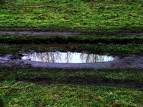
I’ve had a few memorable experiences with approvals but my favorite took place with the new nine at Nobleton Lakes. A member of the Conservation Authority fought to protect a series of 16 foot diameter puddles in the middle of a (clay) farm field because it was a “potential pocket wetland that might support amphibians” This is was very amusing since I had photos showing the pocket wetland was completely empty two weeks ago before the rain. This was even more frustrating when you look at the adjacent Class 1 wetland (highest designation) 200 yards away and knew that it had proposed holes approved to go through it from another architect’s approved plan! I was only trying to alter the routing to keep the holes between the woodlots and out of the wetland because I thought it made for better holes, less disturbance and I didn’t like the idea of going near a wetland area.

Back to Castlestewart, the badger which is an extremely aggressive creature was nearly eradicated by farmers due to the nature of the animal. It is now endangered and there are badger experts who are brought in to protect any known badger dens in order to protect the species. Mark Parsinen was asked to bring in an expert and the council also hired their own. Now I best add these experts are not cheap! Well as it turns out the two experts could not agree what to do and fought constantly about how best to preserve the den (which nobody has ever seen active). Each time they met and disagreed you know somebody is left still paying the tab. Some argue that this would just be called a classic consulting tactic to increase the billable hours. So now there is protection around the den, too bad there seems to be no badgers.

The other thing they had to do a Castlestewart was to build a large, and I mean large, berm to block the view into the site. Makes sense, so the locals won’t have to look at the site right? No…. it blocks the view of the birds from their nesting area a mile or two down the coast. Apparently the site of construction drives the birds into being inadequate parents for their offspring (I guess). Just one thought, can’t birds fly?

If you wonder why we do this, this is just part of the approval process on may of our new projects. Protecting the environment is important; rationale thought would be even more helpful sometimes. I think they just forget we are all actually on the same side.

....and this concludes my writing on Scotland

Tuesday, October 03, 2006

Kingsbarns


Kingsbarns has been one of the most widely praised golf courses to be built in the last 50 years. This was considered the first great golf course to be built in Scotland since the Mackenzie Ross reconstruction of Turnberry. The course was a project that Kyle Phillips had looked to get built for quite a few years before finally linking up with Mark Parsinen. What Kyle had to begin with was a spectacular setting that sloped quite severely toward the ocean. It was not ideal for a lay of the land course but would be exceptional with lots of earthmoving. Instead of trying to route around some very difficult cross-slope Kyle and Mark simply shaped the entire site to bench a series of holes, which also means that every hole looks easily out towards the ocean. Why Kingsbarns works is because of the shaping. Where this could have been a very American style “faux links” golf course, it was not. Faux links usually feature repetitive looking with shaping but Kyle and Mark went to great pains to emulate the land found on the existing dunes courses, including using a dune expert. The shaping here is a model for all projects and may be some of the best ever on a course built with almost no natural contours.

The cool part about the shaping was that Kyle and Mark built literally 1000’s or irregular shapes including scars, ridges, straight lines, sharp slopes, sloughed faces, and small scale rumples until the whole site looked as if it existing like that in the first place. Even the land immediately in front of the 6th tees featured rumples a few small gorse bushes to providing a very “natural” appearance. It still looks shaped at times, but at other times the work is so good that you wouldn’t know. The best way I can describe the work is there was almost no detail missed no matter how seemly insignificant. That definitely teaches any golf architect is that once again it is the level of detail and the level of commitment to finishing everything off properly that is the difference between a great course and one that is worthy of discussion among the world’s best. This seems also to be further proof that the commitment and interest of the owner is very important to ensuring that everything is done well

Kingsbarns reinforces my belief about having an opening vision on what you want to build. If you want to build a links then you must spend the time observing and learning what a dune line is supposed to look like. You need to understand the irregularities of links land and the small features that also come with the much larger features. You need to be able to think through what erosion and rehabilitation look like. You also have to understand the hole concepts and style found on a links and not resort to more standard American style ideas, like raising all the greens. My favourite work at Kingsbarns was the many greens that come in on grade or others that fall with grade. Rather than having the greens always pitch from the traditional back to front he mixed up the variety which held far more interest. I think one of our biggest failings in North American golf architecture is not building enough greens that are extensions of the fairway. That is one of the ideas that I will certainly bring to my first solo course. This style of green play encourages the option between using the ground or flying it in, the traditional North America style green site almost always requires a ball in the air.

Does Kingsbarns deserve the praise and world attention it gets? Yes, they were able to create a modern course from scratch that appears like a links course. Considering what they started with, this is a testament to some very talented people and a fantastic imagination. It is one of the best four or five modern courses I have seen.

Saturday, September 30, 2006

Montrose


The tee shot on the wonderful par four forth


(click on the pictures to enlarge)

Robert and I finished up Cruden Bay and originally intended to make a run south to play Crail. I had loved the idea of playing this short par 68 that hugs the edge of the ocean. Traffic conspired to change or plans and send us to a closer course called Montrose which was half way between Cruden Bay and St. Andrew’s. I must admit that I wasn’t as excited to see Montrose, but Robert had told me he liked the course so I figured it was worth a try. I was also a little sore at this point and the thought of playing in another 3 club wind wasn’t very appealing.

First off Montrose turned out to be much better than I expected and I think even more solid that Nairn. Nairn had a few great holes that Montrose lacked but Montrose had no awkward holes that many of the secondary courses seem to have. The course essentially goes out the first seven holes along the coast the coast skipping in and out of the two coastal dune lines. Unfortunately other than a few holes at the beginning there are few ocean views due to the large coastal dune which is eroding very quickly right now. The famous tee at the 6th is gone through coastal erosion. Many of the holes play beautifully up the middle of the coastal dunes through fantastic valleys while other skip up and down the areas where the dunes join to form a more prominent wide but flatter section.


The memorable plateau par three third


An interesting generality that I realized about links golf is almost every links course begins on the ocean in the best golfing terrain before moving away from the ocean and returning inland. For the life of me I can’t understand why but this is the case from Nairn to Montrose to St. Andrew’s to Troon and on. It also explains why the golf in the UK rarely features great finishing holes since most like Royal County Down and Turnberry are over the least interesting land on the property. The North American approach seems to be to get the best to the last like the holes at Pebble Beach.

The turn at Montrose features tee shots off the secondary dune and onto the flatter land below. You would think that the best is left behind but the fall off in quality was very small because of some clever use of the gorse and good solid green sites. All holes set along the secondary dune (includes 9, 10,16 and 17) feature gorse banks along the left dune and out of bounds down the right. This makes for some more accurate golf but fortunately there is adequate room for these shots. Each of these holes features wonderful hummocky fairways and great green sites.


Playing "into town" at the short par four 14th


The course moves in from 11 through to 15 and uses gorse to separate the very flattish land through this stretch. What works well is most of these green sites are quite interesting and make up for thee flatter land. Montrose can be summed up as a very pleasant surprise that should be on any golfer’s itinerary who isn’t obsessed with playing only the most famous courses. I think in Scotland the quality of the average course is well above the normal course we would expect anywhere else. I think it would be worth going over to play all but the elite course on a trip because you would still get the full Links experience at a fraction of the price. Needless to say I was quite grateful for my stop at Montrose.

Friday, September 29, 2006

Cruden Bay


The land at Cruden Bay with 15 green below


When you get out of your car and look out from on high promontory where the clubhouse sits you can’t believe your eyes at the scene below. Cruden Bay has undoubtedly the best setting of any course in Scotland. What makes it fantastic is the course is not only set in among huge dunes, but also features a massive 100’ sea cliff that comes into play along the way. That’s an understatement when you consider the 8th plays into a huge bowl surrounded by the sea cliff and the 10th tees off the top back into the valley below!


The punchbowl at 14


Where Cruden Bay is great like the 4th, 5th, 6th, 7th, 10th and 13th it takes aback seat to no course in the world for both drama and quality of holes. Even others like the 4th, 8th and 17th are exceptional in there own right, but are overshadowed by the most dramatic holes on the course. If the rest wee as high a quality we would be talking about this being one of the 10 best in the world. So why is this not a top 10 or top 20 courses in the world? Mainly because of the couple of holes that vary from weird to awkward depending on whom you ask.

Some think the opening stretch are pretty average but I found the first two to be good solid holes. A few have suggested that the 3rd is an odd duck, but that’s because the green is tucked tight behind the large dune on the right. The hole is still short and relatively easy and the green is fairly receptive to the bounce of the hill if you don’t mind trying a little luck in your approach. The course picks up pace from 4 through to 8 with a very memorable stretch. The 9th atop the sea cliff is an ideal transition hole from the spectacular 8th to the dramatic 10th tee shot and I think people are crankier about the walk up from 8 than they are about the hole. The run in approach is a must for this fall away green so possibly it is more of a case of people not finding the strategy than there being any weakness in the hole. The course once again is pretty solid from the 10th to the 13th. It is 15 and 16 that cause all the complaints. This is also where the club is considering change, partially due to safety too.


The sea cliff at the 8th is 100' above the green!


The 15th hole plays up hill into a beautiful bowl shaped fairway. The next shot is over a rise to a green that is a full 20 feet below in a tight little bowl with all sides sloping sharply in accept the back of the green. This is a fun shot to hit and see where you ended up. It is also a fair shot since you can literally bounce the ball in from any side or fly it directly in to achieve your goal. I think removing this hole would take away one of the more fun and quirky holes I have ever had the pleasure to play.

The 16th has been called the blind dogleg par three because of its length and the massive dune that obscures all views to the green. The hole is fair since a short shot will be run towards the green and shots can be bounced into the green from the massive dune. The problem is more the tees are in full flight from the 14th, the tees on 16 are definitely in play from the 15th tee and you can’t see if play is through (if players forget to ring the bell). There is no question that this is a safety issue. I just think there aqre other alternative to what is currently proposed.


The awesome approach to 13, notice how small Rob is, the green extends to his location


The highlight of the day for me were the natural landforms in play and the roll in the front of the 13th green was the best feature I have seen in quite a while. It towers 20 feet above the grade short right of the green and features a very sharp slope down to the hollow. Anything hitting it falls will feed back into the hollowing leaving a nightmarish shot into the green. The green is actually set 6 feet below the roll and hides behind it creating a bit of punchbowl due to the huge sea cliff backing the green. The green falls right and away from play to create a reverse redan. This is definitely one of the finest green sites I have seen and one I will copy one day in my own solo work.

The other cool feature that I want to use in the right situation is the huge knoll in the centre of the 17th fairway. It is 15 feet high and steeply banked but also kept short. It is right where tee shots land and defends the hole without being unfair since most shots are playable from a lesser slope or simply find their way down to the fairway. The feature is more sheer fun than anything else, but that is what Cruden Bay and great golf are all about.

Thursday, September 28, 2006

The Catlestewart Project by Gil Hanse


Gil and the bunker detailing


I had the great pleasure of meeting up with my friend Gil Hanse and touring his new project called Castlestewart that he is building for Mark Parsinen. Mark Parsinen was the gentlemen who built Kingsbarns which was one of the most successful new projects to be done in recent times. It’s likely the reason there is now so many new projects taking place in Scotland after such a long drought of new work.

The site is just outside Inverness and overlooks the Firth of Moray. The site is spectacular with incredible views at the town of Inverness, the suspension bridge, down the length of the Firth of Moray, and the far headlands which has up to 500’ sea cliffs. The bulk of the site is up top about 100’ feet above the water, but there is a lower shelf wide enough for golf holes that will feature a spectacular opening run for both nines. Both opening holes play off the sea cliff and down onto the plateau above the ocean with the holes playing tight to the ocean itself.


Looking at the first below from the tee and the 9th to the left


My favorite part of the routing was the choice not to try finish below and face an awful walk up to the clubhouse. I also like the fact that there were not seven straight holes along the ocean; this was a good way to break up the nines. Both the finishing holes are instead set along the top of the sea cliff which still feels like the holes are right on the ocean, and in fact offer far superior views up and down the sea coast. The nice thing that Gil and Mark accomplished was that they had many of the landing areas away from the edge so that the approach looks diagonally down the coast. I really like the effect. What was also kind of cool was that they point to headlands or other prominent land marks intentionally.

The course was about six holes along, but the shaping was quite clear on a few holes (or at least it was for me). I must admit they were moving a lot more dirt than I would have expected, but after hearing and seeing why, they certainly were doing some very interesting things to the course. The bunker tests were probably the most interesting thing that Gil was doing. He was combining revetted bunkers with a technique called chunking to create the bunkers that you would see if you could find the old books by Hutcheson. The bunkers all seem to be eroding and revetted at the same time, and that is the look that Gil is going to use. These are truly the most unique bunkers I have seen anyone do and that is a credit to Gil’s imagination.


The uphill 12th, playing between the sea cliff and ocean


The other cool idea that he is using is a run or series of rumples that you would see at Baltray in Ireland or lots of courses where the ground have never been smoothed out before seeding. The rumples along with the unusual shaping will help make the holes appear more of nature and less of Gil. It takes a great imagination to pull this all of but I think Gil will be easily successful. I certainly can’t wait to see it done.

Wednesday, September 27, 2006

Nairn


The tee shot on the 3rd


Nairn is a very traditional links beginning hard up against the ocean and playing straight out before turning to come back. The opening stretch is easily the most memorable because of the proximity of the beautiful wide beach and Moray Firth beyond. The openers were very nice but the course really is at it’s finest from the 3rd through to the awesome 5th.

The feature that is most unique to Nairn is the revetted faced bunkers where the revetting appears to be a perfect moon shape. There is very little bunker below grade, in most cases, but the backs are built well up to create depth. The mounds behind are almost perfectly symmetrical at the top which makes the revetted face just as symmetrical. While this sounds too uniform, the effect is far more pleasant than I would have expected since you have all these steep moon shaped shadows along the fairways.

The third hole uses the moon shaped riveted bunkers for maximum impact. The faces are much higher than the surrounding approach and are very prominent because they are unusually high. The three bunkers that frame the fairway end up creating the most wonderful undulating bowl of an approach. Each bunker adds a beautiful twist to the roll of the approach since each is about 3 feet above grade. The effect is one I can easily emulate with any natural plateau green site.


The 370 yard 5th


The 5th hole is the jewel of the club. A brilliant 370 yard par four where the ocean protects the aggressive line and James Braid has added a bunker that is situated exactly where you would want to lay up. The green is the best on the course since it is well elevated and framed in by deep visible bunkers on the right, a strong false front and a diabolical bunker hidden on the left (where it appears you can bail to).

The 6th and 7th seem plain despite their proximity to the ocean and I must admit I wasn’t expecting much coming in at that point. Where I got a great surprise was at the 10th. The 10th and 12th play slightly downhill all the way and look directly out and down the coastline. These were both excellent examples of framing a view using the gorse to point the eye at the ocean beyond. The gorse used this was felt very similar to tree lined Parkland holes other than the fact you could occasionally look over the top. The two holes were also another excellent example of how running holes on a 45 to the ocean provides the best panoramic view of a coastline. The fact that both holes had no backdrop just made the views even more spectacular.

There was still one great hole to come and the downhill 15th was perhaps the next finest after the 5th. The hole is a downhill par three of around 200 yards with the ocean clearly visible as a panorama from the high tee. The bunkers all appear to be directly in front of the green, yet the prominent front bunker turned out to be well short with a hidden sunken fairway in behind. This was just like the fairway at the 17th at Merion and it made me wonder if Hugh Wilson had seen this before building Merion. The fairway then rises up into a magnificent false front which leads into a very wild green. The bulk of the green is a high front and right plateau, but what makes this one very memorable is the wildest back swale and pin position I have seen in a while. This all adds up to one excellent golf hole. The only question I would have is could you bounce in your approach in


The incredible downhill 15th


I mentioned to Robert that if I had this property I would have routed it differently. I would begin away from the ocean and taken you to and from the ocean multiple times. I would have tried to have at least one or two holes playing directly out at the ocean. In particular, at the far end of the course I would have turned to play directly at the ocean. I feel at Nairn, like many traditional links, having all the ocean holes at the start made the course the returning holes almost guaranteed to be less than the holes going out.

Tuesday, September 26, 2006

Royal Troon


The excellent small bunkers cut tight to the green on the 5th


First off I will tell you I played Troon with a 30 mph wind and driving rain for about 15 holes. This may or may not be a factor in my opinion. I will leave you to judge that for yourself.

Troon is by far the biggest disappointment on the trip. I had played the course before in 1989 and at that time suggested it to my Dad that it was the least interesting on our trip. The second time round the course left me even more flat than I was the first time. There were a few holes like the 5th or the 15th that were far better than I remembered but there were just as many holes like the 9th, 11th and 16th that were far less interesting. The opening stretch has little to no dunes and very little landform until you hit the par three 5th. The course really hits its stride at the awesome 7th followed by the Postage Stamp which remains one of the greatest par threes in golf. After that the famous stretch run around the large dunes is where Troon is considered to be at its best but the only holes that stood out to me were 10th (which is only good) and 12th (which is a favourite). Once again the golfer moves out into light dunes where the holes are average except for the excellent fairway contours found on the 13th and 15th. It struck me that there are far too many average holes for this to be considered one of the worlds 100 greatest.


The huge roll in front of the 15th and the sunken green


While I pick on the course there is one element that makes the course very interesting and also a course that holds up well for tournament play. The greens are fairly small and the bunkers are cut into the greens as tight as any bunkers are in any links course I have seen. It is the proximity to play combined with the small and deep nature of the bunkers that manages to ratchet up the difficulty. There are very few places where there is an easy approach because the bunkering at Troon seems to be well placed to challenge or collect and approach. I certainly can’t criticize the positioning or technique of the bunkers, in fact I think this is the courses greatest strength. I certainly have begun entertaining the idea of much smaller, tighter and deeper bunkering as a way to have an impact and keep the maintenance down at the same time.


The best short three in the world


I guess my issue with Troon is the routing and setting doesn’t seem to me to be as strong as the detailed work. I’m not convinced that Troon is either a great location or a great routing outside of a couple of holes. Some people would suggest that I’m looking too hard at the site and not enough at the detailed work and that by my standards a great course can’t occur without a good site. For those people I offer courses like Winged Foot, St. Andrew’s Muirfield and Pinehurst to prove that is not true. I still think Troon’s greatness has everything to do with hosting opens and its wonderful history and very little to do with the actually quality of golf it offers.

Monday, September 25, 2006

Prestwick


The tee shot over the Cardinal bunker on the Alps


If you asked me for a list of courses which I would recommend you go visit to go learn about golf architecture, I would include Prestwick as quickly as I would the Old Course at St. Andrew’s. The Old Course contains the foundation for most of the principles and strategies of golf course architecture. The lessons of the old course are well documented and well copied, but Prestwick is the course where an architect goes to learn that sometimes you need to ignore convention and push your boundaries in order to create a more interesting game. It’s the place where Pete Dye had the epiphany that lead to the greatest recent change in the way courses are designed.

It doesn’t take long for a golfer to realize that Prestwick is different from most golf courses. The first hole at Prestwick is very narrow and bordered on the entire right by a long wall that separates the golf course from the railway. Out of bounds is definitely a huge consideration on the first tee, and yet you need to be tight to the wall to get a view to the green site. Rather than have clear visibility of the green, the bunkers in front also hide the green. Play to the left off the tee and a large knoll blocks the view to the green and the surrounds.

The 3rd hole features a massive bunker complex called the Cardinal bunker. The tee shot involves judging your distance up to the full blind beginnings of the hazard. The second shot is over the massive expanse of sand and bulk heading that makes the shot completely blind to the fairway or the green. The fairway is full of moguls from one end to the other meaning the ball can bounce anywhere.

The 5th hole hits blindly over a 40’ dune, 210 yards away to a green surrounded on the sides by bunkers with the green falling hard to the left into a deep bunker. The 7th hole is 440 yards up hill down the narrowest fairway on the course. The 9th plays 440 yards into a green that falls at least 3 to 4 feet from left to right where a bounce in approach is the only chance of staying on this blind green. The 13th is a 460 yard par four to a very small green raised 4 feet above the surrounds and featuring a four foot false front. The real treat is the green features shaved banks around the sides making all but the finest shot not good enough. This is also proof that par is sometimes irrelevant to a great hole. The 15th fairway is completely blind and as narrow a fairway as I have ever seen surrounded by gorse, but somehow seems natural an. The approach is blind over a hill with the green dropping 4 to 5 feet from front left to back right. The 17th is the famous Alps with a shot over a 30 foot dune, over a five foot deep revetted bunker and to a green with wild undulations.


The false front at 13


By now you must be wondering how I find this course so charming, but it all magically fits together. Part of it is the history and our ability to accept quirkier work from the past and not from the present, but most of it has to do with the overwhelming number of fascinating details that are almost unmatched by any other course. The golf course is so full of brilliant little moments that the parts may exceed the whole in this rare case. As architects we are always looking for ideas and they are much easier to find in small bits rather than in entire courses or even holes. Often our epiphanies come from the subtle use of a roll or a small minor feature rather than an 18 hole visit. Prestwick is so full of little unusual and interesting ideas that I think one walk and one playing has likely only unraveled half the actual charm found at Prestwick. I’m quite certain I could go there year after year, enjoy each round a little more, and learn something new on every play. That is the definition of greatness in my book.

Sunday, September 24, 2006

Western Gailes


The amazing 5th at Western Gailes


Western Gailes turned out to be a big surprise since I had assumed the course to be a very wild and very quirky. It was probably the least quirky links course I have ever played. Most of the fairways are set in natural low and flattish land between the dunes with almost every shot being very easy to understand. If someone were to build a course on links land now this is what I would expect it to look like. The bunkering was excellent and almost all clearly visible from each shot. The greens had some interesting contour, but for the most part the contours were on the gentle side. The layout is very fair and very straightforward, so much so that I would recommend this as the best starting course for a trip through to play Scottish links golf.

The burns(creeks) were fascinating in particular the one at #15 since the far edge was intentionally picked up to make the locations very clear, but it also created a beautiful deep shadow lines and then ended with a run away slope on the back that could be used to kick the ball onto the green. At Western Gailes there were four crossings and most of them were used to front a green similar to the famous 16th at Turnberry. They make for some delicate approaches with front pins and a fascinating contrast to the dunes holes.

The bunkers were generally very small, deep and tough to get out of. The certainly make a great model for difficulty with minimal maintenance. What was really interesting was that some of the contour around them was kept tight and ran directly into the bunkers. It proves that bunkers do not need size to have an impact and that short grass still can have much more far reaching effects if used well. I want to use the idea of slopes that are short and banks that feed the ball into the bunker since the effective area of a bunker quite large without needing a lot of actual sand.

What I enjoyed the most about Western Gailes was the way the course offered so many fun options around the greens. There was a great deal of short grass, but also the rough was kept very light which invited the player to use the ground. The other cool thing they did was using an even shorter cut than the fairway immediately around the green which allowed for putting from almost all sides. This idea needs to come across the pond. I have only seen this done at Rustic Canyon and on the approaches at high end Philadelphia area courses.


The par three 6th down in the bowl


The last thing that struck me about the course was the color. The greens and fairways are similar to what we enjoy by where it gets so much better is in the rough. In the rough you have the fescue with its light brown wispy tops, interspersed with the deep brown of heather (which can bloom a dramatic purple), the purple leaved wild rose which is beautiful but tough to play out of, and of course the deep green of the gorse bush. Add in the taller and nastier looking sea grass and these contrasts do much more to frame a hole than trees can. I much prefer looking at the cant and roll of the land that a dull stand of trees any day.

Friday, September 15, 2006

Sandtrap Interview

The following is part of an interview I did with Alan Olson at The Sand Trap.com. The link to the web site and interview itself is below. I recently found out a number of friends who read the blog regularly missed this and asked if I could post the interview. I also thought it would provide people with lots to read while I’m gone.

The link to the full article:
http://thesandtrap.com/archives/throwing_darts/ian_andrew_golf_course_architect.php

What styles and architects have influenced the design work you do today? What have you taken from them an applied in your own work, and how well have some of the features of older courses migrated into the modern world of golf?

The Golden Age of architecture is without a doubt the high water mark of golf architecture. The work of architects like Alister Mackenzie, H.S. Colt, Charles Alison, George Thomas, A.W. Tillinghast, C.B. MacDonald, Seth Raynor and Stanley Thompson still remain the ultimate benchmark of greatness for golf architects. Even their quality of the writing has been a huge asset to understanding how great golf architecture is created. The courses that they have built have become the foundation of great golf course architecture. They have influenced me with the boldness of their architecture and how many of their courses feature a few holes that border on controversy. They never played it safe; they were always innovative in their approach and never afraid to push the boundaries of either the player’s ability or their art. They all certainly had a knack for finding the best holes in the landscape, even if it meant ignoring one stunning hole to find a better overall golf course. They most often found their greatest holes, but also had the ability to create them when the land was offering little assistance. Finally they all spent an inordinate amount of time on the smallest of details which is the most overlooked factor in creating a great course. I think it is also important to point out that architects like George Crump and Hugh Wilson were just as influential on architecture even with only one course.

I think it also important to recognize when peers have done some exceptional work too. If we ignore our peers, we limit what we can learn. I’m really enjoying the recent work of many of the so-called minimalists. Tom Doak and Bill Coore in particular, are creating exceptional courses and working in their own unique styles which I enjoy. I find their architecture is firmly routed in the principles of the architects from the Golden Age. I’ve had lots of opportunity to talk with both and I find that our principles are very similar which give me a lot of confidence going forward to build my own courses.

My philosophy is I’ll borrow from any architect at any time. Every site has an example we can draw from to find the best solution. I believe, like C.B. MacDonald, that there are likely no new ideas and that is our responsibility to identify the best of what has been done and find new and interesting ways to apply them. My first project makes a good example; it had no elevation change on the entire site so I borrowed the concepts from Pinehurst #2. I raised the green sites up onto plateaus to add interest and challenge to the course. I created some very dramatic contoured greens to make the second shot and putting very difficult. I also borrowed Ross’s technique of using the drainage swales to create the appearance of elevation change. People seem to enjoy the enormous amount of creative shots around the greens and don’t seem to notice that the site is still relatively flat. I believe you look to the best example you know that work and then try to improve upon this with you own ideas to add even more interest and fun.


Describe your style of design, your “signature” if you will.

I think the architect’s responsibility is to make the game interesting rather than just aspiring to make the game difficult. A player should face a round full of options where they can take multiple routes or even hit different shots into greens depending on wind or their own ability. I believe in little earth moving, designing shorter courses, multiple short fours, very contoured and complicated greens, fairway width, opportunity for chipping, and building dramatic hand sculpted bunkers. I don’t think I will ever have a “signature” or distinctive style because I want every course to be a response to the surroundings. From my point of view, anything else is an imposition on the land, and that doesn’t lead to great architecture.


Did the explosion of golf courses in the mid 1990’s harm golf as a whole with cookie – cutter designs created to cash in on a booming trend, or was the growth good for the game of golf? Why or why not?

Even bad architecture can’t really harm golf, but it certainly does make for a very weak business for the person who paid to build the course. That said I do think that some of the most important architectural work in the last 50 years has occurred at courses like Sand Hills, Pacific Dunes and Rustic Canyon. Golf architecture has once again made important strides in the right direction for golf. I do think the nineties will be another period where the most popular designers will have a legacy of quantity and not quality.

Where the build out of the nineties has hurt the game most is the cost of golf went up exponentially with each vanity driven dream trying to outspend the last one. There is a remarkable willingness to buy into the concept that that a golf course is only great if it’s expensive. The result is participation in the game dropped because it is affected by economics – golf became too expensive for the ‘average’ person. Again we will repeat the previous cycles, as prices drop with oversupply, the game will find it’s footing once again. As for architects, the oversupply means it will be harder for us to find new projects for the foreseeable future.

Are modern golf courses too difficult for the average golfer as opposed to the classic designs that featured different levels of risk/reward based on a golfer’s playing ability and if so what features should be “re-introduced” to modern golf course design to make the game of golf more enjoyable? Also, why is the short par four seemingly on the path to extinction?

Ninety percent of everything wrong with golf can be summed up by length. From the ball, to the additional cost of building new courses, the monotony of excessively long layouts, through to the loss of the short par four. Everything seems to be designed to host a PGA tournament; from the necessary length, perfect playing conditions, clearly indicated strategies, through to the gentle contours required for lightening-fast greens. It’s like every architect and owner somehow feels their new masterpiece is destined to hold a tour event and they design their courses accordingly. These courses are generally way too difficult, feature little or no options and have a high green fee. If architects would return to building courses for those who actually use them we would have much better courses.

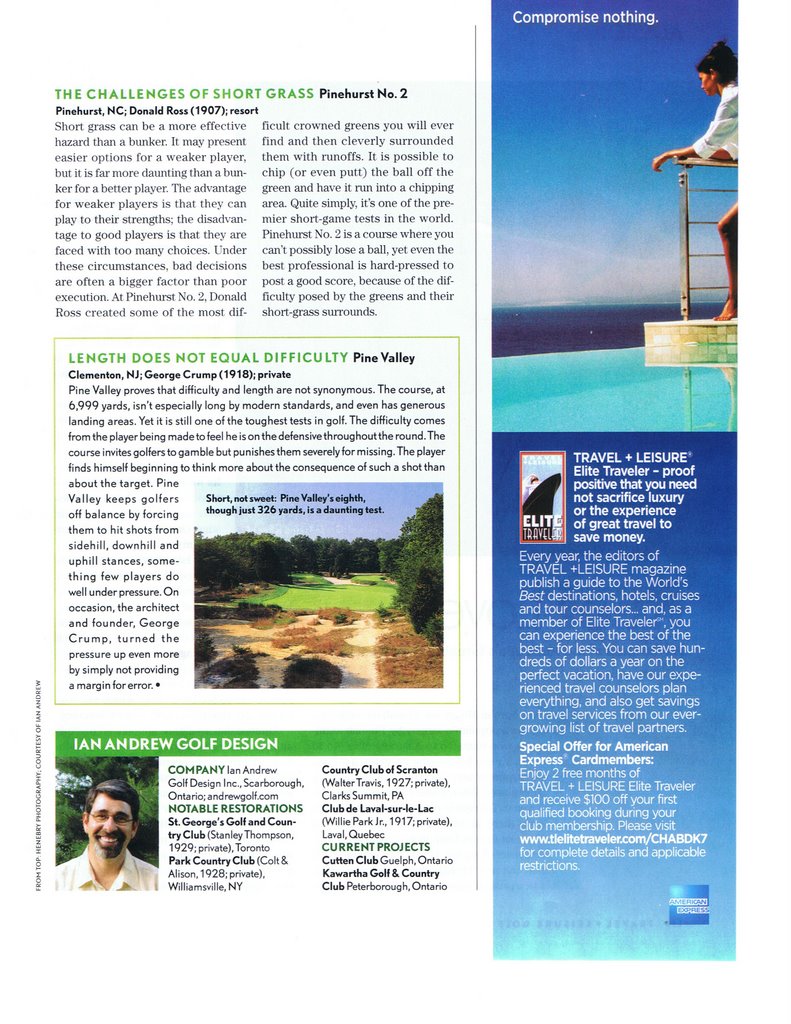
So what should be re-introduced? Golf courses need to be shorter and wider. Width introduces options for a better player and playability for the vast majority of players. Options lead to interesting choices, which lead to a more enjoyable golf experience. If we enjoy the game, we will play more. If participation rises, the health of the game improves, it helps all of us who love this game. Before anyone suggests short and wide courses are too easy, just look at the scoring average for the tenth hole at Riviera during the Nissan Open. Difficulty and length are not a direct correlation. Just think of Merion and Pine Valley, two courses that are very difficult despite being short by modern standards

These are 4 of 17 question in the interview
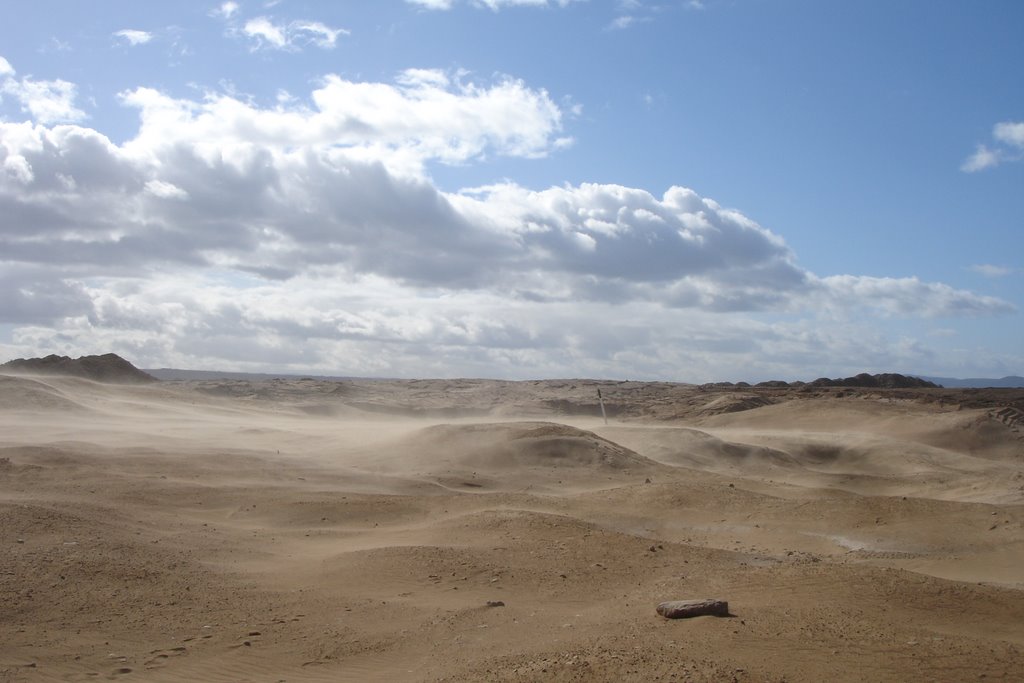
Saturday, September 09, 2006

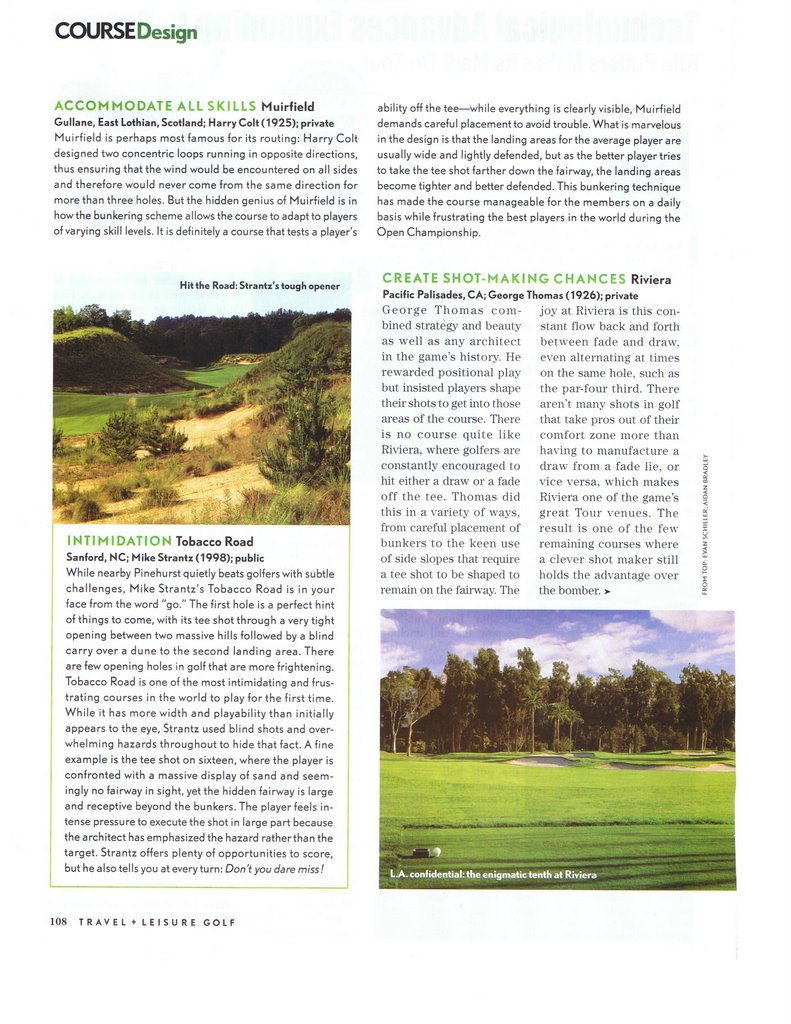
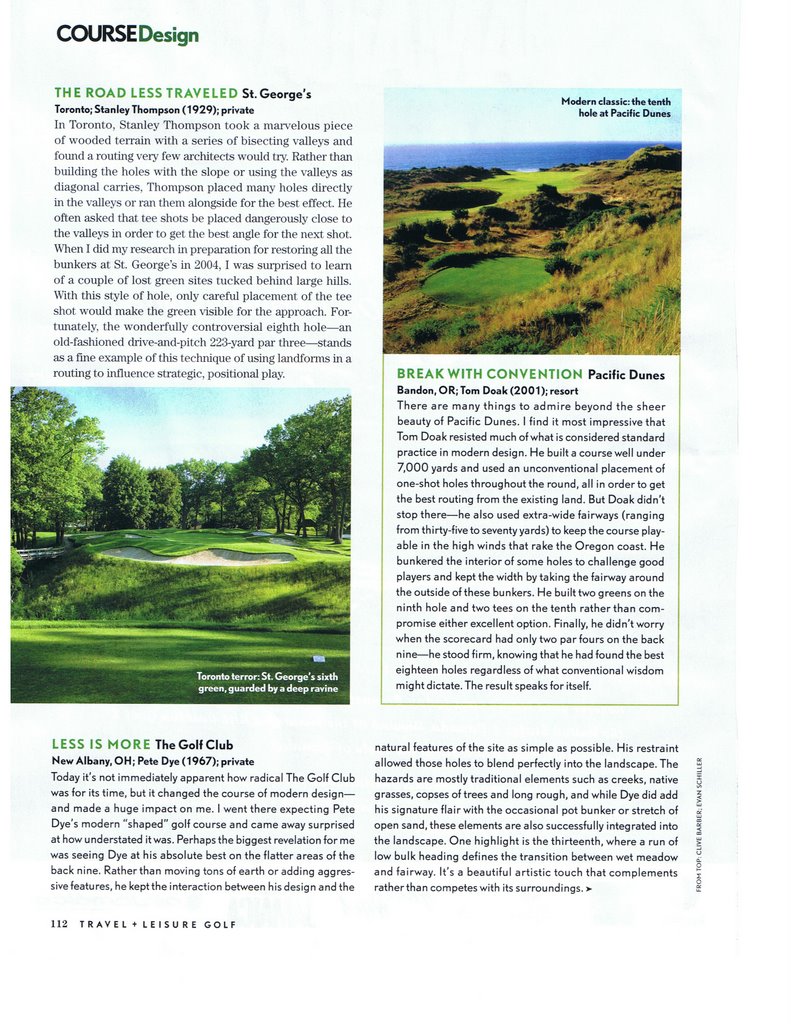
Travel + Leisure Golf - My Article in September Issue

click on each page to read the article and use the image expansion tool bottom right to blow it up further - it will take 10-20 seconds to pop up automatically on your computer


Friday, September 01, 2006

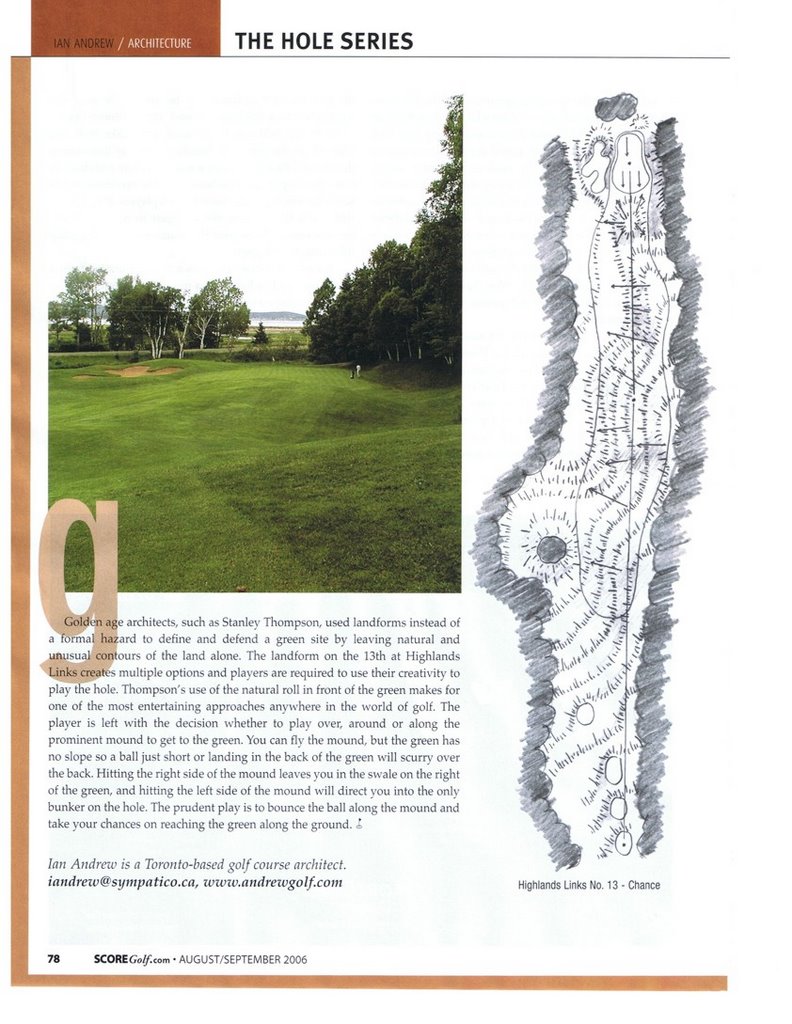
The Hole Series


click on image to make larger

In this month's Score magazine is another installment of my Hole Series.

Thursday, August 31, 2006

Your Strategy to Beat the Architect


The short, direct and dangerous route on the left and the long and safe route on the right - great strategy by Stranz at Tabacco Road


We all want to shoot lower scores. Almost everyone sticks to swing tips, lessons or practice to improve their ability to hit the ball better. A few spend the time to learn course management and make great strides in keeping rounds together when they usually would come apart. Very few take the time to analyze the strategies and the architects thinking in order to beat them at their own game.

Ever noticed how on certain architect’s courses you always seem to play well, whereas on another architect’s you seem to always make mistakes. And I’m not talking about the simple factors like width or green contour, but more about what the architect gets you to do. I find most architects are creatures of pattern and tend to use a similar bag of tricks most times out. The very clever ones seem to be able to spin an infinite amount of variation using a myriad of old ideas, but the majority sticks to a limited set of options on a consistent theme. The clever ones require a lot of work for you to learn the course and one playing is never enough to try and out think them (if you ever can – see my piece on the 10th at Riviera to understand what I mean). For the rest, all you need to do is spend enough time observing their habits and it will help you with your decision making.

Most architects seem to prefer to stick to the basics on strategy. Bunker the fairway right and the green on the left and you have the most common strategy in golf. Play towards the trouble for the best angle into the green. This is the base strategy of probably half of all “designed” holes in golf. There may be more bunkers surrounding the ones that matter, but if you remove the fluff, you will be able to often break it down to this idea. Now this can vary from Flynn’s use of carry bunkers on a diagonal to clearly indicate the line and location for the tee shot, or be illustrated by the use of parallel bunkers by Willie Park Jr. (and others) where you play as close to them as possible for that ideal line. My only warning is for someone like Pete Dye, he will offer this on 16 or 17 holes and then on that exception you find you made the perfect shot to end up with the worst line. As Pete said, you have to do it occasionally to keep their attention, otherwise they are too comfortable.

Where it gets more fun is when you play a course by a less conventional architect like Mike Stranz. Mike’s philosophy was enticement and punishment. He loved to offer a shorter dangerous route combined with a longer safer route. Scoring will come from avoiding the pitfalls with Mike, but the big challenge is how long can you avoid your desire to “give it a go.” I watched a clinic on how to score at Tobacco Road, my playing partner (Bobby Weed) took the occasional chance for some birdies, but also played safely away from certain death settling for a par right from the get go. Often restraint is the most important tactic on a course made for gambling – although it’s not near as fun..

Each architect has their favorites, William Flynn and Doug Carrick love carry angles and using that technique to indicate the ideal line. Rees Jones leans towards the most basic of approaches of position for line with almost no variation on that approach. Bob Cupp likes to guard the line to the “mayor’s office,” a spot which sets up perfectly for an approach into the fall of the green. Each of us has our beliefs in what we think “you” should have to do in your round of golf. Learn our beliefs and our habits and you may save an extra shot.

Tuesday, August 29, 2006

Stanley Thompson is Officially a Person of National Historic Significance


I got an email from Ken Donovan today that couldn’t have made me happier.

“Stanley Thompson has just been recognized as a person of National Historic Significance by the Historic Sites and Monuments Board of Canada. This designation will take place at Cape Breton Highlands Links in Ingonish. “

Ken is best known for writing the wonderful essay called "Thinking Down the Road: Stanley Thompson, Canada's Golf Architect, Artist and Visionary, 1893-1953". If you haven’t read it you should, it’s found in the The Nashwaak Review, St.Thomas University, Fredericton, New Brunswick, vol. 14/15 (Fall, 2004 -Winter, 2005), pp. 252-302. The interview with Geoff Cornish in the back is as entertaining as his wonderful essay. The pictures are enough to leave your mouth open wishing you could see it in that form.

And that is where this announcement comes in…….

This means that an important course under government control, like Highland Links, can be restored as a place of historic importance. The fact that Highland Links is a historic site would give the people in charge of the course the opportunity to go to Parks Canada and explain to them why the tree removal is necessary to “restore the historical views and playing widths”. This would provide an opportunity to finally open up many of the long corridors and view sheds lost through growth and Parks Canada policies.

This also opens up the slight possibility of restoring the bunkers back to the original locations and shapes. They are clearly shown in a wealth of photos that are easily obtained through the course or through the National archives. There are even a few found in advertisements and other sources. I dream of seeing Highland Links restored properly, and this definitely takes this from the unlikely back to the possible. It’s a very happy day for any golf historian. I have to commend Ken and Mark for their efforts .

The other courses that spring to mind are Banff Springs and Green Gables which are also on Park Canada land. It’s never to late for Banff, but it may be too late for Green Gables which is scheduled for a renovation by McBroom which from all reports will fundamentally change the course.

On a more personal level, I don’t think this changes things at most existing courses. It may encourage more preservation, but most courses are well aware of the legacy that they understand is worth protecting. I look forward to seeing the impact at Highlands, it’s so appropriate that the ceremony will be held there to honour Stanley Thompson.

Field Notes


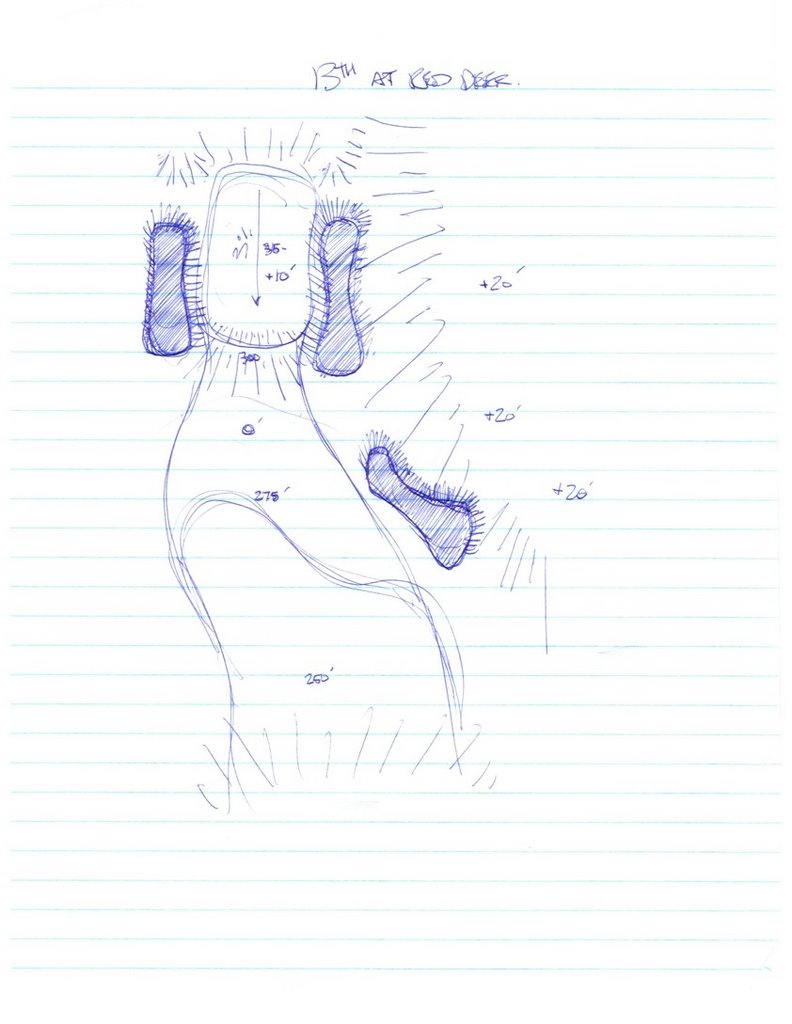
The proposed 13th at Red Deer


There are a lot of occasions where you are invited out to review a golf course and get invited to explore all opportunities. You find out from the club that they are open to making changes either for improving the overall quality of the course or to find much coveted length. Often this leads to the exploration of alternative ideas to improve holes, a chance to review strategies, or even the occasional look for an entirely new hole. When I do this, I tend to sketch my thoughts in the field and these “doodles” are often fairly accurate reflections of what I end up doing later.

The image at the top is for the new green site (which is actually the original green location) for a hole at Red Deer Golf & Country Club. When reviewing the course I determined the club had a great opportunity to shorten one of the fours into a drivable par four to add more balance to the layout. When I looked at the green site and circumstance I immediately thought of the 7th green site at Scarboro. That hole is a really great short par four by Tillinghast, and it offered a great solution on how to make the hole at Red Deer complicated and dangerous at 315 yards.

The cleverness of this hole comes from the green and the bunkering. The green is narrow and very difficult to hit from anywhere but directly in front. The narrowness demands great accuracy and makes the choice between laying-up and trying to hitting it real close a tough decision. The fact the green is elevated with a strong back to front pitch and the false front adds additional challenge for better players who spin the ball. That’s why I often turn to the great holes and green sites for inspiration; there are so many good ideas from which to draw the best answer for the club. You just have to be familiar with the holes and able to recognize where they fit best.


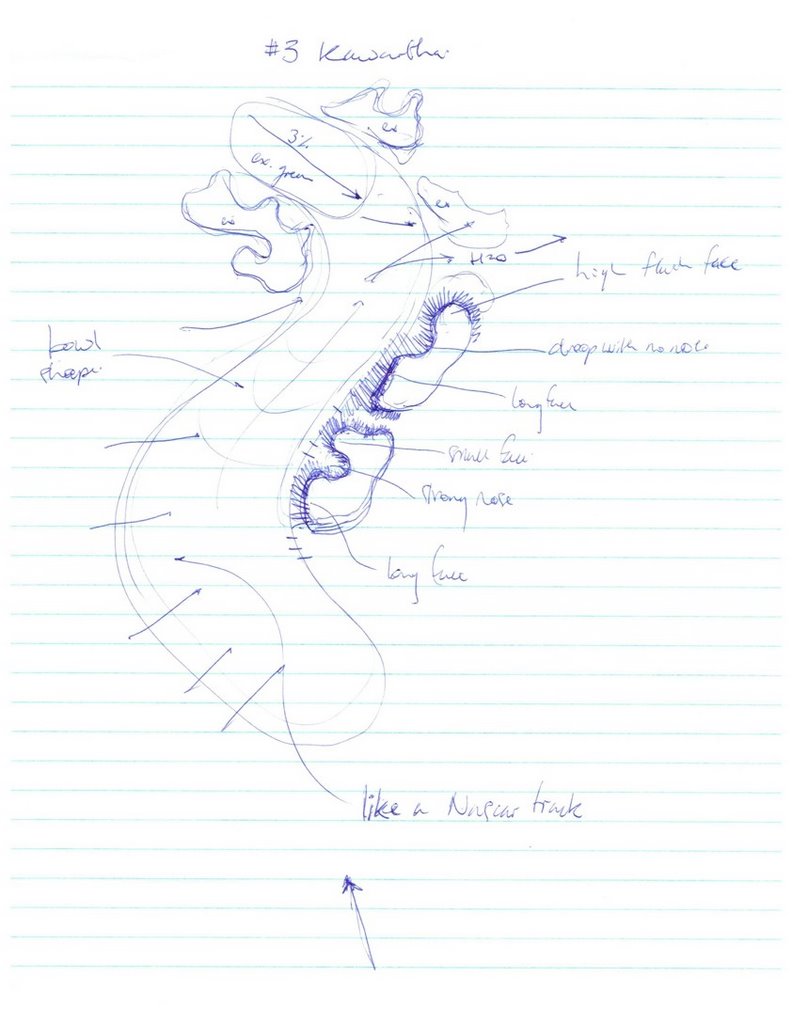
3rd at Kawartha


The image above is the other side of drawing ideas in the field. Working drawings provide the basic scope and general direction for the work, but the reality is many holes are altered in the field to make sure that the what you see in your head makes it all the way to built form. These are called field fits and they are done to tie in work properly, ensure visibility, create the intended slopes, provide more movement, add dramatic flair, and generally add more of the architects imagination and creativity than any plan could explain. all I find they occasionally require some doodling to work the ideas out in my head or to explain to a shaper the concepts as opposed to the grades. I was at Kawartha today removing all the mounds and trees from a recent renovation to the 3rd fairway and trying to make a situation where the tee shot still fit the rest of the course despite a much wider clearing. The concept explains much of what I’m trying to do with fairway movement and bunkering to use the width provided and still create strong strategies that work on that site.

Monday, August 28, 2006

The Red Deer Charette


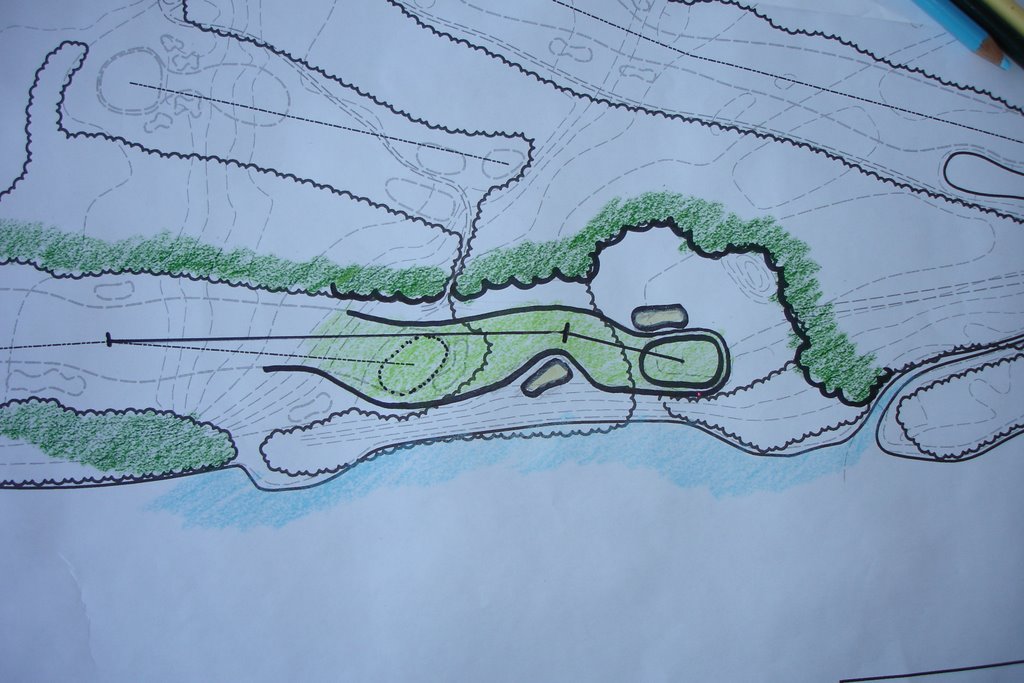
This is the extension of the 4th hole to bring the Red Deer River into play and into view


This wasn’t a completely a charette because I did do some preliminary routing work to give myself some ideas on what was possible. Usually the first stage is to walk the golf course with members of the greens committee and the superintendent. I like to use the initial stage is to collect ideas and alternatives for discussion. Since the interview was conducted out on the course where we did discuss ideas, I was familiar with the holes and had a good feel for what direction the club wanted to go. A little routing investigation was a smart head start. I still intentionally took on the approach of a charette, to see if I could make the plan grow from a couple days looking at the course and talking through ideas.

I arrived at Red Deer (just in time for rain), and we went into a boardroom to talk about the plans and possible ideas. I definitely prefer to meet before going out to review the course, because it makes it easier to focus on what I need to accomplish. The club confirmed they were very interested in additional yardage being an important part of the plan, but proved to be very open to the ideas in trying to return a little more traditional architectural character. They understood when I recommended that a little restraint should be shown to retain a variety in yardages and a little courage would be required to really make the course a reflection of its era. I was very pleased that they agreed with my approach and were willing to take a long view and make a few extra changes to undue certain modernizations that did not fit. It was a relief that they understood my traditional vision for the club.


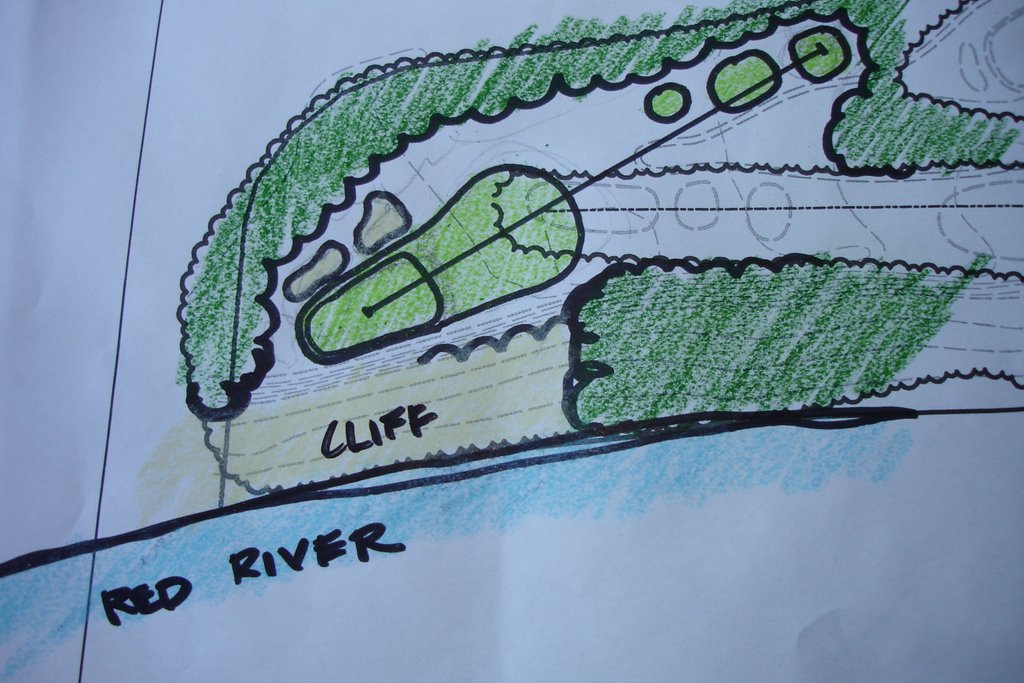
The potential new par three looking the other way up the river


We did make it outside after the meeting to walk and review the larger changes. I did discover some of my ideas worked better than expected including a new potential par three with a spectacular view up the river. I also found one of my larger changes did not since the mapping did not match what was in the field. We returned to the clubhouse and had dinner, this time with the entire board and once again went through our options. I took some time to explain my thought process and walk them through the potential changes. I also gave them two possible plans depending on whether a proposed land swap did go through. The committee was quite enthusiastic about the change so at that point I had clear direction. I wasn’t sure we could accomplish all this in one visit, but the committee made was pleased with the plans. I still wasn’t done.

I spent the second day looking at alternatives and reviewing them. I also spent four hours accumulating all the problems and difficulties of the property for the Superintendent. A superintendent a sharp as Wayne is an architect’s dream. I felt I finally had all the background information together and was ready to return to the plan.. I finished up with a round of golf with the Director of Golf, club president and next years club president. It was eye opening to see where the ball was going, which fortunately it went where I aimed that day! I did make a few revisions according to what I learnt from that round.

That night I went back to the hotel and begun the traditional end to the charette. I finalized a plan based upon the current envelope, the club’s direction, and my notes from the field. I began to produce a series of sketches to illustrate the changes to the holes. I also collected a series of images to illustrate the style of architecture using examples from existing courses to talk about different ideas. I ended up even producing a few simple illustrations to explain the different principles of modern architecture versus a more traditional architectural approach. In short, more carry bunkers off the tee and flanking bunkers at the greens versus more target bunkers off the tee and forced carries at the green.. The next day I presented the ideas to the membership and it was met with quite a few question and a very strong level of support. At the end of the presentation I knew I had a plan (with a little more tinkering at home).

I would definitely do this again.

Tuesday, August 22, 2006

Technology Part 3 – Defending without length

I couldn't find this post in the archives - I think I may have forgoten to post it when it didn't become an article for a magazine.

So what can an architect do to add difficulty without adding length and till maintain playability? Island greens, more water, forced carries, long rough, fescue and fast greens all add difficulty and 6 hour rounds, so what are the alternatives?

1. Make the player think. Alister Mackenzie said, “A first class hole must have the subtleties and strategic problems which are difficult to understand, and are therefore extremely likely to be condemned at first sight even by the best of players.” Giving the players options and tempting situations keeps them a bit off balance, even with the equipment they have today. If the strategy is simple and straight forward they will play to their strengths, but if a hole is full of enticing options they will often entertain the most foolish line trying to gain an advantage on the course. The 10th at Riviera is the perfect example, where the smartest play is the least obvious and the riskiest play is the most understandable.


2. Make them manufacture shots. The shot that the professionals are most uncomfortable with is being forced to hit a fade from a draw lie, or a draw from a fade lie. They would rather take their natural swing than have to manufacture a shot. Using the natural cross-slope of the land to influence play is the least used and most effective method to add additional difficulty to a hole. This is a technique perfected by William Flynn at Huntingdon Valley, where he routed many holes against the natural slope of the land to force the players to work the ball against the grade.

3. Place pressure on their expectations. Short holes are wonderful things; they give the average player a chance to make a par, whereas the great player feels the pressure to “make” a birdie. At Merion, the better player feels great pressure to score on the shorter middle holes and almost always become far too aggressive trying to score through this stretch. The results are usually disastrous, particularly when the shorter holes require more management than some of the longer ones.

4. Closely mown grass around greens. This has long been a staple of links courses throughout the world. Bluegrass surrounding a green offers only one type of recovery — the flop — a favorite of good players, and it also contains a missed approach. However, if the green surrounds are closely mown, the near miss often gets propelled away from the green. Now the good player must decide whether to putt, bump and run, or to attempt a flop shot. Options present opportunities, but also lead to mistakes. The US Open at Pinehurst showed the difficulty created by short grass around greens.


5. Bold undulations on the greens. With bold undulations on the putting surface, positional play becomes even more important to gaining access to many of the pin positions. It will even dictate strategy right back to the tee. If you miss the approach, you are left with a delicate putt requiring the player’s full imagination to avoid dropping a stroke. St. Andrew’s is a great example where a player will hit many greens and still make lots of bogies by being on the wrong side of the hole.

6. Bunkers that are a Hazard. Walter Travis had the following quote about bunkers. "The primary idea of a hazard is to punish, to the extent of one stroke, a poorly played shot, and to make the recovery exceedingly difficult, and even by the virtue of the following shot being extraordinarily good. If this end is not attained, the existing hazard fails to fill its functions." When the player aims at the perfectly groomed hazard because it offers an advantage, the hazard ceases to be relevant to the intent of the game.
7. Intimidation. A hazard with little penalty for a miss has no psychological impact on a good player and the player will swing with confidence. When the penalty for missing is severe, a player’s pulse will quicken and they will feel the pressure to make the shot. If the player begins to think about the consequences of missing his shot instead of a good result, the architect has intimidated the player. At Pine Valley, the first time player is so overwhelmed with the possibility of disaster everywhere that they rarely notice the wide fairways and large greens that George Crump has provided.


8. Removing the clear line of site to a target. As architects, we are always looking for a way to add tension throughout the round. The blind shot has the same psychological impact as water, out of bounds or a forced carry (without the penalty strokes). Players have come to expect everything to be visible and clearly defined on each shot, and any break in this modern pattern frustrates them. Even blocking the view of the green, but allowing for the flag to be seen, upsets the player’s ability to visualize the shot. Tobacco Road uses this technique to make the player uncomfortable, but as the Scot’s would tell you the hole is only blind once, and because of this Tobacco Road is much less intimidating on the second play.

Is a Larger Ball the Answer?: http://thecaddyshack.blogspot.com/2006/05/larger-ball-this-is-new-idea-that-has.html

Working with Golf’s true sculptor – the shaper


Paul Timbers, Grant and Donnie Robb at Kawartha


The first green surface I had any involvement with was the 5th green at Greystone. It was one of the first times Doug had me join him out on site to teach me some of the basic things I needed to learn about creating greens and other features on the golf course. It was a great chance to see drainage installed among other important details that I had to learn before I could design anything. Through circumstance Doug had to go review some major drainage works and grading and suggested it would be better if I join Albert and see how a green is built first. The 5th green was set into a natural amphitheater and was an excellent green site already. Albert was in the process of making the plateau when I arrived.

I introduced myself to Albert and said I’m here to learn from you, and I received a smile and an “OK, that’s not what I’m used to but that should prove interesting.” Little did I know that a little humility was the perfect way to get to know the often cantankerous and moody Albert, who also happens to be one of the best shapers I have ever had the pleasure of working with and a good friend. Albert asked me what I wanted on the green surface, and to be honest I just kind of repeated what Doug had talked about out of fear. Albert said, “what about the swale in back it’s not on the drawings but it would be a good idea.” Lesson one - listen to what the shaper suggests - I said I agreed with him that a swale was a great idea, but asked can we keep the green surface the same size. Albert said “Sure but I need to lower it a couple of feet and take it slightly right, but that will work fine.” Lesson two - when a good shaper says he can make it work - get out of his hair and don’t give useless directions. In 15 minutes it all fit in wonderfully, and I can say I honestly had no part in this. I realized right then that Albert just knew instinctively what would work - lesson three - trust them and work “with” them.

Albert shaped up the green and we got out a laser to shoot some grades. The green looked awesome to me, but I though a pin position was impossible to access because the slope was away from the approach on a long iron in. I explained how I thought the ball should be received particularly on such a tough shot and asked what he thought. Albert smiled and said you’re right that would be too tough and said give me two minutes and he reshaped the section to receive the ball. Lesson four – always explain how the shots should work- they can make anything work but must understand clearly what you intend (as opposed to what you drew). Intent is the key direction we have to offer. Talking in broad strokes helps a shaper, micromanaging a shaper is a great way to get crap (and that’s your fault not his).

My advice to any young architects is to respect the shapers, explain yourself fully on what you expect, trust them for input, let them contribute to some of the final forms, take a stance that you have a final say to avoid and idea you don’t like but allow them to venture a little to discover better ideas. Treat them like a good friend and they will make you look better than you are, and you will end up with some of the closest and most reliable friends you will ever make.

I’m going to miss at least a couple of names, but I want to thank all the great shapers who have made me look like I have a clue:
From Evans – Albert, Louie Melo, Mike Zant, Dave Sutherland and Dan Minduik (sp.?)
Gateman – Richard Armitrage (Ballantrae), Louis Pedro, and Darren Hancocks
TDI – Steve Tate, Jamie, Domenic Carrere, Brian and Paul
NMP – Michele
And all the independents or small companies – Spencer Adams, John Northy, Doug Shwartz, Gary Elison, Ron (be gone), Peter, Dan, (I miss) “Moose” Thompson, Gord Wendover and the unbelievable talented Thomas (“Dickie Do”)
Finally the ones that have seen everything and done it all and continue to share their wealth of experience - Dick Kirkpatrick and Paul Timbers

Monday, August 21, 2006

Longer isn't the Answer


From Cam Cole in the National Post on Saturday:

[Cam Cole] “This is a big time course, so….”
“Is that what it is Calgary’s Steven Ames interjected.”…
…”He didn’t mean Medinah wasn’t a good golf course. He just meant that as major challenges go, this one is too soft, too getable – and it maybe proving the definitive argument that simply making courses longer is meaningless to the generation of professionals who can handle long but have trouble with narrow.
One of these days people who design courses – and the organizations who designate them as major sites – are going to figure that out.”


Since I’ve been on this particular bandwagon for quite sometime and have written a whole series of articles on this subject – you can understand how happy I was to read that everyone is coming to realize the truth. Only the USGA and other ruling bodies have not come to terms with this reality. The USGA and there “architects of choice” Rees Jones and Tom Fazio have set about a policy of lengthening every course to prepare for a major. Well we have all come to realize that all this policy has done is make the architects in question wealthy without having any impact on play.

So I ask you, what do you think are the factors that combine to make difficulty? The most common answer is length, rough and green speed. This is considered the holy trinity by the USGA and other tournament committees. They feel that length is needed to put long irons back in the hands of the players and to make the players play the courses “like the players did in the past”. Using the longer rough is an attempt to balance the reward for accuracy with the rewards for length. Green speed has become last line of defense with the idea that speed makes recovery shots and putting extremely difficult.

Well here’s my response to their methods. Length only manages to eliminates the shorter players from being competitive. It does not put long irons in most of the player’s hands because we can’t possibly make it long enough to battle technology. If we did go to that extreme and the weather was horrible, players would shoot ridiculously high scores because the course would become unmanageable. We would be better off with much longer fairways that restrict the roll of the ball and place some limits on spinning shots.

The rough is a deterrent, and here I feel they’re right. For the life of me I can’t figure out why it isn’t a policy to grow long rough at all the events to eliminate the boring “bomb and gouge” method of play. I don’t watch professional golf for this reason. It’s still a tough call since no rough on sloping sites allows for risk of letting the ball “really get away” because there in nothing to stop it from heading into the trees or down slopes to a much worse fate. The long rough places a premium on accuracy off the tee but also contains missed shots and saves many bad approaches coming into greens from being much worse. This is a good area to potentially mix the heights or approaches on a regular basis for variety.

Green speed has made the professional game easier! Yes I honestly believe this. Players now don’t have to have a putting “stroke” they only need to have a way to get the ball on line. The greens are so short and so perfect that they don’t have to think about grain, texture or any other factor that they once had to overcome. Since the greens are so fast many of the really great pin positions are lost because they are too extreme which takes away from the architecture of the course. Greens are now designed or renovated flatter for fairness which works to the player’s advantage. It’s easier than it used to be.

On that note, what is the number one way to make a course difficult, green contour! Pinehurst #2 proved that green contour and the fear of the consequences is the best way to keep the scoring in check. It got the players thinking and many of them played holes hesitantly which is not a way to “go low”. With many of the greens being so complicated, fairway position became important so that they could spin the ball and hit into a receptive slope to keep the ball on the surface. Green contours are what make the short 10th hole at Riviera lethal despite being only 310 yards. Green contours are what keep the scores down at the Masters, not the extra 500 yards and the rough. Green contours are the best defense against the modern players.
Thursday, August 17, 2006

Found - Kawartha's plan


This was not planned. I found out today that an art gallery has the 1932 Stanley Thompson plan for Kawartha Golf & Country Club. I will get more information and post the location, so that others can visit the drawing if they wish.

This makes me more optimistic that the drawings are not gone, they are out there to be found.

Finding Stanley Thompson….


The famous Banff model


Between the 1940’s and the 1970’s many amateur historians or collectors removed drawings and plans from clubs, particularly when the club showed no interest in preserving and keeping the documents. Sometimes they had the club’s blessing, sometimes they did not. Often they would take it home before it got tossed away. Other materials were archived and forgotten.
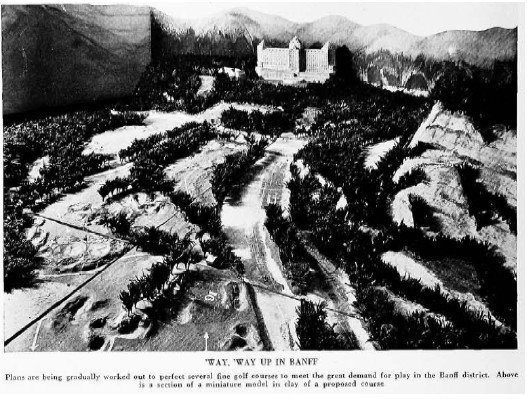
Finding Stanley Thompson’s missing documents has been my personal Holy Grail for well over 10 years. I share this obsession with other people including Bill Newton of the Stanley Thompson Society. Bill provided me with a window to what is lost, “When I was about nine or ten and on a visit to Uncle Stan at Dormie House, I remember his sand table where he sculpted holes, the large map of Canada with red pins marking his projects, and a paper mache model of a golf course. Many years later, I realized that it was of Banff. And years after that, I became haunted with the notion of it all lost along with other items. Consequently, I formed the Society with preservation as a primary objective.”


Big Baby at Jasper around opening


A year ago I was given a number of Stanley Thompson letters from a gentleman acting as an intermediary for a collector. I received the documents, digitally scanned them for distribution, and presented the originals to Karen Hewsen, the librarian and archivist at the RCGA, for preservation. It is my opinion that, if we are to understand the history of golf architecture, these historical pieces belong in public archives and not in private collections. Clubs and collectors may prefer to keep their originals, but with the current digital scanning technology, even a scan made available to the RCGA’s archives would help. The part that still haunts me is his collection he has all Stanley’s drawings including the water color and I dearly would like that to be available to the public again. Right now he won’t part with any of it.

Karen Hewson has speculated that the whole collection is sitting lost in the National Archives in a box waiting to some day be catalogued. I was hoping she was right, but Geoff Cornish had said in an interview done recently that they left everything behind when they moved to Dormie House. I fear that the models are most likely long gone because of this, but it has surfaced recently that the gentleman who owned/bought the office building did indeed go through his things and keep a few items. I understand John Smith from the Thompson Society has reportedly talked to him about acquiring the items. I would love to find out what he has even if there is no way for any of us to acquire the records – just so we know what is still around.


Routing plan for Highland Links


I’m very dependent on finding these items to do an accurate restoration work. It was photos donated by Paul MacNaughton to St. George’s Golf & Country Club that were instrumental in the accuracy of the bunker restoration work that I completed for St. George’s in 2002. The information in those photos contributed directly to the success of the project, giving important insights and valuable data that we otherwise would not have had. Craig Moore has just recently found a 1955 aerial of the Cutten Club that will make our restoration efforts far more accurate. Imagine a window into the course only two years after his death.

There is so much missing from his field note books (like Sunningdale’s) to his models (like Banff’s); is it in a dusty box or on the wall of a collector’s house. I sit and wonder.

Wednesday, August 16, 2006

A Routing Study - Highland Links


The 2nd looking down to the green


This by far is the most unusual of Thompson's routings, and it is why this is one of the most enjoyable experiences in golf. When Stanley surveyed the property on foot, he must have recognised how unique each area of the golf course was going to be. After he had finalised his routing, whether intended or intuitive, he made a decision of shear genius. He separated each unique area with a long walk. So why was this important? This makes the course unfold like a series of chapters from a great book, each chapter (or set of holes) has its own unique setting. When combined together it makes for wonderful journey through the local landscape.

I’ll explain this further. The first six holes are routed along the rolling land of the headland, which originally had ocean views on all six holes (this is something they desperately need to fix). I couldn’t think of a better way to start with all those ocean views!


The wild and much tighter 7th


After the sixth green, the hole that plays along the ocean, Stanley takes you inland on a long walk to relax and enjoy the river valley as you enter the forested highlands (first change of pace and setting). The trees and mountains now dominate the setting of the course, and the player has to adjust to a more secluded and intimate setting. The holes are now fully framed by trees and mountains, with the tee shot on the 7th being intentional tight and tough to offer a complete contrast to the previous holes. Stanley does a wonderful job of creating an exciting stretch of holes while still maintaining a walkable course through this tough terrain. This stretch continues through to the tenth green.


The valley holes of 10-12


Once again a change of scenery started with a walk over the old swinging bridge and along the magnificent Clyde Brook. The 11th and 12th were once wide open, flat and fairly straightforward. This gentle stretch of land and golf was made to act as a breather in the middle of the round before taking on the tougher stretch to follow. I love how the old photos show the river was intended to be visible from both holes. I found out the river was to be the focus of the two holes but they ran out of money to pay for the bridge crossing that was required. The walk from 12 green to the 13th tee is the prettiest walk in golf (another great transition to a new setting) again along the river and up to the 13th tee.

At the thirteenth hole, Stanley returns the player to very rolling land with views out to the ocean. While the holes are much tougher, experiencing a view of the ocean make them inspiring. This remains my favourite stretch of holes on the course and the golfing terrain he selected has no equal. The highlight of the round is probably the dramatic 15th that tumbles wildly down towards the ocean in the background. Once again the golfers experience another wonderful walk, this one by the church, to the final set of holes.


The magnificent 15th


Holes 16 to 18 do not have a view to the ocean, although, I can’t help but wonder if the ocean was clearly visible on the right of the 18th hole. The final stretch is a return to the darker evergreens similar to the opening holes, here Stanley had designed a series of friendly holes to give players an opportunity to make a par. Stanley was always cognisant of resort play and making the courses enjoyable for the average player. I think he felt after such a long journey, making a par in the final stretch would be a great way to finish the round.


The 17th hole


Highlands remains a top 100 course in the world. Out of the five best Thompson courses, it is probably the most understated architecturally, but it may be the course that works most closely with the landscape. This is why many feel it is Thompson’s best work and the best course in Canada.

Tuesday, August 15, 2006

Top 100 Continued - What makes a course great and My Top 25


Toronto's wonderful 15th green site


So what makes them great?

1. Great routing – hardest element to measure, but best described as the holes seem to all work perfectly one after the other.
Example: Highland Links is a wonderful run where each hole seems in the right spot (I'll touch on this tomorrow by discussing the Highland routing)

2. Great architecture – from greens to bunkering
Example: St. George’s bunkering is so good it can almost carry the course single handed

3. Great setting – there is no comparing an Oceanside course to a housing course
Example: Dakota Dunes versus Eagle’s Nest

4. Mixture of hole types and hole lengths – 18 holes in a valley setting or a 7,400 yard course is dull
Example: Devil’s Paintbrush provides the seemingly impossible with the seemingly too easy all day, a testament to good design and fun

5. Balance of strong and fun holes – can beat your brains in or be too easy either
Example: Hamilton does a wonderful job of testing all your skills and giving you plenty of opportunity, a perfect mix of brains and brawn

6. Great par threes – It is almost a must
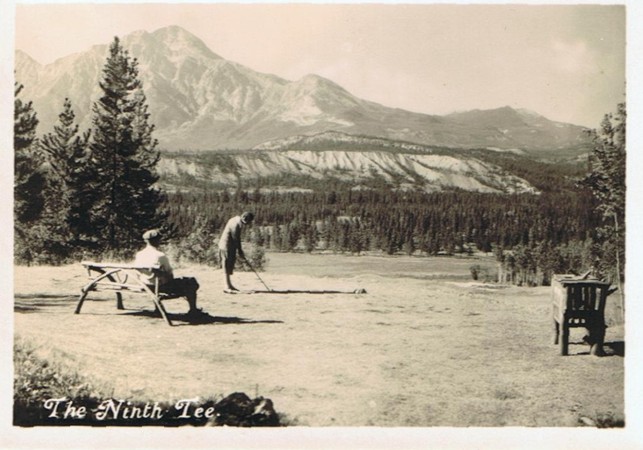
Example: Jasper Park has a perfect set from pitch to driver and all yardages in between

7. A full mixture of par fours from drivable to unmanageable
Example: Toronto Golf has the perfect mix of all yardages green types and settings

8. Par fives that are interesting rather than just long
Example: No course in the world can top the mixture of great par fives at Highlands

9. A golf course that makes you think – 18 clearly defined holes with one option per shot lacks strategy – the course must invite you to take risk and play smart
Example: Kudos to Rod Whitman for giving you a million options at Blackhawk.

10. A course that has continuity – from architectural style through to feel, too many ideas or too many elements ruins a good piece of architecture

This is the weak point of Canadian architecture, the new courses have an advantage because they haven’t been tinkered with. This is also the reason so many of the courses like Mayfair have gone from the top to off the list.

My Top 25

St. George’s
Highland GL
Jasper Park
Hamilton
Toronto

Banff Springs
National
Capilano
Devil’s Paintbrush
Eagle’s Nest

Westmount
Scarboro
St. Thomas
Catarqui
Blackhawk

Rosedale
Lookout Point
Summit
Osprey Valley Heathlands
Wolf Creek

Beaconsfield
Bigwin Island
Laval
Oviinbyrd
Riverside

My take on the Top 100 – The Panel


Hamilton G&CC 12th hole


I see the list as a selection of the greatest 100 Canadian “golf experiences”, rather than the selection of the greatest 100 “golf courses”

My main issue is with the list is who makes up of the panel. To Bob Week’s defense he has done a great job of improving the panel but I still think he needs to go one step further. Removing the two top Canadian amateurs and the two PGA tour professionals would help remove some of the bias that all top golfers bring to the table. They almost always judge a course on how it makes them play. They tend to favor long tough golf courses in immaculate shape over anything else. They also have a tendency to see only the courses that hold events or exclusive private clubs where they are treated exceptionally well. They don’t have the time to travel the countryside to see enough lesser known courses to have a balanced perspective. I’m not saying they aren’t interested in or don’t understand good architecture, but I do believe they come with certain expectations that favor the elite city courses over the rest. Just look at the list.

The panel is always strongest if all the members are well traveled, because then we are comparing courses on equal terms. There are a few guys who are not as well traveled as you would hope. I’ve been to every city except Victoria and I still think I haven’t seen enough. So who would help the list….w ell what group is better traveled than the golf architects? I strongly believe the panel would improve with the addition of around 5 or 6 architects to help provide balance to the list. Doug Carrick, Tom McBroom and Graham Cooke just to offer a couple of names would help provide perspective from one coast to the other. I think this would also help get more support for the courses in smaller towns that often overlooked since the architects often seek out lesser known gems on their travels. I think that courses of significant architectural merit, like Toronto GC would finally get the proper support they deserve. The current panel is very bias towards new work, and architects tend to be more bias towards older courses and this would help balance things out.

Some may suggest the architects have the most to gain and would vote for there own work. This may be true if Tom’s list of top holes in the world found in Paul Daley’s book is any indication, but I think you can trust that group to vote for the best courses. I think the best way to oversee this is to make the architect’s votes public. If they are bias to their own work, this can be easily seen, and they can be removed from the panel. No architect needs that humiliation. You may suggest architects have too much to gain to be part of the process but so do the director of golf, golf superintendent, director of marketing (for clublink no less), who are all part of the panel! I think it’s time to bring back the architects to the panel. I think it will make a better list.

I’ll post my top 25 this afternoon, and I may write something else too, then I think I will drop this topic at the end of today.

Monday, August 14, 2006

Top 100 - how many have you played?

Ive played:

9 of the first 10
10 of the second 10
7 of the 3rd 10
5 of the 4th 10
6 of the next 10
13 of the next 25
and 14 of the last 25

64 of the top 100..... I would love to know the panelist average since I have more opportunity than most with my renovation travels.

Top 100 - More thoughts

I thought I'd post on and off on this subject today and tomorrow and then move on.

Here's some thoughts on misplaced courses.

1. National - this is simply not the best we have to offer in Canada

2. Beacon Hall - never got this one, never will, a nice club on a nice piece of property with very safe architecture. Does not make my top 25

4. Paintbrush - love the course, but a little too high

9. Shauaghnessy - this is proof that too much extra credit is given for hosting an open (see Glen Abbey)

11. Taboo - way too high, nice course, but service far exceeeds the quality of the course (or does that matter?)

13. Glen Abbey - not in my top 25, just look at the front nine by itself and tell me the course is great

23. Copper Creek - I worked on this an even I know it's wrong

35. Osprey Valley Heathlands - top 25, Carrick Design's best detailing ever

47. Bear Mountain - is a new course, what gives?

49. Summit - misunderstood for how good it is, too understated perhaps, should be top 25

54. St. Thomas - easily a top 15-20 if you go and see the course

57. Catarqui - top 20, a great piece of Thompson history

59. Marine Drive - a completely dull course played down a "hallway"

62. Laval - sufferes from no visitors, great back nine

63. Rosedale - other than being short please tell me where the weakness is?

67. Scarboro - could be top 10 and no worse than 20. Never understand why people don't get this one is it just yardage?

72. Mt. Bruno is definately a top 25 candidate, but may be access is the issue

76. Beaconsfield - may favourite Montreal layout gets no love, is this still fall out from the Ladies Open? Top 25-30

84. Glendale - This course is a bit of a sleeper, worth seeing

86. Lake Joseph - the top 10 was silly , but so is this

I already supplied my list of courses that should have made this.

Top 100 - Initial thoughts

I will definately be writing on Score's Top 100 in Canada tomorrow. This is what I think is missing from Score’s list?

Top 50
Kawartha
Burlington
Islesmere
Royal Ottawa

Top 100
Highland CC
Maple Downs
Oshawa
Galt
Waskesiu
Red Deer
Kanawaki