Tuesday, May 09, 2006

The Importance of the Insurmountable Hole


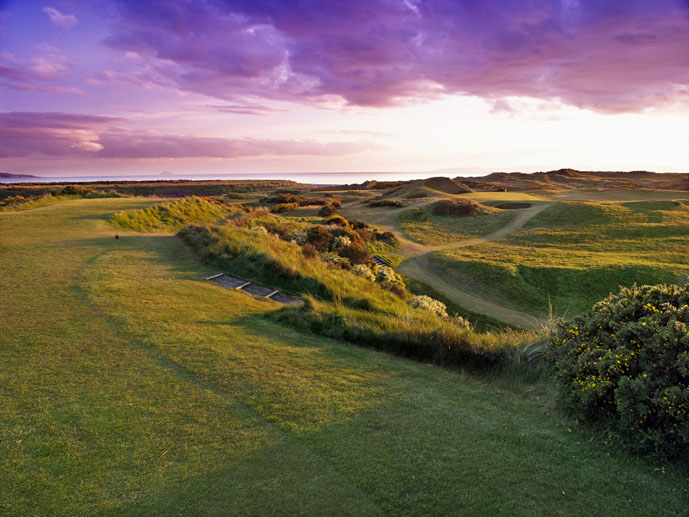
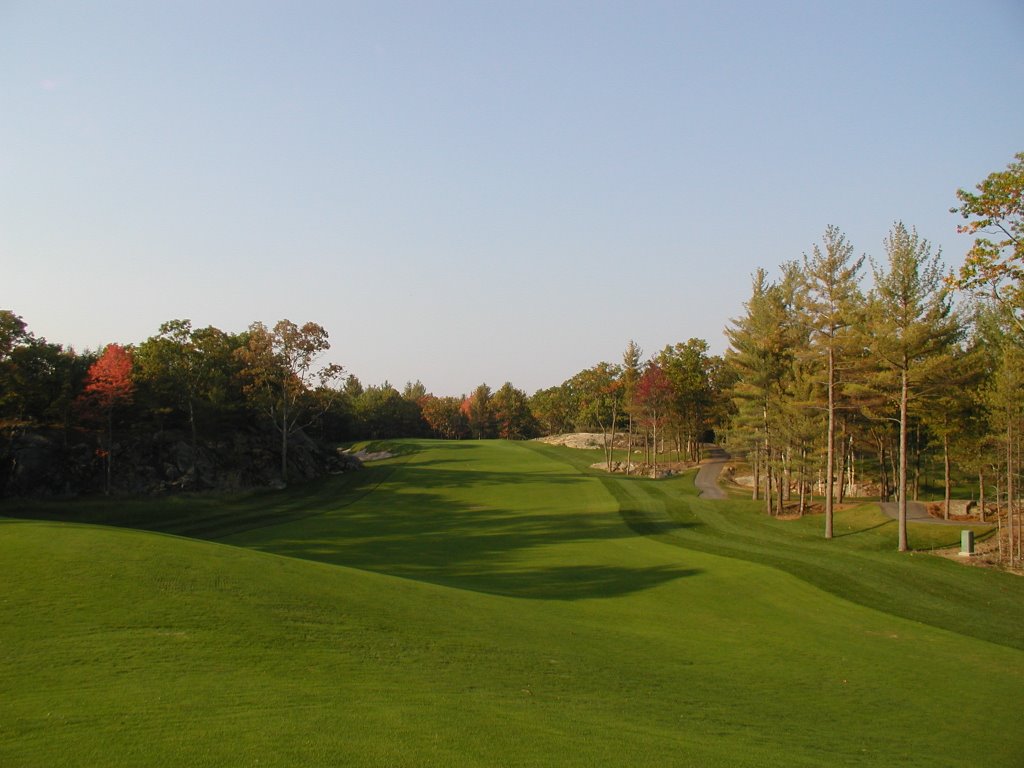
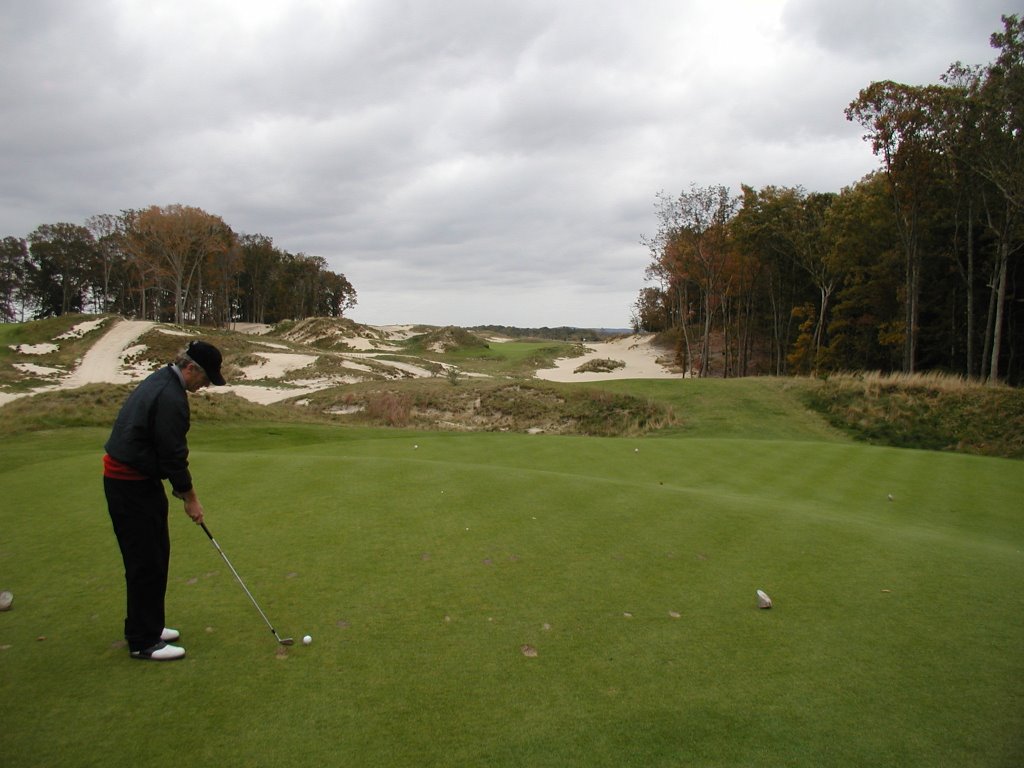
The 6th at Kawartha 235 yards to a high plateau


I wrote a long time ago about the need for a “breather hole” on a course dominated by a series of exceptionally challenging holes or through challenging terrain. Today I want to talk about the importance of the Insurmountable hole, in this case set among a series of easier holes.

Yesterday I played golf at Kawartha Golf & Country Club, a great Stanley Thompson layout that has been profiled on this blog before. The first five holes at Kawartha are a nice slow introduction into the course, a selection of medium par fours with one very short par five (a hole I would love to see play as a long par four with just a few shorter tees for playability). After the first five, the player runs smack into the teeth of the course, the first of the long par threes. The 6th hole is a very long and very uphill par three of around 235 yards. What makes the hole tough is that it plays at least one if not two clubs uphill. The green sits atop a diagonal ridge to the left that is severely sloped, with a rambling deep bunker cut in the face of the slope. Long right is a directional bunker that is impossible to recover from because of the slope of the green. The green is also set up a few feet higher on an additional slight rise, like the 15th at Catarqui (another insurmountable hole). Only the very best shot will find the surface and the slope turns the rest od the approach shots around and back down the slope. Oh yes, and then there is the green, nothing fancy just a severe pitch directly at the bunker on the left. You must be underneath the pin to make a putt. The green is not ridiculous enough to roll the ball off, but a putt from the sides is pretty much impossible. That, my friends, is an insurmountable hole. You would remember a birdie there for a long time, a par is a victory to be savored (it probably won you money) and a bogie is clearly an acceptable result. The members say the average group finishes out in 20!

My playing partner called the hole goofy. I in turn said after 5 short holes where Thompson allowed you lots of opportunity to score, the hole is ideal. Golf needs changes of pace to be interesting, and it is at its best when holes contrast the previous in length or difficulty. What I like about the 6th at Kawartha is if you haven’t got your game together yet, it’s time for Thompson to start taking strokes back. He’s telling you that it’s time for you to show what kind of player you are.

I’ve often talked about flow in a round of golf. This is a course where Thompson was building for the employees of GE (originally owned by GE) and he made the decision to build a golf course that was playable. There are almost no fairway bunkers on the entire course and there are lots of middle length holes to enjoy where good players have ample opportunity to score. What Thompson did is ramp up the difficulty in a few select holes to test the player. Remember it is nearly impossible to lose a ball on our insurmountable hole, he just used the land to say you’ve had your fun, now can you play a little.

Great holes like the Road Hole at the Old Course are practically impossible to make par on for all but the greatest players. Overcoming one of these “par and a half” holes means a lot more to the average player than making a par on a on a simple par four. The insurmountable hole is important to providing interest and contrast in the collection of holes. It often provides memories too, make a birdie on the Road Hole and you can tell that story for a lifetime!

Monday, May 08, 2006

Dealing With Flat Sites


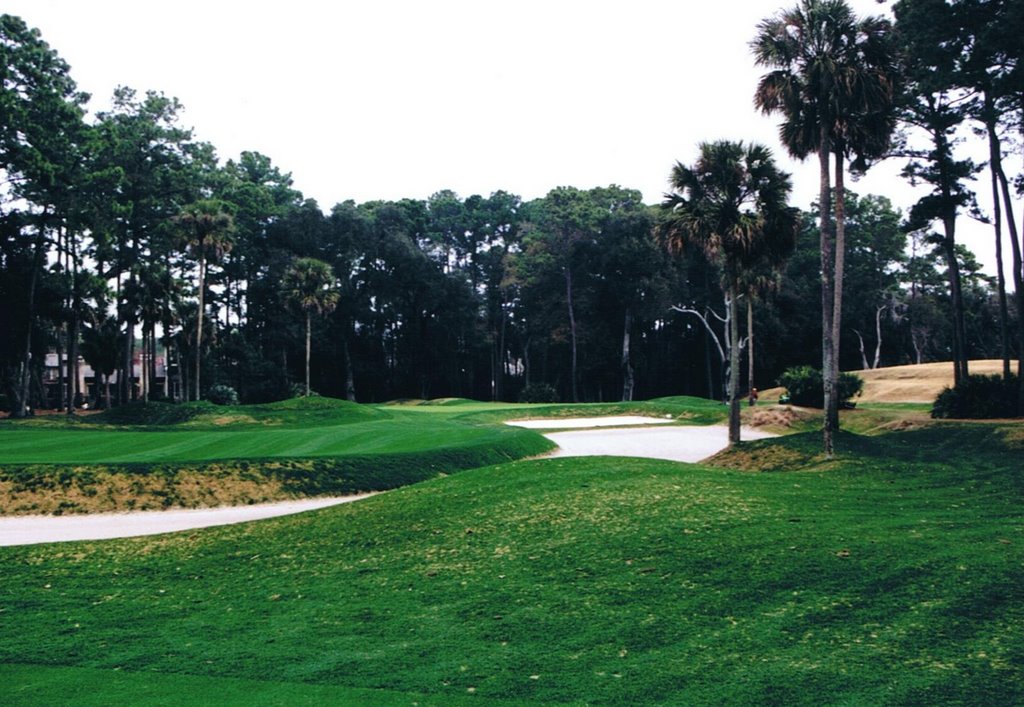
The TPC at Sawgrass was one of the best courses ever built on a por site. Dye lifted the fairways and used bunkering as transition.


Greg asked, “How you would work with a flat piece of land. Is this a golf architect's worst nightmare, or something better? Does a flat piece of land provide more options, or fewer? What are the main things that drive a flat design? What would you do with a wooded lot vs. a clear lot?”

The good is that you have almost complete artistic freedom to create exactly what you want. The bad is that no matter how hard you try, you will always be limited by the flatness of the site.

The key to handling it becomes making a decision on how to provide some relief to the holes to make the course interesting. The old standard of placing containment mounds around the outside of holes makes for a horrible and unnatural golf course. The key is to create a natural feature like a sand quarry or a ridgeline to add at least one prominent landscape element from which you work from. The pit can be used to create the fill needed to lift areas such as tees and green – even fairways too. The ridgeline running through the middle allows you to use it for backdrops and to provide views out over the property to situate tees greens and even fairways.

A flat site is not an architect’s worst nightmare, but it presents a very complicated build for drainage and a very average starting point which usually doesn’t lead to a great golf course – unless an architect has an immense imagination and a good solid budget to work with. Built on the cheap, there is very little an architect can do to overcome the site.

The architecture for a flat property can have the most options since it is limited only to the imagination and the earthmoving budget. You are left to create it all, which suits someone like Pete Dye, whereas to many others this task is far to large for them. You have a blank canvas; the problem is if you have no natural features to work with, you also have to manufacture all those too. It’s a lot to create and very taxing on the imagination.

The things that drives a flat design is getting fill to make features and finding a way to drain the golf course effectively. You have to brilliant with drainage to build flat courses, it suits the engineering side of the golf architects mind more than the seat of the pants designer. It is also hard not to fall into using large bodies of water that come into play – that provide you with lots of fill to work with. This is used so often that you can probably picture these types of holes everywhere. Here in Toronto it describes almost every new 18th hole built in the last 25 years!


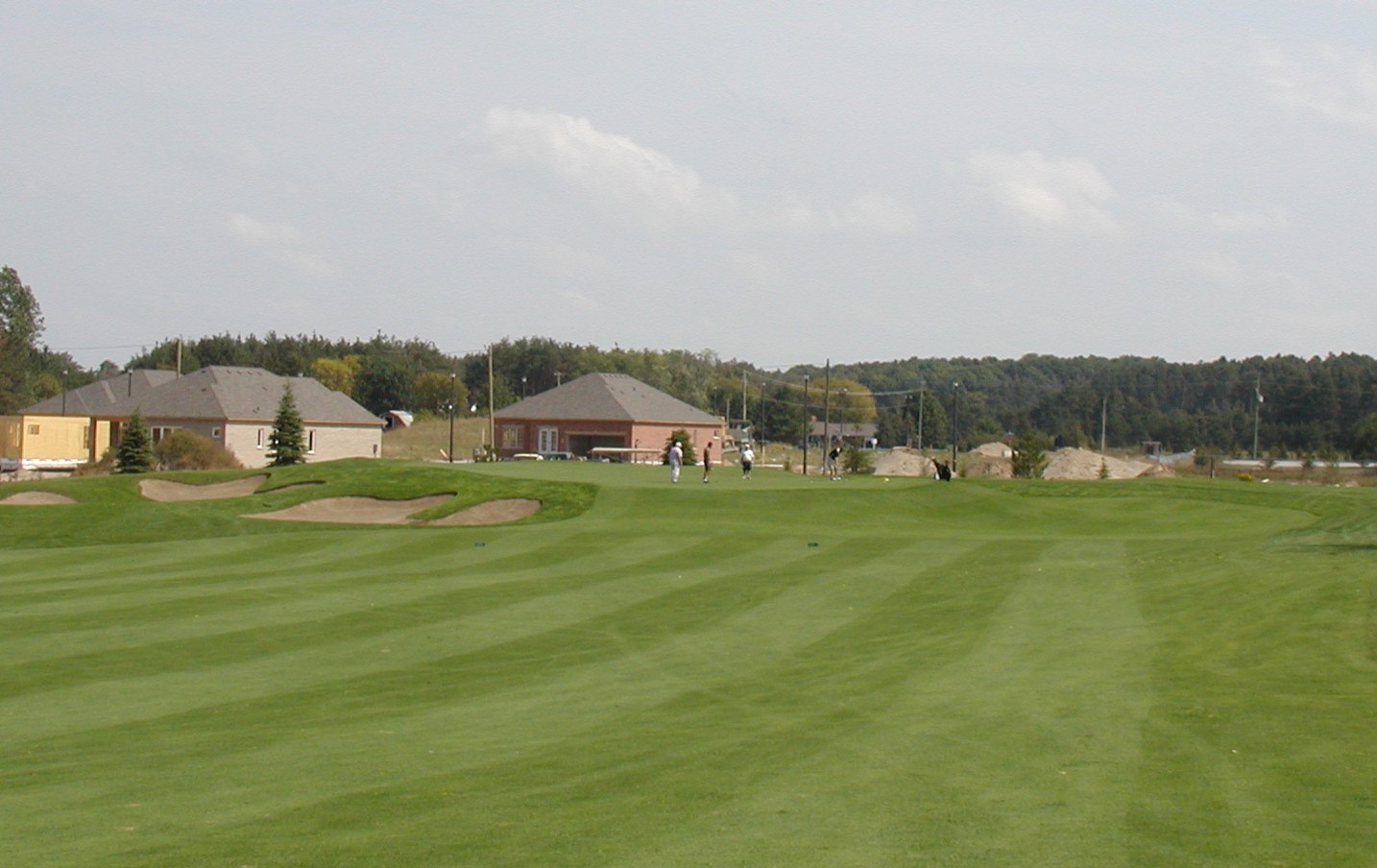
Ballantrae is a housing roject built on a flat site, where the golf course deals with all drainage and storm run-off.


The only thing I would do different with a wooded site is to not place fill up against the trees. The key to creating a natural looking course is to disguise the fills so they look like they are natural and nothing is more obvious than mounds or a big fill against a tree line. The best example of working with flat site in the trees is the TPC at Sawgrass. That was a horrible site, but Pete managed to make a magnificent natural looking course by raising the playing areas up in the middle and then using ponds, rough areas and waste areas against the trees to hide the fill placed on the fairway. I would definitely borrow my approach from Pete. He borrowed his from Raynor and Banks. I might even consider a course based on the template holes of Raynor and MacDonald as my method of dealing with a perfectly flat site.

Sunday, May 07, 2006

Routing to Add Difficulty Part 2

In routing to add difficulty I wanted to discuss four (possibly more) different ways to make a hole more difficult by the way you place holes on the land. So far I have touched on using crowns and using cross-slopes to add difficulty in a routing. The lesson at Garden City is one of the best and easiest to use because the situation exists on almost every property right down to the gently sloping ones. The rest usually require natural undulation to exist.

The third method is the placement of strong topography right in the landing zone, so that the landing zone is in fact much tighter and much more challenging than the fairway width. I have two different examples of this, one is using a valley style hole that has the placement of the rolls of the hills make the tee shot tough to negotiate, the other uses huge bowls eating into a huge plateau to make placement important.


The first example is the 11th hole at Oakland Hills. The large roll on the left extends right across the fairway and deflects any tee shots to the right side of the hole. What makes this extra tough is the right side roll is where the bunkers are cut. The difficulty lies in trying to thread the tee shot by the bunkers by playing a draw, having to try take it down the left and risk a downhill lie in the rough, or having to lay short of them and having a brutally long approach into an elevated green. Convention would have had the fairway go further right creating a natural bowl shaped fairway, but when Ross kept the fairway left he made one of the better driving holes in golf.


The second example is the 16th at the National Golf Links of America. The tee shot is played to a huge plateau starting 180 yards out. What makes the shot fun is that three 30 foot deep bowls that eat into the plateau. The first one on the front right has a large bunker cut into it and it frames the tee shot. The one on the left is 240 yards from the tee and collects a tentative tee shot. The last one on the right behind the first one is 300 yards and collects the longest player playing too aggressive. The fairway runs the ball all the way to the bottom into the left bowl and far bowl and the player is left with a difficult and very blind approach to the punchbowl green. The alternating bowls make accuracy off the tee important on this hole.

The second type of hole is the use of the plateau. My examples involve green sites, but landing areas can also be a plateau and usually involve an elevated tee shot over a valley played to a plateau on the other side. But it is the plateau green that adds the most difficulty when used in a routing. The plateau green can come in two styles, the green that is set above the grade but is still visible to the player on the approach, or it can be much higher and not visible from the landing area. When there are no trees immediately behind these are often called skyline greens, because that is all you can see. The difficulty comes first from gauging the club required and then from having the ball repelled away from the green if the green is missed. If you take the extreme case at Pinehurst, sometimes the ball is repelled off the green even when you the hit green itself, but now we are heading more into the detailing than the routing of a hole.


The first example is sometimes called the volcano green site, because of its appearance. The 2nd at Pine Valley involves an uphill approach to a green that falls off in all directions. The green is fronted by deep and intimidating front hazards putting pressure on the approach, but missing wide or long leaves the ball well down a slope with the green running severely away. This is not a long hole, but is still one of the toughest in golf.


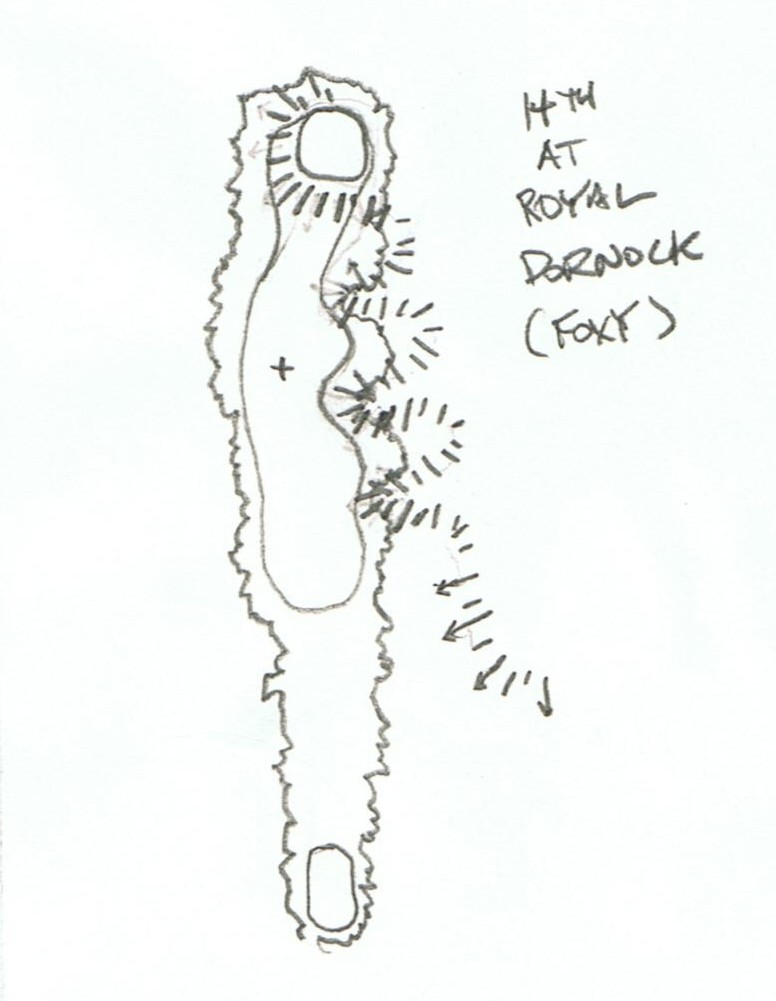
The second example is the finest par four I know, the 14th at Royal Dornock called Foxy. The green is about 10 feet above the fairway. The difficulty is in finding this green with your approach. In this instance the approach and sides are all cut short which means only a great approach will stay on the green, the rest are left to run off the slope and stay down in the valley leaving a touch chip back up the slope to try save par. The front and side slopes work to create almost a crown effect with the front of the green adding further difficulty to the approach, this is an extremely challenging hole with no bunkers.

There are others, like leaving uneven or rumpled land in the landing areas, and running greens with the natural slope which is away from play, but I think many of these examples cross over into detailed design. So I’ll leave this subject there…..for now

Saturday, May 06, 2006

Routing to Add Difficulty - Part 1

How do you make holes easy by routing, very simple, route the holes through valleys because it contains the ball and propels the shot to the flattest area. They happen to be very attractive and very popular holes because of the natural framing. This is why a lot of architects use containment mounding; it creates artificial valleys along all holes. This is also why so many big budget architects cut all the holes into the land and create to make valleys where they don’t have them. I really hope by now this blog has established that a popular approach, like above, does not lead to greatness, it only ensures comfort to the player.

I wanted to discuss four (possibly more) different ways to make a hole more difficult by routing alone, so that you may understand the value of using the land in creating difficult situations. Once you see the techniques, you will understand more of what goes into creating a great hole in the routing stage.

The easiest shot is hitting into a bowl, the most difficult shot is hitting onto a crown. When a crown is used as a landing in a fairway, it places a premium on the ability of a player to hit a shot. This unpopular technique is one of the best to place accuracy at a premium above distance.


The 13th at Pine Valley shows us that the crown defines the landing area and the difficulty just fine without bunkers. The actual amount of fairway we have to try and hit is quite small, since anything on the edges will be propelled of into the rough. While the corridor for the hole is as bigger than most of the other holes, this is by far the toughest and tightest landing area to find on the course.


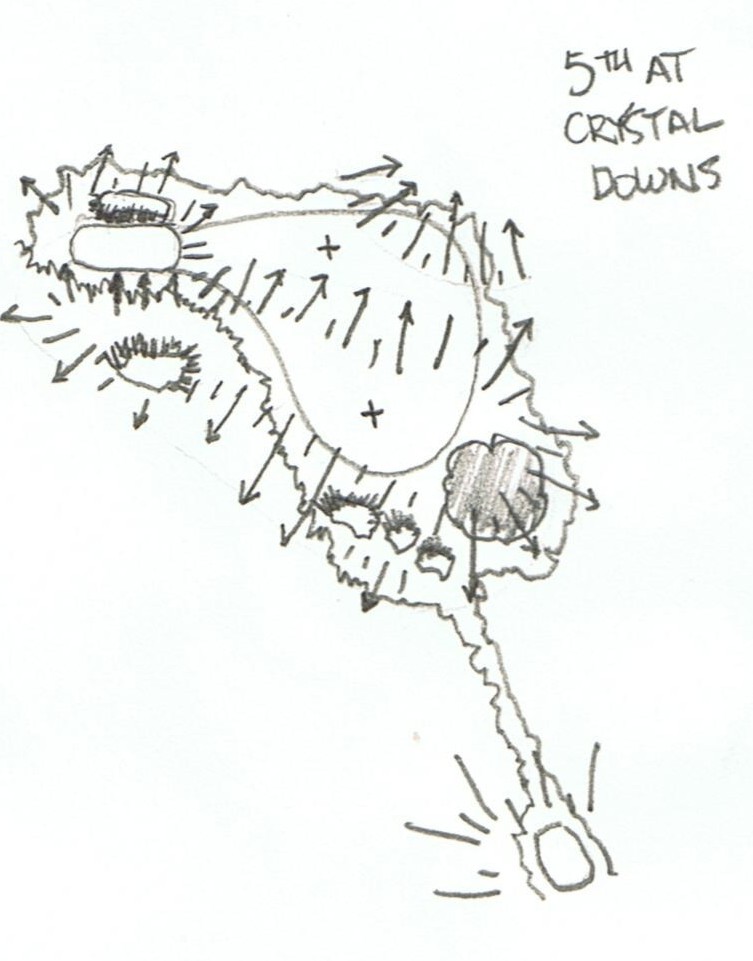
The 5th at Crystal Downs goes one step further on the idea. The player has to decide whether to try leaving it on the diagonal ridge for a clear shot, but most likely from an awkward lie; or to try and take it blindly over the ridge to a flat plateau and risk having it roll into the rough in the lower right bowl. The landform dictates every part of this hole since even the green slopes hard right away from the ridge making placement a key from the tee, and going for the green a pipe dream. All this difficulty at 335 yards.

The second method is using the natural cross slope against the player. When the land falls hard to the right, it sets up a natural fade for the golfer. If the green also falls the same way we get have the difficulty of having to hit a draw from a fade lie. Now only a simple cross slope is dictating the shot making of the player.


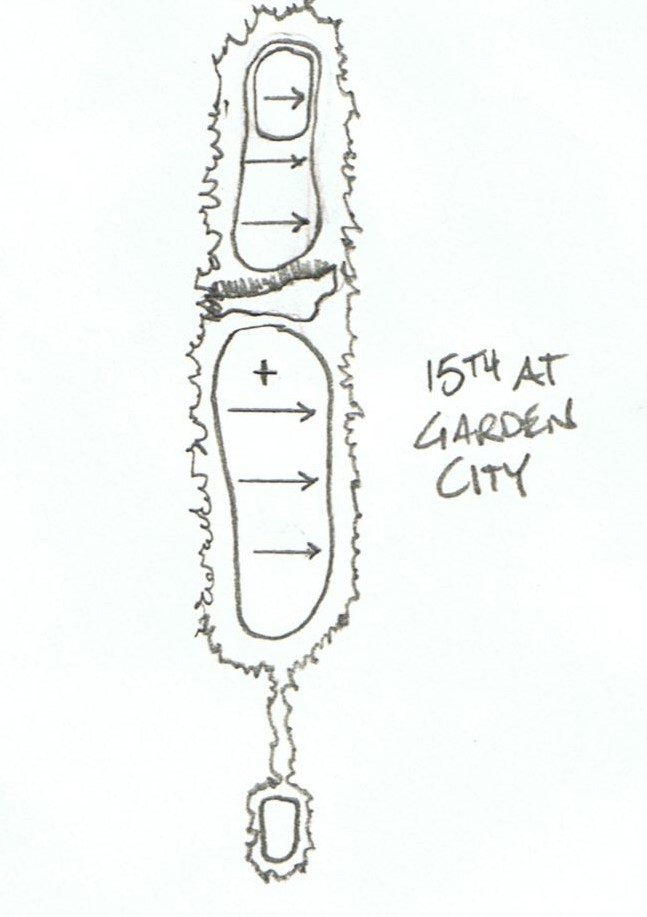
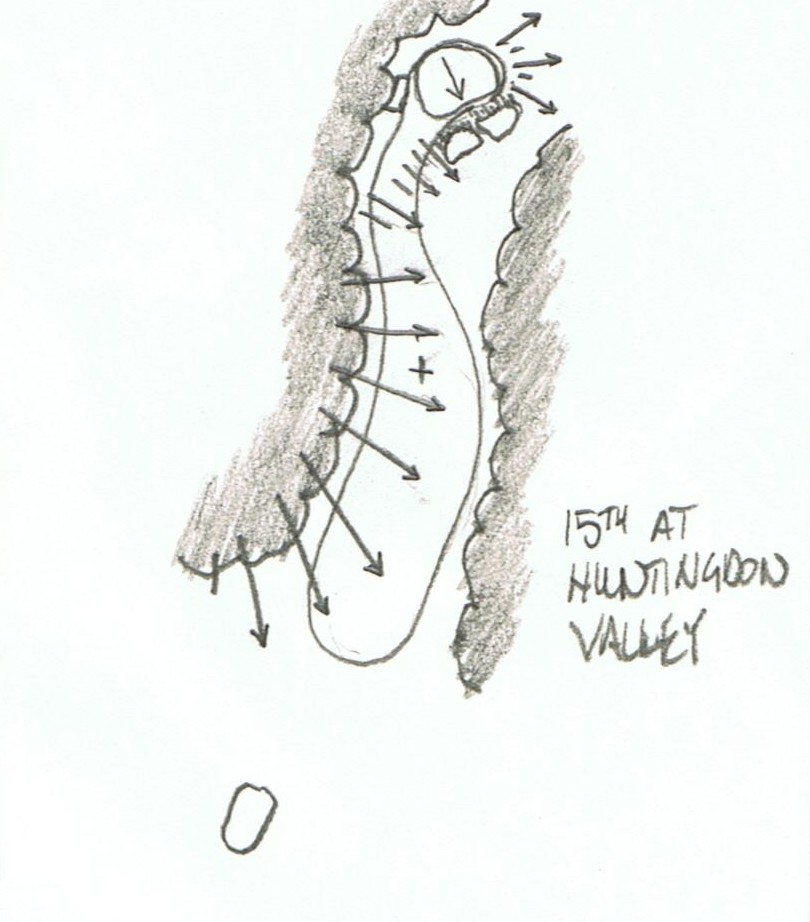
The first example is so simple and so effective. The 15th at Garden City slopes hard right from tee to green, with fescue on either side. The player must hit a light draw to hold the ball on the fairway and then hit a draw from a fade lie to find the green. Both require shaping shots on a hole with no bunkers in play, just the slopes of the ground dictating the play of the hole. I can’t believe we don’t see this one a lot more, its so simple and so effective.


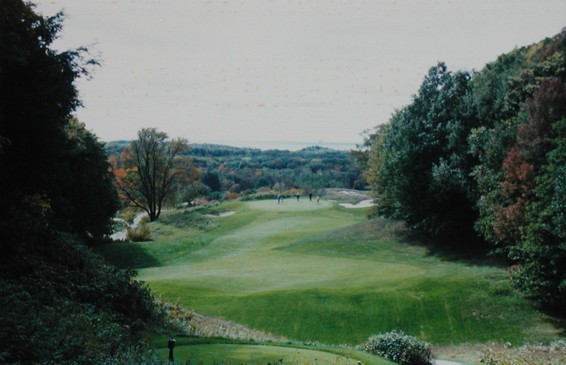
William Flynn took this one step further when he used a more aggressive version of this technique at the 16th at Huntingdon Valley. The slope of the hole falls very hard to the right, but Flynn chose to bend the hole around the trees to the left. You end up with a hole falling to the right and doglegging to the left. You have no choice but to draw the ball into the slope to hold the fairway, and you must hit a perfect tee shot to do it. Then you face an uphill approach from a heavy fade lie into a green that requires a draw, because he angled it to only accept that shot. This is the most difficult type of hole to play, and a very unpopular hole with modern players because they must manufacture a shot under pressure. Very few architects will build this style of hole due to the difficulty it creates.

Sunday I’ll provide two more types and two examples of each again.

Friday, May 05, 2006

A larger ball - this is a new idea that has huge merit!


This from David Feherty who talks about how technology is hurting the game and what he'd do if he were Commissioner for a day:

"I would change the size of the ball. I'd make it .02 bigger. With one fell swoop you would cure a bunch of problems. The ball wouldn't go as far. It would spin. It would be harder to hit straight. It would be harder to hit far. It would be very slightly harder to get in the hole. On the upside you'd bring a lot of old courses back into relevance. It also sits up nicely around the greens. The amateur player has more fun playing with it. I grew up with the 1.62 (ball) and I remember changing to the 1.68 and thinking, wow, this is so much more fun playing with this ball. For the high handicapper, those shots around the greens are difficult. When the ball is a little bigger, it makes such a difference. There's more of it to get underneath.We've done it once before. I don't see a reason not to do it again"

Absolutely the most brilliant idea I have heard to date.

Routing a Course


The 5th hole at Crystal Down, a hole only an architect as good as Mackenzie could find

Routing a golf course is a very subjective skill. Most architects have their own preferences to what they think makes a great hole and in turn the composition of holes that make a great routing. No two architects think alike. No two players appreciate the same routing either.

The architect’s job of routing usually revolves around the natural features available on the property. Architects, or at least this architect, are always looking for natural undulation since it produces the best “natural” holes. Great use of undulation has more effect on the quality of a hole than the careful placement of hazards. This is so important I’m going to repeat it; great use of undulation has more effect on the quality of a hole than the careful placement of hazards. The architect’s job is to use all the available topography to get the best collection of holes possible. Occasionally one exceptional hole must be abandoned to get a series of better holes or to find the best flow for the golf course. Why, because one great hole does not make a great golf course.


The wild a short par four 17th.


An architect starts out by identifying the best sites available for “natural” holes. The best sites for greens such as plateaus, natural bowls, or locations natural framed by features found are immediately identified on the site walk. Ideally the architect can find a string of holes that they can follow in a logical sequence, and this usually helps to start the process. The rest is an exercise in laying out holes, testing a sequence and laying out more holes till a natural progression finally appears on the routing plan. The routing plan is massaged through many options which are tested until the architect finds the best routing. Immediately the architect heads out into the field to test the routing and the process begins again. This continues until the architect walks a routing where they know they have the best collection of holes. The next walk is to plan the strategies and feature work to make the best individual holes. The

What many don’t see or understand in the process is the small things that make a big difference. The long vistas off site that can be “borrowed” or a stunning view found right on the property is easily taken for granted by the player. These are identified early and planned for by the architect. Unless the property is exceptional, the architect will have to use connector holes between the natural holes to find the best routing. Almost every course has a connector or series of connectors, even Pacific Dunes and Friar’s Head has them. Anyone can design a hole that sits naturally in the landscape waiting to be discovered, the great architects are the ones that can hide the connectors within the routing so that you can’t find them.

Part 2 Tomorrow – routing to add difficulty or playability

Thursday, May 04, 2006

Technology overwhelming architecture - Part 2 - The Result?


At 126 yards, the postage stamp is proof that length and difficulty are not related.


Technology killed tennis – will golf be next? Tennis is nowhere near as popular a game as it used to be. Why, because technology changed the game to a point where watching the sport became dull. The change in (racket) technology replaced shot making with the power game. Professional golf has gone through a similar transition. When people stopped watching professional tennis, the participation dropped and has never recovered. Interestingly, participation in golf began to decline the same year the power game began to dominate men’s golf.

Technology is impacting the way we play, but the problems of technology run much deeper than that. While it does matter that we no longer can relate to the play of the professionals, it matters much more to us that technology is changing the economics of the game. Technology in golf is pushing the cost of the game up dramatically, and creating a situation where people can’t afford to play.

Does this affect architecture? Whenever the issue of challenging the impact of technology comes up, the solution always seems to be adding length to retain difficulty. Look at the professional tour – each new course is longer than the last, and much of our great architecture is being dismantled just for length. The problem with building longer and longer courses is that it increases the acreage required, increases the costs of acquiring the land, increases the cost of the build, increases the cost to maintain, and ultimately increases the cost to player. The longer the courses get, the more expensive the game becomes, the less people can afford to play it.

But the problem is not just with the equipment. It lies also with the reluctance of designers and owners to challenge this direction. Everyone has become scared to build a golf course less than 7,000 yards because it will not be a “Championship” test. As Tim Morghan from the USGA suggested at a meeting I recently attended, why don’t we just ignore the elite 1% of the game and build shorter courses for the people who really play the game. I spent Tuesday trying to convince a potential new client to build less than 6,800 yards to meet the real demand in golf and to keep his costs down for a more economical project.

The argument is if we remove length from our design palette, then we’re left with short courses that can’t defend themselves. Until very recently Pine Valley, Merion, Myopia Hunt and Cypress Point all were less than 6,600 yards and they are considered to be among our very best courses. Merion and Pine Valley are two of the hardest courses I have ever played and length is not a key factor to the difficulty of either.

So what can an architect do to add difficulty without adding length? Remember we also want playability so I’m going to ignore the idea of island greens, more water, forced carries, long rough, fescue and fast greens. That puts me at odds with the current trend, doesn’t it?

Part 3 - Defending Without Length: http://thecaddyshack.blogspot.com/2006/08/technology-part-3-defending-without.html

Wednesday, May 03, 2006

Technology overwhelming architecture, Part 1 – The problem.

This is nothing new Harry Colt was one of the first architects who had to deal with the huge changes brought about by the Haskell Ball. Colt altered and expanded many great courses to compensate for the greater distances golfers achieved with the rubber-cored golf ball.

The Golden Age architects saw the problems coming. As they saw the distances of equipment increase, they realized their strategies that were so carefully laid out were in jeopardy. The also recognized that the variety that they so carefully laid out within the round would be lost on lengthening. It is interesting to read the comments of AW Tillinghast, when Tom Fazio was recently praising him for building “intentional elasticity” into his layout at Winged Foot.

“…the fetish of distance is worshipped entirely too often and there should be a quick end to it.” – AW Tillinghast"

Alister Mackenzie was never a strong player and recognized that golf was a game dominated by the dub (that phrase has been used by many of the Golden Age architects to represent a high handicapper). He felt that he was more than capable of testing the good player, while providing an enjoyable test for the average player, as long as the distance between both players’ games stayed reasonable. What he recognized very early was that the gulf between skill levels and distance requirements for both was growing too vast for architects to deal with.

“Something very drastic ought to have been done years and years ago. Golf courses are becoming too long.” – Alister Mackenzie

It was the father of modern architecture who was smart enough to see where we were going long before we got there. William Flynn is one of the greatest tacticians golf architecture has ever seen. He understood the strategies and shot making required to test the best players, and wrote about this extensively. Some of his brilliant ideas will come up in tomorrow’s blog. He realized with the change in technology of clubs and balls that to getting players to “hit every club” (theoretically) would require the back tees to be pushed back to enormous lengths to accomplish this.

“All architects will be a lot more comfortable with the powers that be in golf solve the ball problem. A great deal of experimentation is now going on and it is hoped that before long a solution will be found to control the distance of the elusive pill. If, as in the past, the distance to be gotten with the ball continues to increase, it will be necessary to go to 7,500 and 8,000 yard courses and more yards mean more acres to buy, more course to construct, more fairways to maintain and more money for golfers to fork out.” – William Flynn

He was also smart enough to see that the economic fall too. I was talking with Rick Phelps about distance a few year back when he was teaching me about the gains made on the ball by elevation. I asked a simple question of how do you plan the course for the back tees (8,500 yards) and still provide a similar challenge or game for the shorter tees (5400 yards). He was frank (which I like about Rick) and said you can’t. So how do you design to a widening gulf between skills levels. Tim Morghan from the USGA might have been right when he said “Don’t, ignore the best 1% and the game will be better for it”

The biggest problem architects have is designing around a moving target. Most of golf architecture is based upon distances. Whether is it the use of carry bunkers at the crucial decision distance that create risk and reward or the measured placement of landing areas to set up a hole or bring the natural contour into the design. Distances are important to great architecture, particularly on average or flat sites where the land can’t assist us in dealing with change.

Here’s a great example. Look at Pine Needles where the tee shots once landed into the upslope of the crowned fairways leaving a long iron; they became pushovers when tee shots carried the plateau and got a boost from the down slope on the other side. That’s what architects are facing. Carefully laid out strategies and placement of features are overrun by technology. I’ll give Jay Morrish the last word.

“I’m just trying to figure out where to put the bunkers on today’s courses. I don’t think lengthening existing courses is the key and it just plays into the hands of long hitters like Tiger Woods. I think the only way to challenge them is with angles and placing the bunkers out there long where they hit those drives.
The problem is technology. It’s hard to think fast enough to stay ahead of how far the golf ball goes today. It’s a guessing game and very difficult to uphold the old standards of making golf courses that will make you hit all 14 golf clubs. We are going the wrong direction as far as the long golf ball and it’s a sad situation.” – Jay Morrish


Part 2: http://thecaddyshack.blogspot.com/2006/05/technology-overwhelming-architecture_04.html

Monday, May 01, 2006

The One that Got Away


The par five 11th, lots of width and lots or rock.


I will not identify the site, since this project is still a possibility, but the likelihood is now very small.

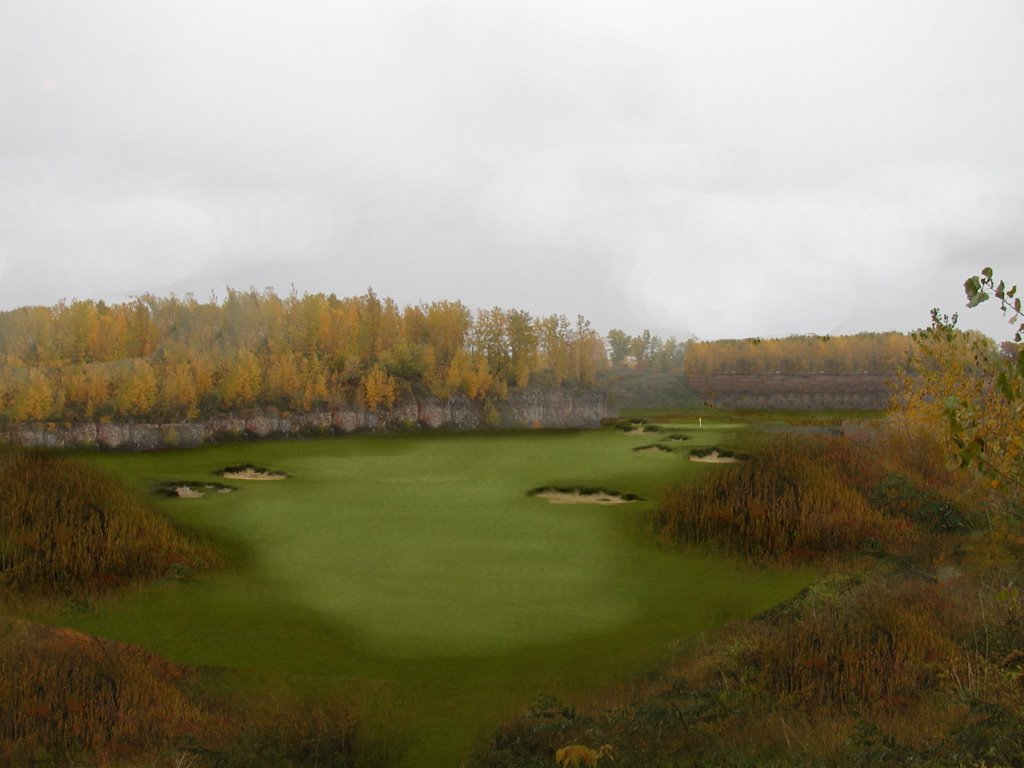
I was asked to get involved with a group to look at the purchase and development of this site. The site is a very large quarry in an ideal location for golf. I’ve seen some great sites through my time at Carrick Design, but I consider this better than all of those. What made the site so special was how all 18 holes would fit entirely inside the quarry. Imagine playing 18 holes off of the top of the quarry, along side the quarry walls, or right into the quarry faces for the entire round. Very few courses can match that drama, and it all of it was natural!


The short par four 8th, over the corner of the lake and the quarry wall, with25 feet of wall in behind.


I was very proud of my routing. I took a great deal of care to weave the holes down into the quarry bottom, through the maze of exposed quarry walls, around the two natural lakes, through the collection of enormous dune like spoil piles, and finally along the miles of quarry faces. I used the internal elevation changes to maximum advantage, providing numerous high tees that looked over multiple holes; yet the course was easily walked. I carefully mixed the par threes from 140 yards to a plateau, to a 235 yard downhill side hill redan. The par fours ranged from 470 to 315 yards touching all yardages in between. I stuck to my desire to have many short fours; one was a very drivable 315 yard hole on the back nine, and there was a cape hole of only 350 yards on the front nine where the green could also be challenged. Adding another at 370 yards and I had three par fours under 370 from the back tees! The par fives ranged from a long 590 yards playing into a quarry end, down to a very reachable 500 yards that was very uphill on the second shot hugging the quarry walls all the way along. Holes played downhill, uphill, side hill; the green sites were completely flat to the grade, up on natural plateaus and even two high in the air to maximize the mixture of approaches. There was a natural punchbowl, a redan, a fall away green site all sitting in the land looking to be used. I was fairly certain that this project could be my “career maker” because I knew I had the routing and the site to do it. But I guess that’s a familiar story in this business.


The 350 yard 5th, a cape around the lake, were you can go directly at the green.


What I have posted is some of the images I had done to show what the project would look like. We used them to secure the investors to finance the project, but unfortunately lost the project because another competing bid was higher for the property. This caught us completely off guard, since we were not fore warned, and it upset me a lot when this turn of events came about. I have been reluctant to post about this project or any other project that I’m working on until they become real projects.

I have spoken to a series of people looking to build new holes, and I have a couple of great prospects, but I’ve been through this enough times to wait until I have project that is going to happen. I will post announcements when things are confirmed, but not until then, that’s my personality I guess.

Saturday, April 29, 2006

Patrick’s Questions Part 2

The 7th at Ballantrae, crowned green, bunkers left, short grass all the way around. My tribute to the duece.


I was wondering if you could discuss bunkers from an architect's viewpoint. From what I can tell, they have many purposes, including giving a hole definition as well as to add strategic elements. Many are supposed to be penal, and for many amateurs they are. But for professionals, it seems like they will sometimes aim to be in them as opposed to the greenside rough since it's more likely that the lie will be predictable. Doesn't this seem to be the antithesis of their original intent? If so, how can this be fixed? I've read that some people advocate not raking bunkers. This is a good solution for match play, perhaps, but not for tournament play.

I’ll let Walter Travis answer with the following quote about bunkers. "The primary idea of a hazard is to punish, to the extent of one stroke, a poorly played shot, and to make the recovery exceedingly difficult, and even by the virtue of the following shot being extraordinarily good. If this end is not attained, the existing hazard fails to fill its functions."

The bunkering that is done today needs to lose the idea of “fairness.” The approach is to make them as playable as possible, not just in the maintenance, but also in the shaping. Most are designed to run the ball down to a good lie and give the player the best opportunity for success on the next shot. We even have a standardization of bunker sand in Toronto for consistency – what happened to adjusting to the local sand? This is a long way removed from the origin which was an exposed area of natural sand where a player had to simply extract themselves in the fewest shots possible. Now the fried egg, ball against a lip, standing partially in or out of the bunker is called bad design instead of bad luck. Bunkers need to return to being hazards that the player wants to avoid them rather than just pretty splashes of white used to add contrast to the lush green. They have lost there meaning in many modern courses.

How course maintenance is crucial to maintaining the strategic elements of a course. For example, here in California, almost all the courses in the Monterey Bay area are soft in the winter from the rain, which means that even if the wind is up, you can't really play the ball along the ground, even if the architect had intended it, since it just won't release from the fairway. Are there design features that make sense when a course is brand new but end up deteriorating over time because it's too difficult or expensive to maintain?


The 10th, surrounded by short grass and the defended by the rolls in the front


Architects account for the predominant conditions like prevailing wind direction in their designs, but anything beyond that is too much to try build into a design. As a player you must adjust your game and sometimes your expectations to shoot the best score in those conditions. I always win money in the rain because of that.

I designed the course at Ballantrae with chipping and putting from the hollows in mind. After a few years the banks of the run offs became very thatchy and you couldn’t bounce the ball off the banks or putt up the slopes because your ball died as soon as it hit. This is where maintenance can remove the most important aspect of your design and there is little you can do other than to ask the super to get rid of the thatch.

The thing that usually disappears is elaborate bunker faces because they require a lot of handwork to keep. This is where architects and superintendents need to be on the same page to preserve the character of the course. If not the superintendent will slowly make changes while your not there if they don’t believe in the importance of the architecture you produced. Most bunker changes occur through inadequate budgets or an internal desire to reduce the maintenance on the course. I would rather remove a few bunkers than lose really interesting architecture.

Friday, April 28, 2006

Patrick’s Questions Part 1


I had a wonderful email from Patrick, that I though would be best answered on line. Patrick was game for this too. I will have to do this in two parts.

If the Old Course is amongst the very best courses in the world, why aren't there more like it? I don't mean re-creating it, but incorporating the same ideas. Everyone who has seen it (I haven't) talks about how different it is from any other course. I have played Rustic Canyon in southern California, and my impression of it is that it's as close to the Old Course as I've seen in my limited experience. I loved every moment of that course. Is there something about this style that prevents it from being built more frequently? Are appropriate soil conditions for such courses uncommon?

The Old Course is all about playing shots. There are very few places on the course where you talk about the unparalleled beauty or the dramatic shaping of feature. The Old Course is on a plain piece of land where the best dunes are actually on the New Course (these are small by UK standards). The greatness of the course is found in smallest and subtlest of contours, the kind that the camera can not catch and most players don’t find “in one round”. This is a course that grows on you as you learn it, and you need to play it more than once to appreciate the courses different strategies depending on which pin you get that day. There is not one way to play any hole at the Old Course – you must figure out the best route yourself, because the architecture doesn’t visually tell you what to do. I think learning a golf course doesn’t suit our short attention span (blame MTV for the next generation being worse). Many golfers want everything clear from the first tee to the last putt. Well that isn’t the Old Course.

When you go around the Old Course you are blown away by how playable it is, how the green contours are far more important to scoring than any other course you have played, how often you have to hit blind or semi blind shots, how you seemingly can hit it anywhere, but you can’t score if you do, that sometimes results seem to be unfair (the “F” word), that a few of the holes are too easy (the Old Course has breather holes).

Yet you can not wait to play the course again, and each time you play the course your respect for the architecture goes up. That defines greatness.


So why isn’t anything built like the Old Course?

It’s partially it’s a fear of criticism, but mainly it’s because of the modern desire for holes that make great postcards over holes that play well. I think it was Sam Snead who called it a cow pasture on his first visit, and I must admit when I first saw the course I was not initially blown away. Most modern architect's could not weather this criticism. Modern architecture strives to give fair, well-defined courses with exceptional playing conditions. Blind shots, severe penalties, unclear strategies, and dull looking architecture can and will bring criticism. Architects are like most people, they have a need to be liked, and that is the failing of many. They play it too safe, and building a course based upon the Old Course would not be playing it safe.

On that note, if Pinehurst #2 is such a great strategic course because of its greens, why aren't similar greens built more often? Your website advocates shaved fringes (which are ubiquitous at Rustic Canyon and lots of fun), but it seems that this is a fairly rare feature.

You could talk about Pinehurst, Muirfield (in Scotland) and the Old Course all at the same time because they are all perfect pieces of architecture that look very plain. Pinehurst is knocked primarily because it is a tough course to photograph, it looks kind of plain and the property is not very exciting. It still remains the most compelling course to try score on where you can’t lose a ball. I built Ballantrae north of Toronto as a tribute to the concepts on “the deuce” and the course is very well liked for it’s green complexes. People do try to emulate parts of the duece, but very few carry the idea through the whole course.

I do think lots of architects have embraced the run offs and roll offs, I just think these areas need to be larger to have more impact on the short game, like Rustic Canyon. The ground game makes for the best and most creative golf, and once you play in Ireland and Scotland you wonder why people like parkland golf in the United States since it’s so one dimensional. I think the short grass around the greens has been embraced by architects and is being used a lot by the younger ones in particular.

Wednesday, April 26, 2006

Par 4 Redans

I was asked for a couple of examples, how about two from the same course, The Creek Club in Long Island.


The "puchbowl" reverse redan green at the 6th feature a high front left all draining through the small opening back right. The bunkers in front are DEEP. Probably my favourite par four of all.


The opener at The Creek Club by Raynor, notice the carry bunker, the deep left greenside bunker and the high right shoulder.

Redans I’ve built


St. Catharines, you can aim left of the bunker and feed the ball across the green. The green slope right the whole way.


I have built a few over the years.

The first true redan I ever built was the 17th at Ballantrae in Aurora. While the concept for the hole was good and the green worked as planned, the hole is too short. The original hole was going to be 200-210 yards before the housing lots got changed in the middle of construction to increase the lot sizes to increase the housing square footage. The hole was forced down to 165 yards (back tees) which allows players to always fly at the green surface every time. It taught me that there is a minimal length for the concept to work properly.

I have built two reverse redans; one at St Catharine’s (the green and fronting bunker at least) and one at Frog’s Breath (where bunkers are exchanged for rock and the hole is uphill adding length - very stunning looking). I have run a few greens away but have not built the feeding grade going into the green up to have the same impact as a redan would have on the approach.

There is no question in my mind that I will likely do a redan green on my next course. There just too much fun to play!

The Redan


The redan at Shinnecock Hills


My favorite hole concept is the redan. I feel there should be a redan green on almost all courses because of the interest it creates for the player. The redan is one concept that favors the shot maker as opposed to the bomber.

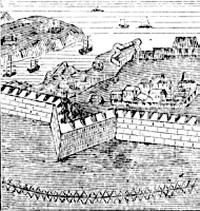
The “redan” can be described as quite an efficient technique in thwarting enemy approaches. The use of this unusual structure has caused many failed attempts at gaining on this position. This description could be describing the old fortification like the Great Redan in Sebastopol Russia, or it could also describe the most unusual and effective defense posed entirely by a green complex at North Berwick.

Horace Hutchinson interestingly described the front bunker complex as the redan. “The redan is a deep steep-faced bunker close to the green, but is of no great length or breadth. The driven ball may go nicely to the right of it and curl round as to lie on the green without crossing the great escarpment of the fortification at all. But it has an aspect of no little terror as one faces it from the tee."

He is right, that the name of the hole comes from the angle of the bunkering and the diagonal they create since they are similar to angle of the redan fortification. But in today’s context the name redan is used to describe the green contours and the concept of a fall away green set on a diagonal. To back Hutcheson up, the French word Redan actually means “jagged notch.” A redan is the extension outward of the wall between two parapets. The extension is projected outwards in the shape of a “V” and the redan is used to describe the extension. The tooth on a saw, if that helps you visualize it.

The redan hole is found in North Berwick and is thought to be a creation of the green keeper David Strath. The redan is a single shot of around 180 yards to a green that falls away diagonally to the left of the hole. The hole is partially blind over a couple of carry bunkers that provide the line. The left diagonal is defined by the “redan” created by the two deep fronting bunkers. The right has three deep bunkers short right and the green falls off sharply all the way around the back.

Strategically the hole is set up by the diagonal line presented by the front left bunkers, and the player must deal with the hazard, by playing over or around as Hutcheson suggested. Where the hole begins to get clever is that the land falls sharply off at the right, and if a player plays too safe away from the left “redan” bunker, they often end up in one of the three deep bunkers. The recovery shot from this position is the worst on the hole. The best position to miss may be long, but this area has some rough ground and you may come up with a delicate lie. The joy of the hole remains the dilemma from the tee, a high fade to hold the green, or a slight draw to feed the ball, either way it certainly is a fun hole to play. The key to the hole remains in a contour of the green that slopes away and to the back and left. Since there is no backstop or upslope commonly used to receive the ball, judgment and precision are put at a higher premium on the approach shot. The green is slightly funnel shaped so a ball finding the surface will be rewarded unless it comes in too hot to stay on the green, but anything missing the green leaves a tough recovery shot.

This green style has been used on par four’s by architects like Seth Raynor and been copied on countless par threes by Tillinghast, MacDonald, Thomas and Flynn just to name a few. Many copies of the redan were built at well over 200 yards since the architect’s like Flynn felt that length was important to retaining the original strategy. The green itself is an architectural technique, and a technique that should be used much more to combat the current equipment. This is one way to take back some of the technological advantage from the one dimensional “bomber”, and give the advantage back to the shot makers.

Tuesday, April 25, 2006

Time on Site – Part 2 – Other Examples


While many people lay claim to the idea that time on site equals quality, I would like to look at a couple of examples for perspective first. I’m not aiming to take sides on this issue, although I will say [for myself] I prefer as much time on site as I can get. For example, I like to edge my own bunkers to get exactly the look I want.

Let us start by looking at the time Alister Mackenzie spent at Royal Melbourne. We know on Oct. 25th he arrived at Melbourne, Australia. We know on Nov. 11th he was still in Australia, consulting at Royal Sydney. We know he was in New Zealand on January 1st. We also know that he consulted with many of the great courses while there, so that his time was well divided between different sites. So how did Mackenzie get everything done so well at Royal Melbourne in that short period of time? The answer is he didn’t, he relied on Vern Morcom and Alex Russel to get the job done while he couldn’t be there and after he had left Australia. I looked all day to find the exact time spent on site but I could not, but I do remember “a few weeks” was the description in one article I found years ago.

At Pacific Dunes Tom Doak’s plan was to visit the site every three weeks or so all the way through construction. He summed up his perspective well with the following two quotes from Dream Golf by Steven Goodwin (out fairly soon and a good read), “I work best when I’m working fast and am excited about what I am doing, but I understand that construction can’t really move that fast. When I was on site every day I would get tied up emotionally on every little detail of our projects….” So instead of being there daily, Tom choose to have Jim Urbina and he would join Jim for four or five days at a time. Each visit he would review the previous holes that were started during the last visit and would set up the next group of holes for Jim to work on. Tom said about this arrangement “I found that being away from the site off and on gives me a better perspective on how we’re doing…”

When Doug and I worked on Muskoka Bay, we went up every Friday for two straight years. I also made some additional trips during golf construction to make sure we kept on schedule. We flagged out all the tree removal, directed all the blasting, organized all the sand capping, placed all the tees and greens according to the space left by the outcrops of rock and trees. We even moved an entire par three during the clearing. We also approved each bunker and I was on site to approve every green contour in the field. Near as I can tell through my notebooks I was on site just over 70 times and I averaged 10 hours on the site (not including traveling time) each visit.

I’m not sure if one continuous period of teaching and planning is any better or worse that a cluster of days every few weeks. Whether a weekly visit is enough or whether daily supervision leads to a better product. I’m still inclined to think that time on the site makes all the difference to the quality of the course, but Tom’s point of being off site some times to avoid over thinking and to recharge the mind is a great idea.

Monday, April 24, 2006

Time on Site – Part 1 – Stanley Thompson at Capilano


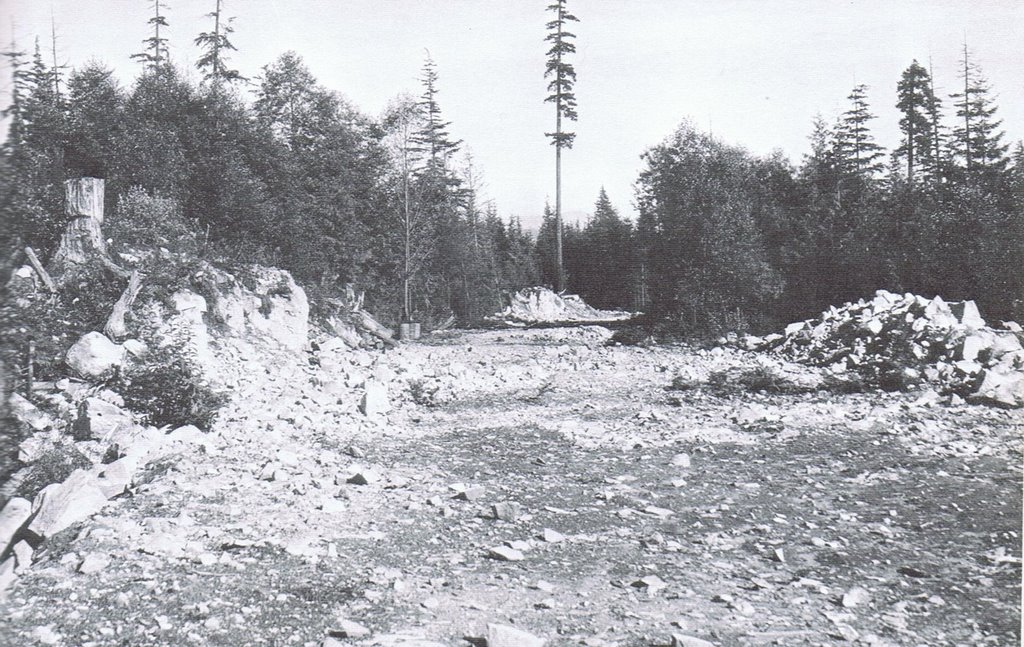
The 15th during construction


Stanley Thompson sent a January 2nd, 1936 telegraph to John Anderson discussing his visit to Capilano, “Expect arrive Vancouver fifteenth instant spending several weeks west coast stop. ………” He obviously spent three weeks working on the construction and seeding of the course. I think each trip was likely of this duration due to the travel time and the limited number of visits he made.

His fees were $732 per visit “including all traveling expenses.” Each visit require four nights on a train in either direction. So three weeks actually meant 12-13 days on site. An interesting note was from those fees had commissions he received from the purchase of goods for the course (like grass seed) deducted from the total. He was not handsomely paid for Capilano and in fact had to send a letter in September 24th, 1938 still trying to collect $253.75 for the last payment.

In a letter on March 9th 1936 he states, “….I am coming to Vancouver in the end of March and I will spend three or four weeks during seeding time to supervising same and flashing the bunkers and greens. This will put the course beyond the tampering stage as regards to the architecture." Again it is clear that Thompson has from 12 to 18 days on site on this visit.

This is supposed to be the 6th hole during construction, but look at the photo below and see if you think it really is the 15th green.


We know Stanley Thompson went to West Vancouver in the spring of 1933 to inspect the site “and had his course design on paper.” Clearing began immediately under the direction of Stan Conway (they first cleared centerlines and worked out), so we can assume this trip began construction. When we look at the pay days we discover there is no record of him being paid in 1933, but he was paid in April 20th 1932. I personally think this is an error in the book Hathstauwk since he first met Taylor at the Waldorf Astoria in July of 1932. The pay date should read April 20th, 1933. This was obviously the visit to the site that produced the routing of the course. He submitted construction plans in June of 193 (this did include irrigation drawings - clearly referred to in another letter).

Using the notes for pay, his next visit came on October 24th 1934. The clearing at Capilano was absolutely brutal and I would bet that little actual course construction began until 1936. The site had to be cleared of massive trees (some of the stumps can still be seen and are 6-8 feet across. The site was also full of rock outcrops and strewn with boulders too. Just cleaning up after clearing must have been the bulk of the work judging by the photos.


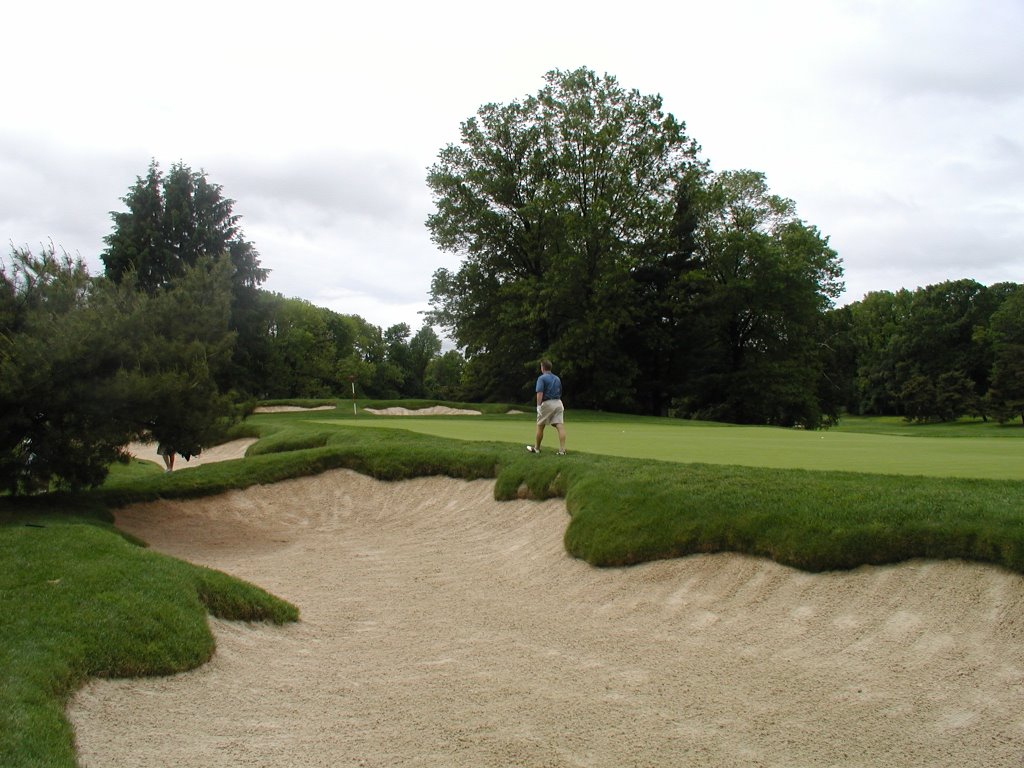
The 15th at capilano today


His next visit was November 9th, 1935, followed quickly by a visit on January 31st, 1936. He was fully the golf course construction and was supervising the green contours and bunker shaping on these trips. He wrote 12 pages of Finishing Notes on February 4th, 1936 that outlined all the work he wanted completed on each hole to finish the golf course. Much to my chagrin, he included a great deal of suggestion on planting and even produced an extensive planting plan for the course. Play began in the late summer of 1936.

Near as I can tell Stanley only visited the site 4 times, once to route the course, once to supervise clearing and twice during the golf course construction. He spent about two weeks on average on the property for an estimated total of 60 days.

Sunday, April 23, 2006

Doug Carrick - Thanks


I thought it was a good time to talk about how I got to this point. I have made it very clear how my father has helped and influenced my desire to be a golf course architect. I’ve talked a lot about my current influences on what I think about architecture and what I want to do now that I’ve gone solo. But the one thing I have neglected to do is thank the man who made it possible.

Doug Carrick and I first met when I asked him if we could meet on one of his construction sites (King Valley) to see what he was building (I’m still quite fond of King Valley and it remains one of my favorite works that he built). It was my first time on a golf course construction site for me, and Doug let me follow him around for a half a day. Doug and I kept in regular contact for about three years and I was waiting for an opening (hoping to get hired). Finally Doug hired me in 1989 to come work for him, first as a draftsman, but fairly soon after that he began to introduce me to construction projects. In the first 5 years Doug spent a lot of time teaching me what he knew about design and helped me understand what I needed to know about construction and contracts. I enjoyed those years the most, everything was exciting and new. For the next 5 years my role expanded as we got very busy, Doug allowed me to handle most renovation and got me involved with supervision of some of the new projects too. I also buried myself in learning construction, construction details, specification writing, and finally contracts. I spent the time to be the expert in the office in this area. Through all of this Doug was always very encouraging, and to his credit was willing to listen to new ideas.

Over the next five years the office grew, two more were eventually hired, and the business changed growing larger. As I look back in hindsight, when we became an office of four it was also the time when the work became more segmented and the interoffice collaboration stopped. It was not as much fun at Carrick Design anymore – and this was a factor in why I eventually moved on. I stuck mostly to renovation work because I enjoyed the autonomy, and Cam and Steve now handled most of the new construction. For the last two years I made the effort to try take things back to the way it was before and actively worked with Doug on Muskoka Bay and Frog’s Breath. We did everything together and I must say this was two of the most satisfying years I spent with Carrick Design. I enjoyed Doug’s company, I enjoyed the interaction between us and I enjoyed what we built. I also enjoyed rebuilding a little bit of that lost relationship that we had through the earlier years. I’m grateful I waited two more years to go to have that experience with Doug again. I simply enjoyed being with Doug on site.

So to Doug I say thanks and I owe you a debt of gratitude.

Saturday, April 22, 2006

Weekend Schedule

Sorry about the late post, but I'm into my second day with a hockey tournament. We're 3 and 0 and that is why I posted late today. I may be late tomorrow unless I get something done tonight.

Ian

The Flow of Merion – the best in golf


The difficult approach to the 11th


I have become obsessed in understanding how the flow of a golf course influences the way you enjoy a great design. One example is how Cypress Point was a slow build to a wonderful Oceanside climax, to me that reminds me of music or a great book. Where I’m more interested is how to use flow to effect the way a player thinks.

Darwin was a fan of Hunter’s book ‘The Links’ – but in the book Hunter argued that the 10th at St. Andrew’s (I believe it was 10th or maybe the 9th) was great golf hole. Darwin said he couldn’t possibly believe that, it was a non-descript breather. But Darwin said it would be a crime to touch the hole, it came at a natural point in the round (between some very challenging/confounding holes coming in and then going out) and its place in the greater scheme of the golf course was perfect. His thoughts are similar to Simpson’s who believed that the ideal golf course must possess at least one bad or odd golf hole

This got me thinking of Merion, a difficult start, a breather or shorter stretch, and a big nasty tough finish. I was at Merion last year and there is something special in the way Wilson has presented his eighteen holes. I was taken by the way every hole fitted together, but more so about how the course unravelled like a three act play. The first six holes are a build of difficulty to the 5th and 6th, where precision is paramount. He then takes down the distance with a run of short holes which are fraught with difficulty and lots of options. It is the thinking part of the course. It also presents the most pressure for a good player, since good players feels they should score well and gets really dejected when the inevitably drops too many shots. Finally Wilson comes in with a really tough finish getting progressively harder to the extremely difficult 18th. Each shot is more difficult than the last finishing with the iron to 18. The pressure and build to the final shot is almost epic.


The bunkering on the 3rd


Merion left me wondering if this flow happened with the holes just working out that way, or if this was an ingenious technique to mentally test and manipulate the player’s emotions. Most architects typically try to build the round like a good story leading to a climax. There usually try to build through moments of excitement interspersed with fun holes (peaks and valleys) along the way; all leading to something more dramatic or clever at the end. Merion’s lessons are very poignant and very eye-opening in regards to flow. The next time I do a routing I will test the flow as well as the holes to see if I can offer something unique.

Friday, April 21, 2006

Collaboration


Pine Valley, the greatest collaboration in golf


I had a recent chance to play a course that I still think is the best I have seen. The day I was set up to play, was during one of those periods where my game was just not sharp (and I had very few answers for it). I showed up in the morning to find out my caddie had been caddying at the course for 40 plus years. I made an unusual choice for me (I don’t give away control easily), and said you not only have my bag but I’m also going to let you make every decision today too (never done this before). I told him I would like to spend the round looking at the architecture, and if there is something you would like to show me about the course, please take the time to point it out to me. That was my second smart move; my caddie pointed out many things that I had missed on my first trip, primarily by looking backwards to understand the influential slopes. They were more apparent backwards as it turned out. I had also told him right up front that score doesn't matter, and all I hoped for was a couple of memorable shots that I could fondly remember. At the first tee he looked at me with a great deal of curiosity and suspicion, but proceeded to hand me clubs, which I simply swung till I was done all 18. I had more great moments than I would have expected; but more importantly I found I had simply soaked in the day (and most importantly the nuances of the course).

This wonderful experience got me thinking about the value of collaboration in golf beyond the player caddie relationship. The obvious relationship is the architect and shaper. Everyone knows that an architect is great assisted by the abilities of the shaper. In many cases the shaper has more skill than the architect and spends his time making a bad architect look good. In the ideal situation they become co-designers where the architect brings the way he wants to dictate play and a concept of what he want to see. The shaper brings an eye to how to lay this concept in the land and how to make the adjustments to the land appear natural. I can name every good shaper I worked with for the last 15 years and how most take their coffee.

The next thought is the great examples of collaborating architects and the great work they produced. Pine Valley is the site of the greatest known collaboration in Golf Architecture history. Look how many great minds contributed to such a great course. George Crump may have had the final say on what we know as Pine Valley, but the ideas of so many great minds, help make up the greatest collection of holes on one course.


The 10th at Friar's Head, a great par three


The second type of collaboration is of two architects who choose to work together to make better courses. Thomas and Bell, Colt and Allison are two of the greatest teams that come to mind. There is no question in my mind that Crenshaw and Coore is the leading architecture firm of our current era. The reason for this is that Bill and Ben not only trust each other, but they trust everyone else’s instincts who work for them. They allow the creative people that they work with enough room to bring additional ideas to the design. That is why they build better work than other firms.

So why do so many modern architects have such a need to lead the company rather than to collaborate? Dana Fry has suggested it may insecurity, I think it is the opposite reason, ego. His office is well known for their charette approach to designing golf courses. The layout that has the best routing gets built regardless of who routed it, or if it was worked on by a series of different people. Yet many other architects control it all. I left Carrick Design because that was Doug’s approach, we were allowed minor imput but that was really it. I don’t think it was insecurity, I think it is more likely that he become so sure of his design ideas that he was not interested in exploring other alternatives. Before you dump on Doug or others in that group, you must realise how many great architects did operate this way. I know through a couple of anecdotes that Stanley Thomson was not interested in any suggestions from his staff. Like everything else there are two ways to do things, I myself would enjoy the opportunity to collaborate with another architect, it would be another great learning experience. Others perfer to go it alone.