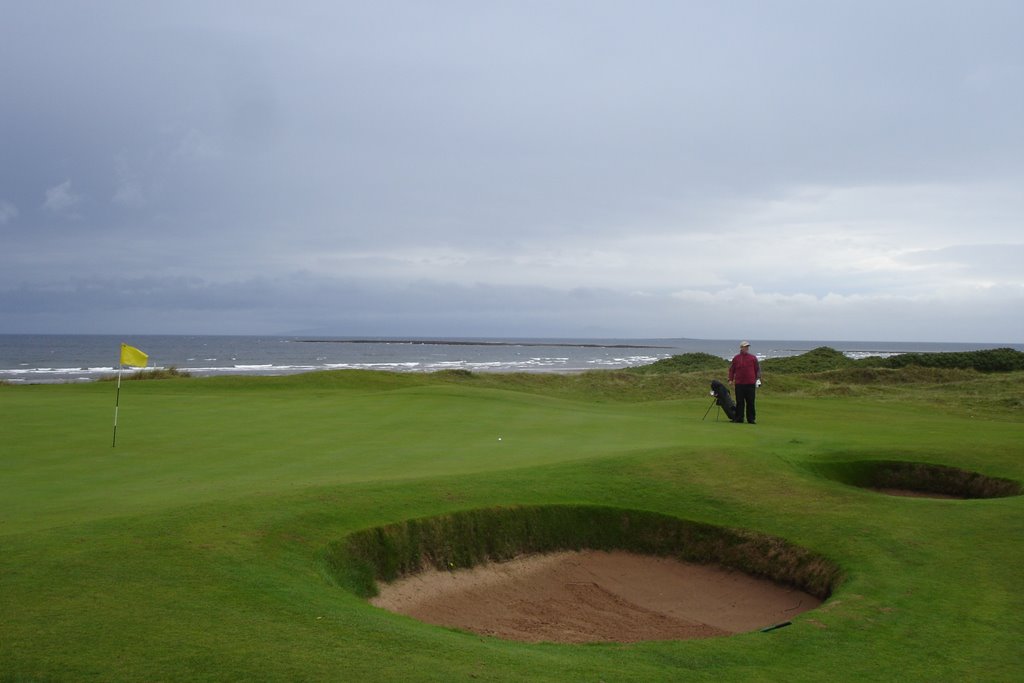
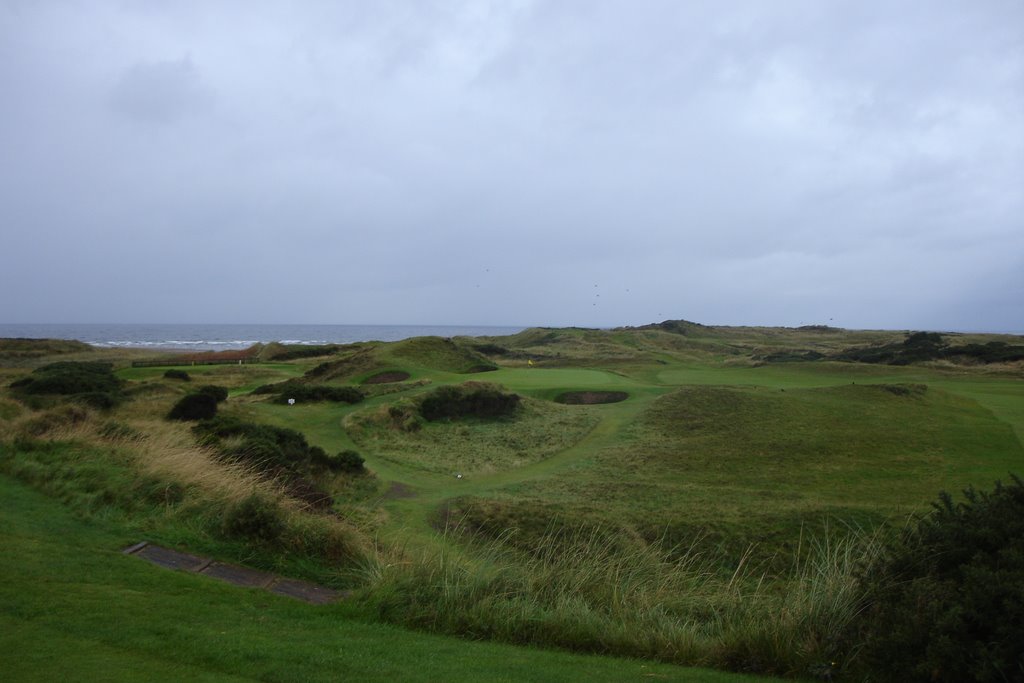
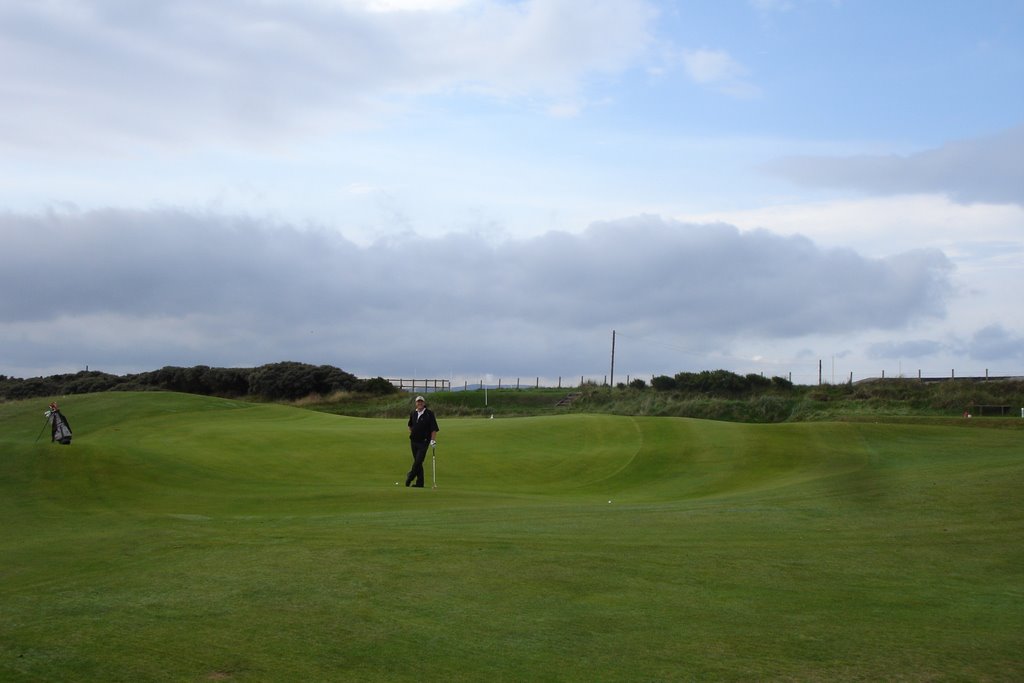
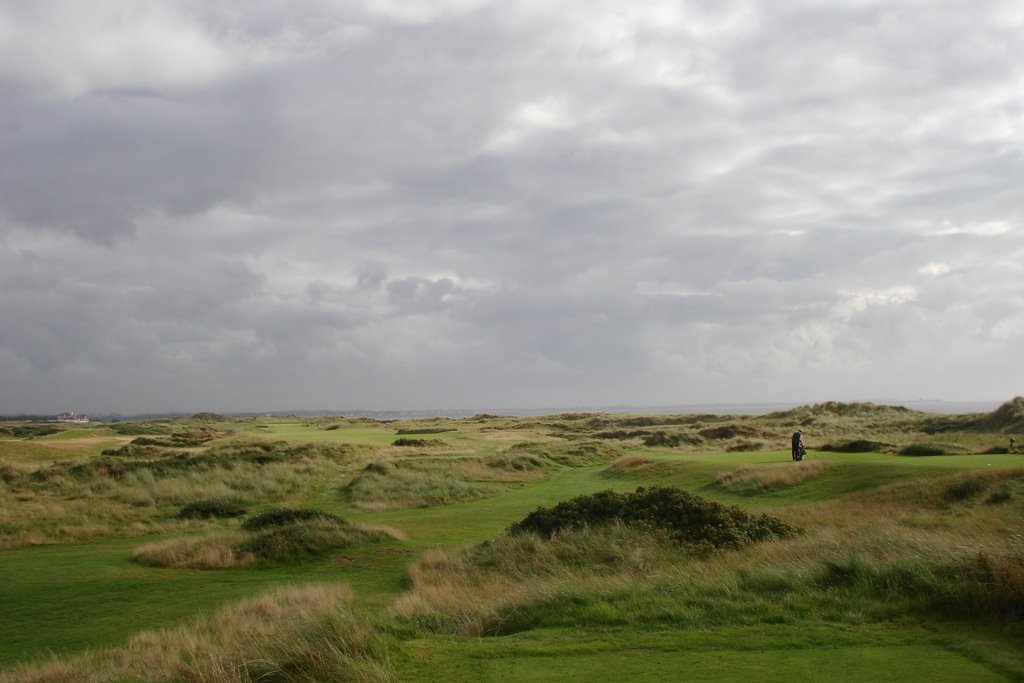
Monday, October 30, 2006

Bunkers Week – Part 8 – Following the Current Trend?
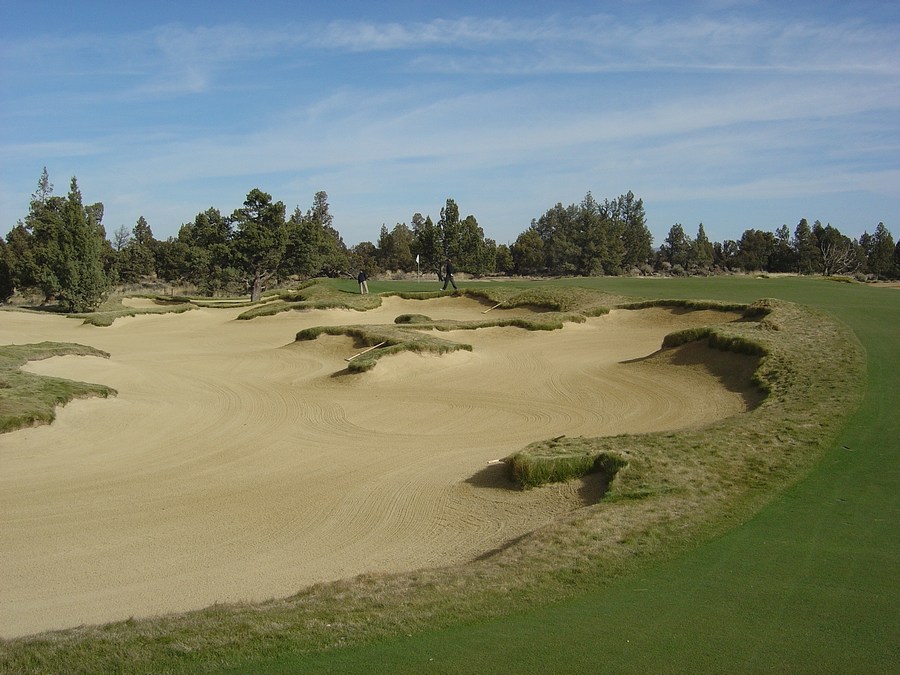


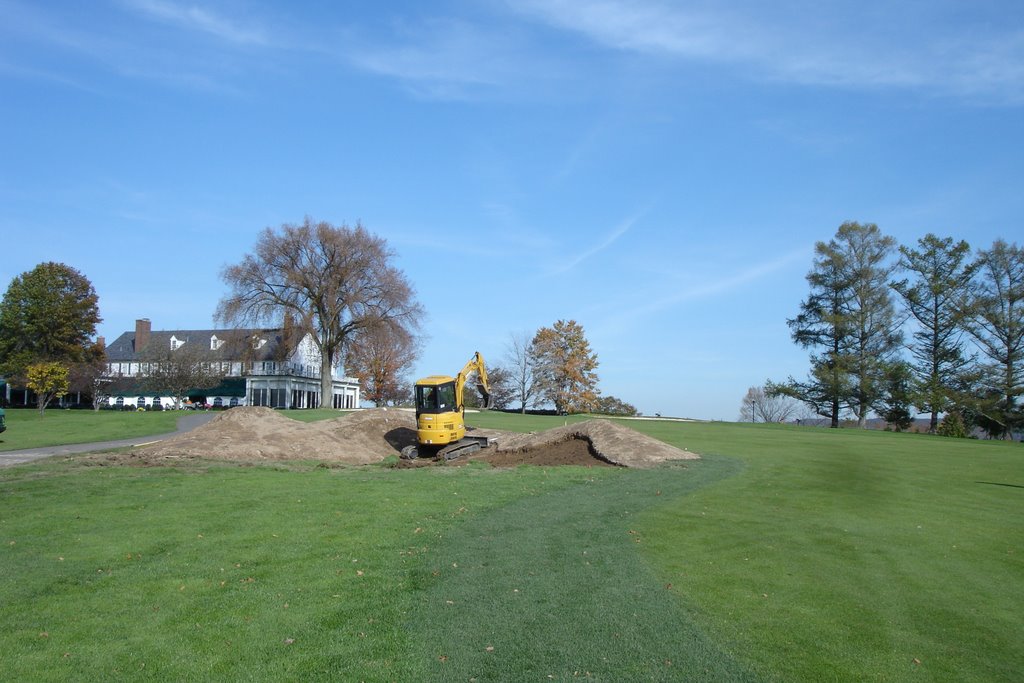
Pronghorn by Faz


Imitation is the sincerest form of flattery…..in golf it’s also a great way to tell when a trend has become old.

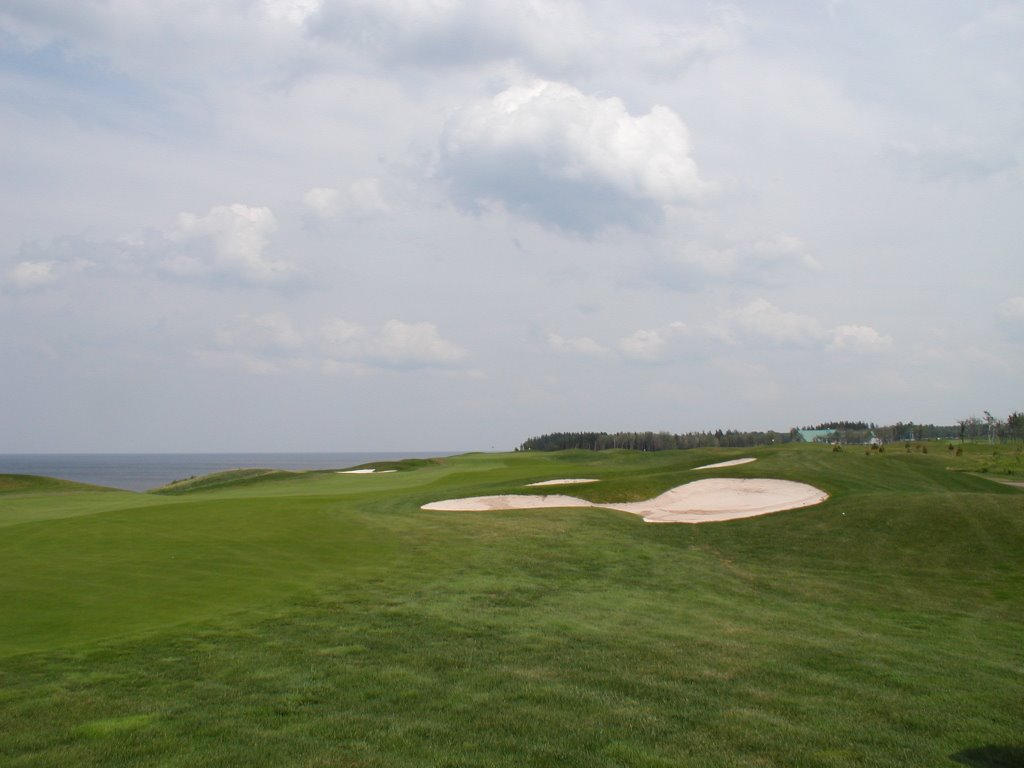
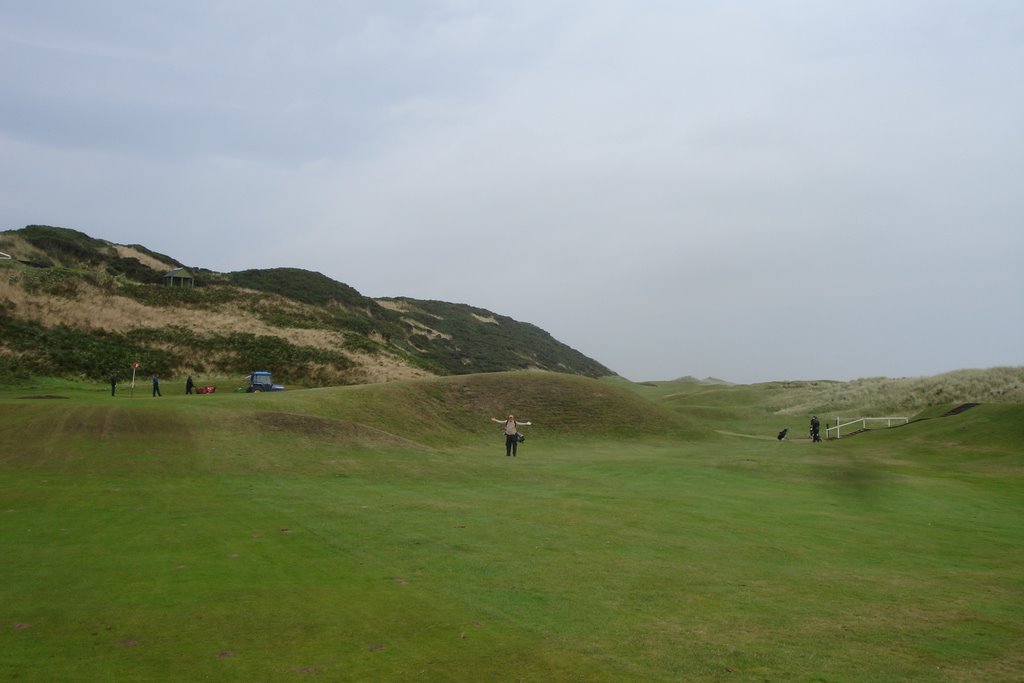
I really saw some interesting picture of a course called Pronghorn by Tom Fazio. It started off when a friend sent me a link to point out how much better the work is than the work done at Coppinwood. Visually the work is a feast for the eyes and impressive, but something struck me right away. I couldn’t get over how much they looked like the work of Bill Coore. We have all been impressed by the work of Coore and Crenshaw at Sand Hills and then Tom Doak at Pacific Dunes. I think everyone realized how popular these projects were and wanted to use the same technique to draw attention to their work.


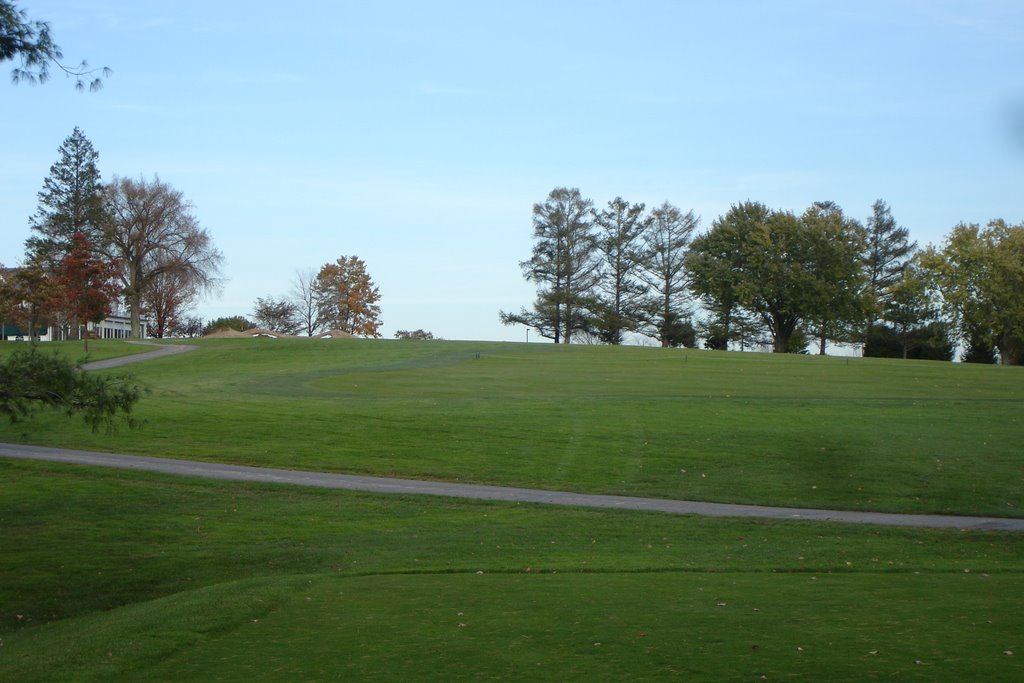
Erin Hills by Hurdzan Fry


Just look at Erin Hills by Hurdzan/Fry/Whitten, they went as far as hiring Jeff Bradley who created Sand Hills and Rod Whitman who shaped much of Friars Head. The work again looks nice, but why didn’t the owner just go out and get Coore and Crenshaw to do the project?

The new #7 course by David Kidd has rough edged fescue faces although simpler in form still quite similar and obviously influenced by Doak’s work at Pacific Dunes. The pictures I saw advertised [when in Scotland] of the renovation by Tim Liddy to the Dukes course has bunkers very reminiscent of the work of Coore and Crenshaw too. They even had a former intern from Doak’s crew heading up the work. I even expect there will be a carry over of Sebonack to a new Nicklaus course. I think we’re now getting too much cross-pollination of one style. I’ve heard a dozen guys say this is where they want to go with their new course.

What I can’t get out of my head is the fact that this “look” is now appearing everywhere. I’m not questioning the use at any of the courses but think about how often this is now being built. It is only a matter of time for this look to appear in places where it doesn’t fit. I already question the look at one of Coore and Crenshaw’s projects where I personally think something else would have been appropriate.
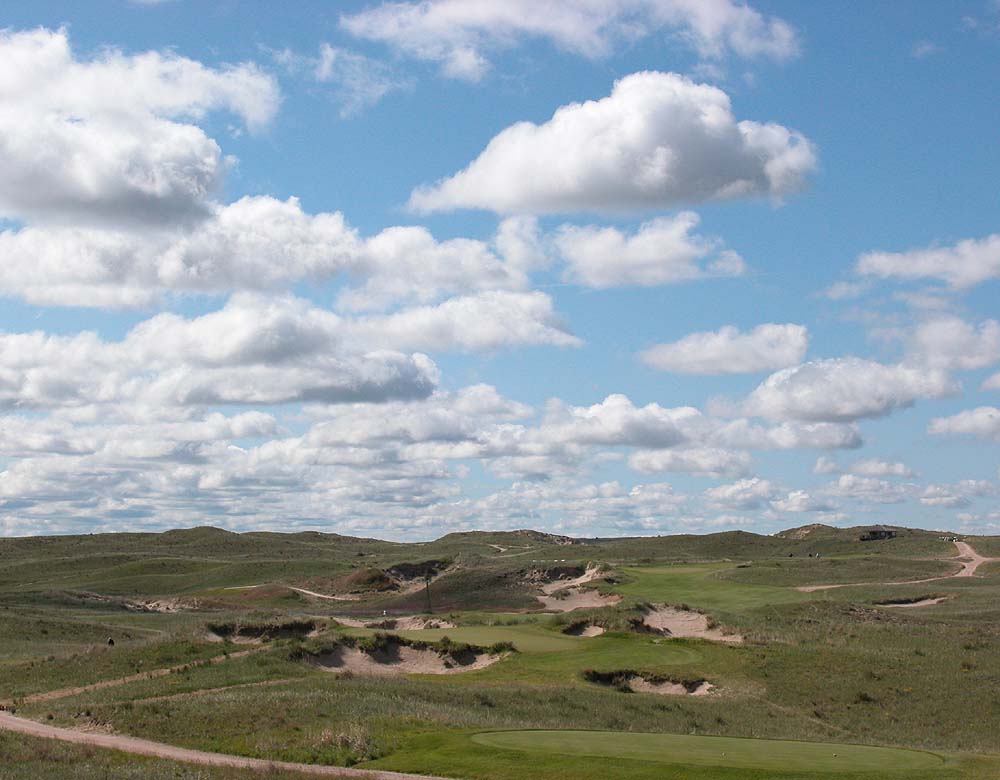


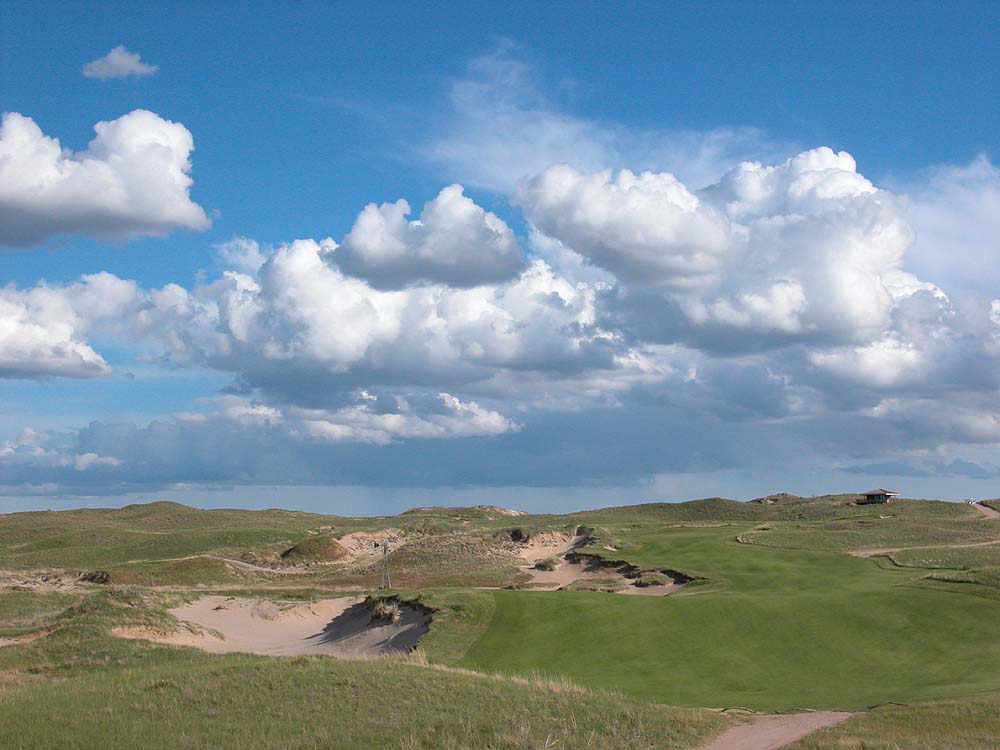
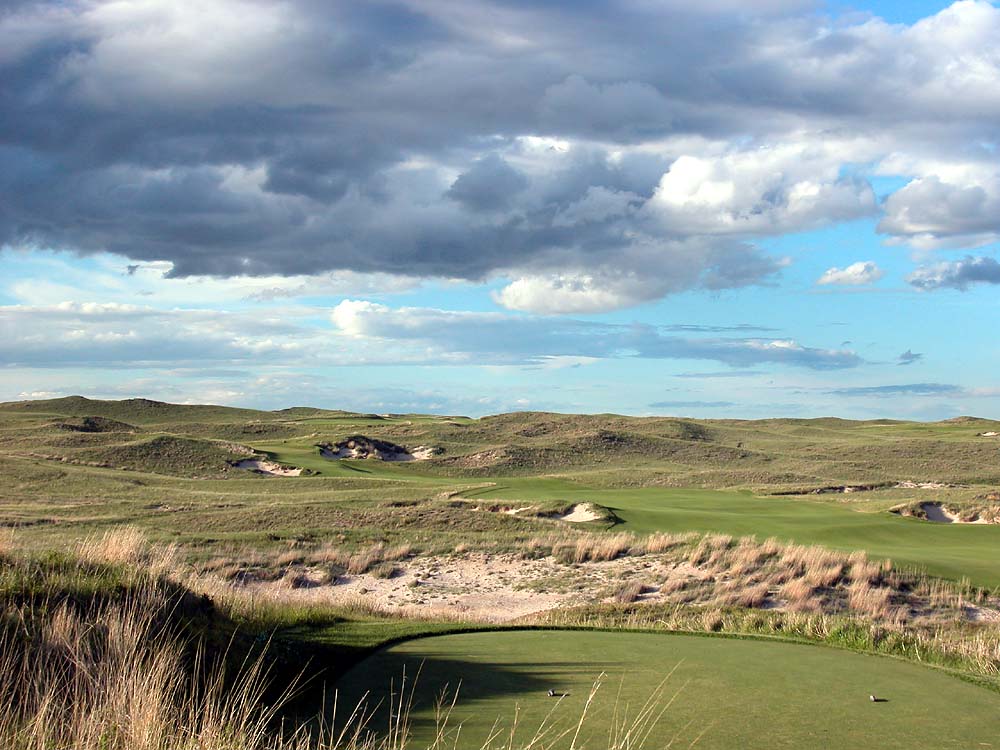
The original, Sand Hills


I have even wondered if it might be time for Coore and Doak to show us something new in the way of a style [not the playing characteristics - just the look and feel]. You know what I love their bunkers, but for me enough is enough. Sand Hills, Pacific Dunes and Friar’s Head blew me away. Erin Hills, Sutten Bay and Pronghorn do not. Not that the work isn’t as good, but I’ve seen it done and it’s also too close to the original to have the same impact. I really thought at the time that the original work was innovative and creative and it pushed me [and other architects] to see more and try to be more creative in our detailing. But like the railroad ties of Pete Dye, once everyone starts to produce this look, the impact is gone. For me, [while I might have previously liked to have worked in this style] I know that I will build something completely different because of the popularity of this look.


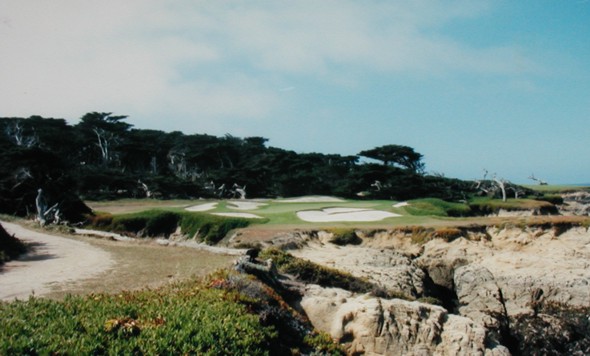
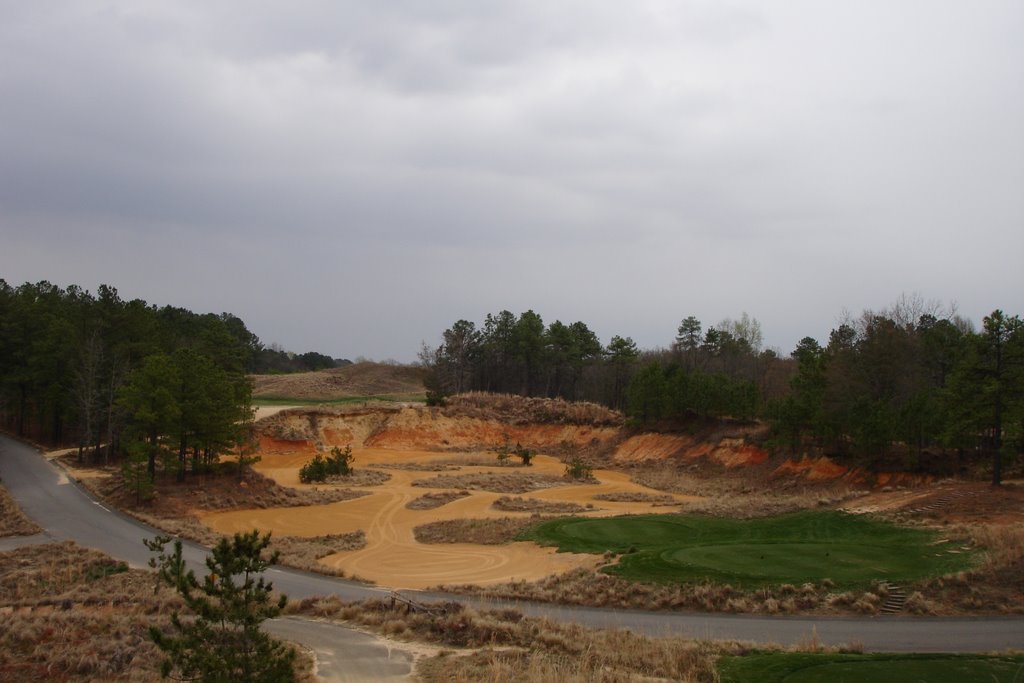
Hidden Creek by Coore, do these bunkers work as well in this enviornment?


I think it’s too bad for Doak and Coore, since just like Dye, once they get so regularly copied it actually takes away from the impact their work currently has. It’s never been good for golf architecture when a certain style becomes fashionable. I still get a joy from the variety found in the Golden Age architects. I should get the same joy from the creativity of this generation of architects too.

We need more variety in our bunkers.

Friday, October 27, 2006

Scoregolf.com article on Ian Andrew Golf Design

Robert Thompson has written an article that captures where I am in my first year of business. He knows me very well and captured a lot of my personality including his comment about me being a glass half empty guy. I like to think I’m cautious but even my wife reminded me that I always assume the worst to avoid disappointment. Funny thing is when I go to interview I’m always feel so confident in getting across what I can do. Sometimes these articles make you realize something about yourself you don’t want to admit that’s true.

Here’s the article:

http://www.scoregolf.com/articles/xx-column-robert-thompson/Building-his-place-in-golf.cfm

Bunker Week - Part 8- Building a Travis Bunker


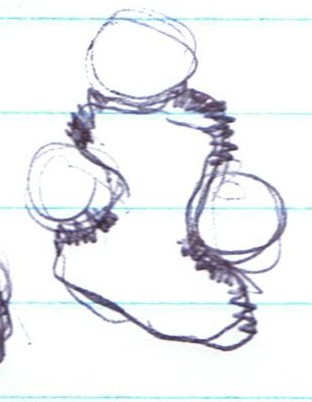
The plan and layout for the bunker


I thought it would be fun to watch a bunker get built one stage at a time.


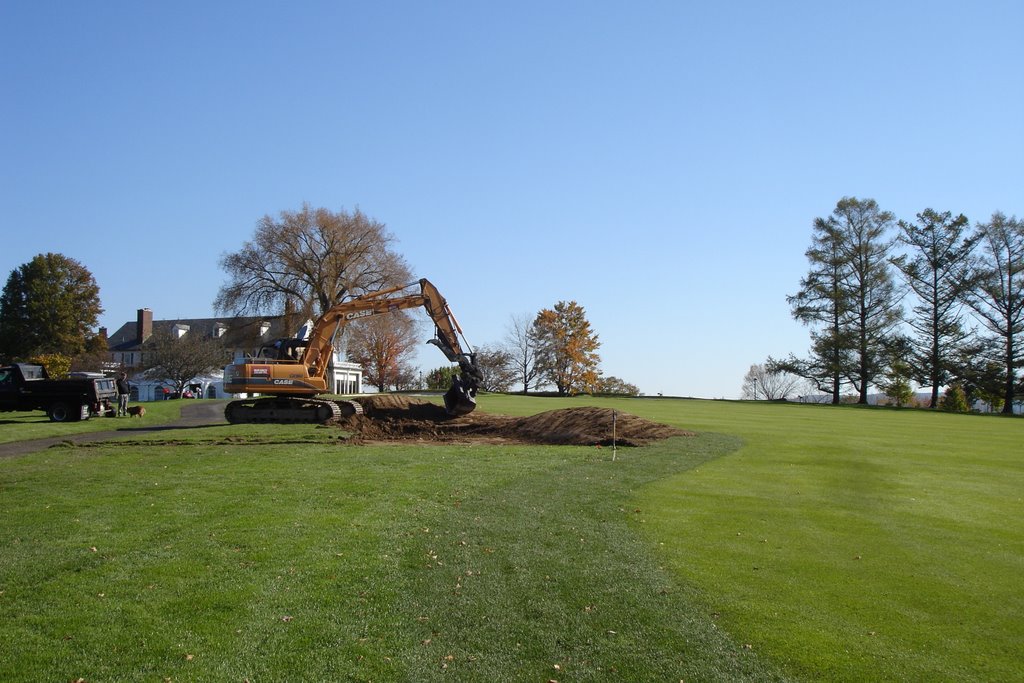
1 hour in.


Before building a bunker the sod is stripped. This is done so the bunker is built only with soil. The reason is that the sod will break down and the mounds will settle uneven if you don’t do this. Before construction the Travis mounds are laid out on the ground and all fill required comes from the interior.


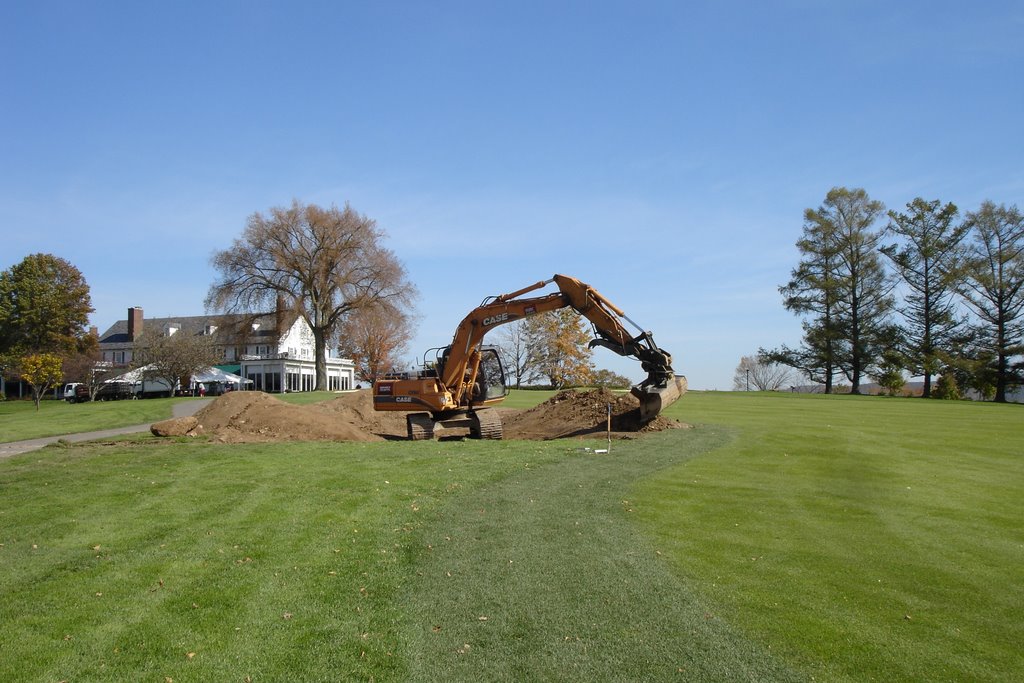
2 hours in


The excavator takes the place of horse and pans to stack up the fill about four feet high in each mound location. Each mound has its own unique “mountain range” like shape. The key is a top heavy mound that looks like dripping ice cream to get the Travis effect. The fill is placed in lifts and pounded with the bucket for compaction. A bulldozer will not get the right forms.


3 hours in


Once the three mounds are in place and packed. The next stage is to build the low transitions between the mounds to tie all the forms together. Once done, the cavity or bunker interior will be formed to create a smooth bowl shaped interior. A real Travis bunker was flatter, but this bowl shape is done for quicker drainage and to help keep the ball to the interior.


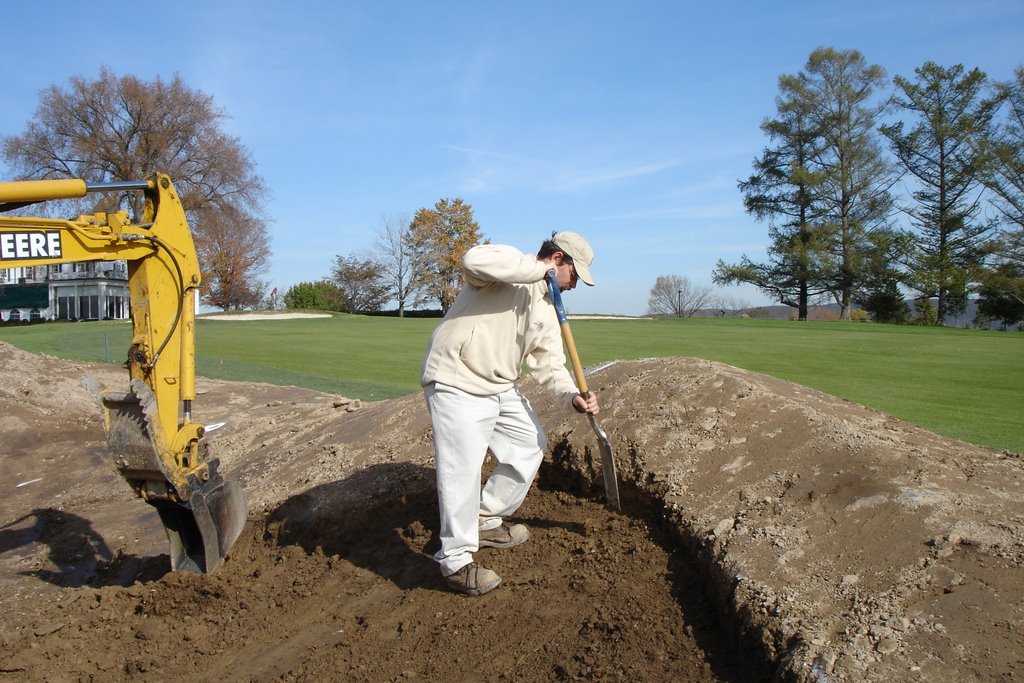
5 hours in


The bunker lines are cut into the interior by hand (by me) to create a 6”- 12” lip that will create the bull nose edge which is desired for the shadows it creates and the old fashioned look it provides. One additional note is that most Travis bunkers were grassed to the bottom, but like most clubs, this club needed to be able to see the sand from the tee. This project would not have proceeded without this concession on my part.


6 hours in


The final picture shows the mini-excavator cleaning out the interior ready for packing and tamping to get a perfectly smooth finish. If you don’t get a smooth bottom the raking will begin to destroy the interior and contaminate the sand right from the beginning. If the interior is bad enough, the bunker will hold ater too. The drain line will be excavated out from the bottom and the drain will be backfilled with the bunker sand. This can be choker sand or pea stone depending on the situation too. The white plastic was added to show the top of the sand faces and was used to check the bunker lines from the tee which is about 20 feet lower than the bunker.


8 hours from start


The bunker exterior is then raked and sod with a fescue/bluegrass blend so that the mounds can be grown long in the future when all the bunkers are done. The sod is not trimmed and allowed to extend into the bunker where it will be left till it knits in. Finally the sod is trimmed back to the bottom of the bullnose and the interior is prepared and tamped back to the new drain line and bunker sand is placed in the bottom and packed ready for play. (There are no pictures because of the rain that came when this was to begin)


From the tee (click onto the photo to enlarge)


That is the basics to building a Travis bunker - or at least one style of his bunkering.

Architects note:This was a test bunker for the club. To be accurate the sand should not be flashed up - but the club was insistant that the sand faces be raised on this bunker for visibility - the club is now realizing the location of the bunker is clear from the mounding and is reviewing whether the sand should go to the bottom as intended when the full bunker program is begun next year.

Thursday, October 26, 2006

Bunker Week – Part 7 – Visual


The movement and drama of Thompson


Bunkers are the most visual and memorable of all the elements found on a course. So much so that some including myself would argue that too much attention is spent on the aesthetics of the bunkers. This may be funny considering most feel that one of my greatest strengths is the quality of my bunkering. Almost all golfers and critiques revolve around the look and playing characteristics of the bunkers and often fail to notice the quality of all the other elements that make up a golf course. A great set of greens are far more important than great bunkers, but everyone is drawn to evaluating a course by the bunkers since they are far easier to judge and far more obvious to the eye. Since bunkers are so obsessed over, particularly the aesthetics, let’s take a look at that aspect.


Elegant simplicity of Travis


The one wonderful impact of bunkers is there are so many possibilities. We have the rugged look of Coore and Doak, sod walls of the links, the wild fingers and bays of Thompson, Tillinghast and MacKenzie, the rugged faces and depth of a Colt bunker, the engineered steep walled bunkers of Raynor and Banks, right through to the dull maintenance and player friendly bunkers of modern architecture. Again, there are ven more from the raw scars to sand blowouts to the inverted bunkers of Travis and Emmet; I really only touch the surface with this list too. So we have established that the actual options are limitless. So why do some projects like Pacific Dunes and Sand Hill work so much better that Atlantic or other modern projects. Or a better question may be, why do architects only make one type of bunker when we have all this limitless option to choose from (that answer is comfort). The answer is that most great bunkering has more to do with reflecting the nature of the site than it does with even with placement.


The movement and artistry of macKenzie


Alister MacKenzie said, “All the artificial features should have so natural an appearance that a stranger is unable to distinguish them from nature itself.” When adding a bunker to a site, you have two options, you can have it blend in which will always work, or you can have it offer a contrast which when done well is spectacular. When done poorly it is a disaster! The work of Raynor and Banks offers an example of contrast that works well by contrast. Why does there work fit? Because they tie everything back into original grade despite the severity of the hazard form. The remainder of the hazard is a s natural as can be. Where it gets more interesting is the chocolate drops of Travis and Leeds that still are spectacular despite their obvious complete contrast. That is a harder thing to explain other than to point out that each feature is hand-made and none look quite like any other. The reason modern features look lousy is they are repeated endlessly because a machine has that ability. Robert Hunter describes this well when he said “All artificial hazards should be made to fit the ground as if placed there by nature. To accomplish this is a great art. Indeed, when it is really done well it is, I think it may truly be said a fine art, worthy of the hand of a gifted sculptor.”

In my experience only a handful of architects have been able to create bunkers that blur the line between strategy and art. The greatest of all was Alister MacKenzie. He was able to comine artistry, with scale, a little intimidation, a tremendous amount of strategy and the greatest blending an architect has ever done. He to this very day remains the standard to what any architect must hold his bunker work, since he is the only architect to manage to have it all work perfectly.


The blowouts of Sand Hills


There is one alternative to all of this to achieve really great bunkering. Go out and find a natural one that you won’t have to create. After all Donald Ross pointed out to us, “The fascination of the most famous hazards in the world lies in the fact that they were not and could not have been constructed.”


Building a Bunker: http://thecaddyshack.blogspot.com/2006/10/bunker-week-part-7-building-travis.html

Wednesday, October 25, 2006

Bunker Week – Part 6 – Strategies


The 6th at Cypress Point


Alister MacKenzie said it best with, “It is much too large a subject to go into the placing of hazards, but I would like to emphasis a fundamental principle. It is that no hazard is unfair wherever it is placed.” St. Andrew’s has bunkers at an infinite variety of distances in some of the more unusual locations. What works well there is they affect all classes of players and all lines of play. All bunkers punish the misadventure yet all offer another route around them to the hole. What begins to make many strategies is when the player can play safely to the left but face a tough approach, or they can play among more bunkers on the right to receive a much more open approach to the green. Therein lies a strategy that is often missed but very much part of the course.

I thought I would provide a series of architect’s comments that sum up their beliefs on the use of bunkering to make strategy. Jack Nicklaus said, “What I like to do is make [the golfer] decide between the glory of the long ball and the practicality of another alternative route.” I find Jack bunkers often on both sides saying if you want to hit driver, than you better hit is straight. I’m fonder of the carry angle that is described by Mike Stranz when he says, “The more you flirt with a hazard – the closer you stay to hazards or successfully carry hazards – the shorter the distance you should have to a hole with a better angle of approach” If you choose to play wide, you avoid the hazard, but face a longer approach in. You take on the hazard and succeed, you have the best and shortest shot in.

Gil Hanse said, “that perhaps centerline bunkers should be the rule rather than the exception when it comes to fairway hazards” Now this is a far more interesting idea when you consider how effective this idea is on the 16th hole at St. Andrew’s (the Principal’s Nose). The player now has to either; skirt the bunker, try fly it, or play short. Where this works best is with keeping strategy when using wide fairways. Alister Mackenzie said, “A hazard placed in the exact position where a player would naturally go is frequently the most interesting situation, as then special effort is needed to get over or avoid it” If you think about bunkers like the 6th at Carnoustie, the Principal’s Nose or Braid’s bunker at Nairn each one makes you realize how valuable they are “in” the landing area rather than lost on the sides. This technique represents an important reintroduction of width and options to the game, all while keeping strategy and challenge.

William Langford said, “That hazards should not be built solely with the idea of penalizing bad play, but with the object of encouraging thoughtful play and rewarding a player who possesses the ability to play a variety of strokes with each club” When we set up a hole with bunkers we have many intentions. We want the player to flirt with most in game of cat and mouse. We want them to challenge a few for the reward of accomplishment. We also suggest that at least one or two should be avoided at all costs. All bunkers should make the player think.

Robert Hunter has a quote that best approaches my own personally philosophy, “The best architects seek, in placing their hazards, to call forth for great shots. Some of their best holes reward handsomely fine golf, but have no obvious penalties for bad golf. Such holes are so cunningly laid out that those playing bad shots lose strokes by the position in which they find themselves” CB MacDonald’s interpretation of the way to use The Road Hole bunker accomplishes this best of all.

I haven’t taught you hardly anything yet, so now you understand why nobody can teach placement and strategy, it is a long slow learning process through observation and understanding.

Next up Visual: http://thecaddyshack.blogspot.com/2006/10/bunker-week-part-6-visual.html

Tuesday, October 24, 2006

Bunker Week – Part 5 – Psychology


No course gets into your head like Pine Valley does......despite the width and playability that is there


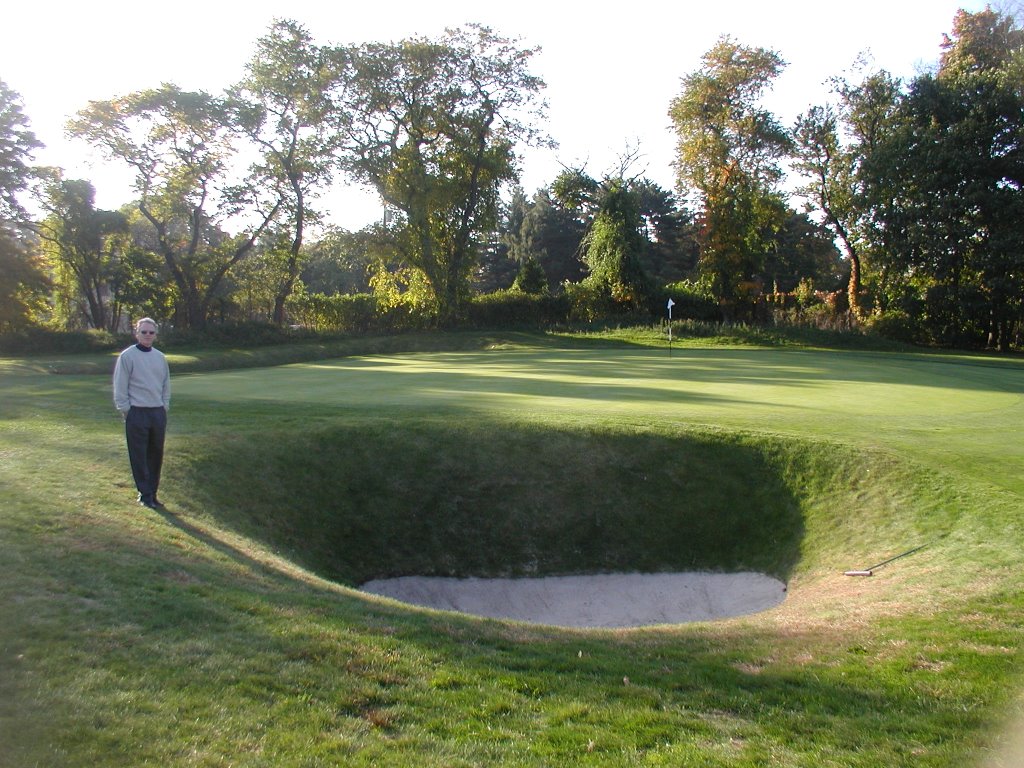
If a bunker is easy to get out of you will give it little thought during the round, but if a bunker requires you play backwards you will always be aware of its location and what you need to do to avoid it. Pete Dye made the comment, “Strategic placement of bunkers subconsciously forces the golfer to head away from the bunkers, when the better route is to hug them….when you get those dudes thinking they’re in trouble.” I think the comment is missing a reference to depth and how it affects the thoughts and mind of the player. There still must be repercussions that force those dudes to think. What gets a player thinking is the difficulty of the recovery. If a player faces a bunker where any club is an option then they will hug the bunker looking for an ideal line since they have no fear of missing the shot. They will also swing without fear since there is nothing to loose and nothing to get nervous about. Tell me how that hazard offers any strategy other than to high handicappers who fear sand in general?

If the bunker is nasty and recovery may not be possible, now the player is aiming away out of fear. He will also make a tentative swing at the ball trying to steer by the trouble rather than hitting a confident stroke. This is when a bunker has enough presence to get into the players head. Donald Ross said, “Hazards and bunkers are placed so as to force a man to use judgment and to exercise mental control in making the correct shot.” If there is no risk, why should a player exercise either judgment or control? The usual complaint is about recovery from such a bunker, but if the player has tried an aggressive line and failed you must ask them why not choose a line further from the bunker? I’ve never understood why a deep bunker in a key location is unfair when an architect provides either width or an alternative route around. As Donald Ross points out, “Often the highest recommendation of a bunker is when it is criticized. There is no such thing as a misplaced bunker. Regardless of where a bunker may be, it is the business of the player to avoid it”

I must admit I love Mike DeVries blunt comment of, “it’s a hazard, deal with it.” It always strikes me as absurd that many a member will tolerate or enjoy the most penal of hazards on the links courses and yet be so critical of a feature at their own club. It is the great hazards at our own courses, and how we handle them that define us as a player. Maybe the issue is ego, since I often deal with players who continue to attack a hole or pin where better judgment will yield better results. The fault is not with the depth or difficulty of the hazard; it is with the player’s decision making. Charles Blair MacDonald said, “The object of a bunker or trap is not only to punish a physical mistake, to punish a lack of control, but also to punish pride and ego” The game is about management and execution, shallow bunkers do not identify either skill.


Mike Stranz uses pressure to make a short course seem impossible at Tobacco Road.....but really it's quite playable


Pine Valley remains the ultimate psychological test for a player. You are immediately intimidated by the amount of sand and the perception that every miss will be punished. The brilliance of Pine Valley’s waste areas is that players begin to visualize disaster rather than concentrating on execution. When you look beyond the trouble, you find the course has plenty of width between trees, wide fairways and large greens; but all you see is trouble! Mike Stranz borrowed from this psychological ploy to develop his courses, including the use of depth and punishment to keep the players attention. He pointed out that we get a bigger sense of accomplishment in overcoming these holes than we would a course without any penalty. I agree.

Tomorrow I take on strategy…………..or try at least

Next up Strategy: http://thecaddyshack.blogspot.com/2006/10/bunker-week-part-6-strategies.html

Monday, October 23, 2006

Bunker Week – Part 4 – The F-word…. Fairness


A bunker you can hit any club out of is concidered "fair" by some, a waste by other.


The origins of golf only had two rules that applied to hazards, play it as it lies and the rub of the green. Now there is too much money and too much ego wrapped up in the game to accept a bad break. We insist that bunkers be uniformly maintained, consistent in condition from course to course and fairly easy to get out of. We have gone from a bad lie being a bad break, to questioning the golf superintendent’s ability and the design of the bunker. The game has changed….for the worse.

We began with the uncertainty and unpredictability of links golf where bad lies were expected and simply played. We learned the lessons of humility and perseverance through the game, but all that has gone out the window for certainty and fairness. The whole modern concept of players aiming at bunkers because they can reach the green from the fairway bunker or get up and down easily from a green side bunker shows us how much the game has changed from the origins of golf.

George Thomas says, “Hazards should be arranged to tempt and challenge, but laid out so all classes of players have optional routes to the hole. Hazards should not unduly penalize from which there is no chance of recovery.” What he is saying is that the bunkers should encourage good players to flirt. The weaker player should have options to play around and away from trouble, and all golfers should have an option to recover based upon their ability.


These bunkers are spectacular and very deep, are they fair?


Others are harsher in their thoughts on the fairness of bunkers. Willie Park Jr. said, “If a bunker is visible to the player, and there is sufficient room to avoid it, it is the player’s responsibility to steer clear of it.” Once again there is the mention of options to play away from or around the bunker, and this is another form of fairness. Fairness has nothing to do with removing the hazards, but instead has everything with providing enough room beside the bunker to avoid it even with extra shots.

Bill Coore has always been one to advocate a mixture of bunkers from the simple to the fearsome thinking all have a place on the course. His philosophy comes across well through the open-mindedness of his opinion on hazards and bunkers, “No element that creates interest can ever be seen as unfair” The player must simply deal with what’s put in front of them with the most efficient use of strokes that they are capable of using. It is up to them on what they are going to contend with and how they are going to avoid the potential pitfalls. Everything is up to them and everything is fair.

The most unfortunate part of this is for nearly 50 years our architecture was dumbed down for fairness. When the difficulty was eased or the maintenance made more “player friendly” it all had a detrimental effect on architecture. Tom Doak has long been advocating the return to a more natural rugged bunker with a less clearly defined outcome. His bunkers bring back a much more natural appearance closer to the origins of bunkers. There is also more risk in getting a difficult lie; and most importantly it places more emphasis on the hazard being where you will likely drop a stroke.
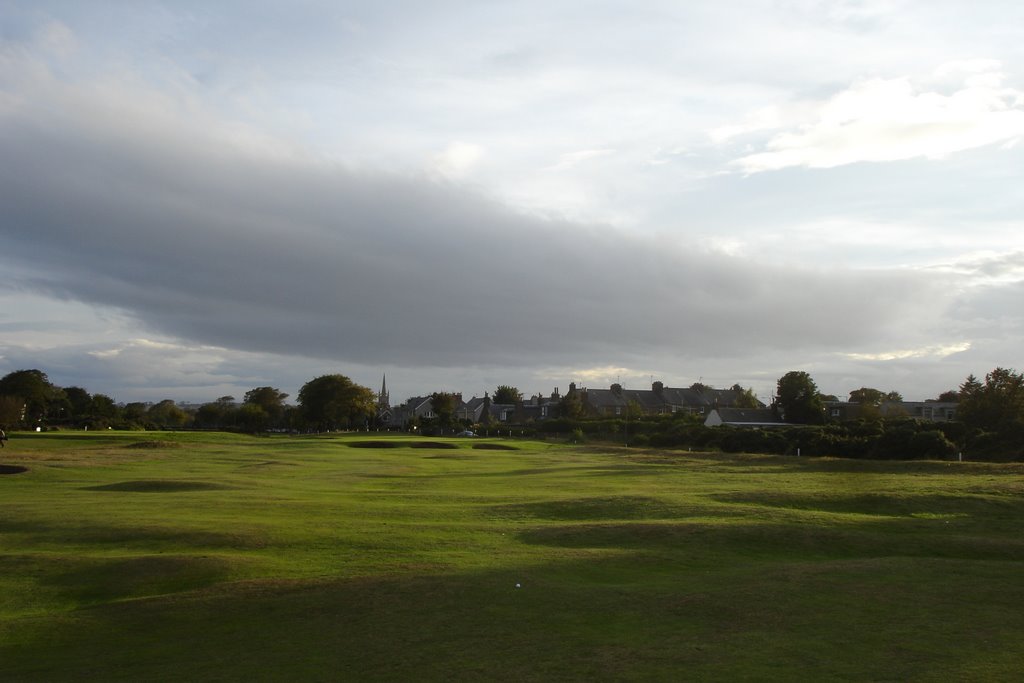
The last word on this should go to Mike DeVries who simply says, “It’s a hazard, deal with it.”

Next up Psychology: http://thecaddyshack.blogspot.com/2006/10/bunker-week-part-5-psychology.html

Friday, October 20, 2006

Bunker Week – Part 3 – Depth


Walter Travis meant for a hazard to mean something


I thought I would explain the value of a hazard and talk about depth before we take on the concept of fairness. I thought I would begin with my favorite quote regarding the value of a bunker and what it is supposed to accomplish. Walter Travis stated, “The primary idea of a hazard [bunker] is to punish, to the extent of one stroke, a poorly placed shot, and to make the recovery exceedingly difficult, and even by the virtue of the following shot being extraordinarily good. If this end is not attained, the existing hazard fails to fulfill its function.”

I regularly deal with greens committees where players believe you should be able to get out of a bunker easily and advance the ball as far as you want to. If they had there way all bunkers would be flat. Yesterday I provided you with Max Behr’s quote to do with the line of charm. “The line of charm is the provocative path that shaves off distance and provides an ideal an ideal line” The line of charm only works when the bunkers offer enough of a deterrent to make the player not follow the line of instinct. If the bunker is shallow a player will play exceeding close and have no fear of having to extricate themselves. They will also swing the club freely since they have no fear of punishment for missing the shot. If the bunker is very deep, and the possibility exists of losing more than one shot, the player will play further away to lessen the risk. The line of charm may still be very tight to the bunkers, but the player will tend to play further away. They will also swing a little less freely if they have fear of going into the bunker. The importance of depth works on more than one level.

Often because of human nature we find ourselves in a situation where we want to risk the carry. If the bunker is shallow, there is little to be gained but an improved position on the fairway; but if the bunker is fearsome enough, then we gain the undeniable thrill of carrying a ball over such a dangerous bunker. The thrill we feel is very much related to the depth of the hazard we just carried. There is also nothing so deflating as attempting a carry over a deep bunker and realizing the ball came up short, particularly if you know you had the ability to make the carry. Part of this is the realization that we must now make a tough recovery.


Thompson's 12 feet deep bunkers on the 12th insist you play right off the tee.


The recovery is what defines the punishment or value of the hazard. If we can get to the green or have a great chance of getting up and down the bunker has limited value. The need to play backwards or “just get it” out has a place, but is not completely desirable either. The best bunkers suggest we can make the shot, but only the best recovery that we can play, one that may erase the lost stroke. Pete Dye expressed this idea of hazards and the recovery shot, “Hazards are essential to the game of golf. I cannot imagine playing without experiencing that marvelous feeling of hitting a recovery shot from a hazard, or the anticipation of my opponent trying to recover from a deep pot bunker only to have the ball catch the upper lip and roll back towards his feet. This is what makes the game exciting and keeps the players coming back for more.”

Next up the “f-word”: http://thecaddyshack.blogspot.com/2006/10/bunker-week-part-4-f-word-fairness.html

Thursday, October 19, 2006

Bunker Week – Part 2 – Why we need bunkers


The bunker on the left defines the strategy of the tee shot


While bunkers are inconvenient and frustrating to the player, they are essential to the core spirit of the game. They are used, in combination with other hazards, to define the risk and set the requirements of the hole. They are the architect’s most common tool to force players to make decisions and to think.

Willian Flynn describes the role of the architect best when he said,“The principle consideration of an architect is to hold the interest of a player from the first tee to the last green” I can not find a better quote to explain our role. Please notice how at no point he mentioned the words difficulty or challenge! The way we create interest is by careful placement of bunkering and other hazards to creates decisions. Decisions lead to strategy and options, and as Bobby Weed always like to say over and over again, “Options equal interest.”

Max Behr one of the greatest writers on golf of all time had a beautiful explanation what golf architects are trying to accomplish with bunker placement. “The direct line to the hole is called the line of instinct, and to make a great hole you must break up that line in order to create a line of charm. The line of charm is the provocative path that shaves off distance and provides an ideal an ideal line into the green, usually by skirting bunkers and other hazards. The golfer wants the most direct line he can find to the hole, while the architect uses bunkers and other hazards to create risk and reward options that suggest the ideal line for the player, or the line of charm.”

Imagine a hole that has no bunkers, or more importantly any other deterrent to playing directly at the hole. The hole is simply a test of a prescribed length requiring a set of shots to reach the putting surface. Now if there is even one bunker added to the front left of the green, the ideal tee shot is down the right to open up the angle in. Now there is a rudimentary strategy. Add a bunker placed in the right rough and you have a situation where you need to skirt that bunker for the ideal line, and the strategy is stronger. That is the first basic of strategic bunker placement.


The most rudimentary of strateges, flirt the bunker to achieve the ideal line


If that were it, and it is for some architects, then we would all understand how to break down great architecture…but it’s not. Consider Alister Mackenzie’s quote of, “No hole is a good hole unless it has one or more hazards in the direct line of the hole” Why not in the middle of play like the Principles Nose at St. Andrew’s. This may be another of the finest bunkers in the history of the game. The bunker is exactly where you want to play to. Play safely to the left but receive a much tougher angle; play right, risking the out of bounds, and get rewarded with the ideal approach line. That is a superior fairway bunker placement and outstanding strategy. This also must open your eyes to realize that the options and reasons for placement are becoming limitless.


Next up Depth: http://thecaddyshack.blogspot.com/2006/10/bunker-week-part-3-depth.html

Wednesday, October 18, 2006

Bunker Week – Part 1 – Bunkers in Nature


Notice the height of the lip!


For the architecture enthusiast, this series will make a good run for at least a week. I’ve decided to concentrate my efforts strictly on bunkers.
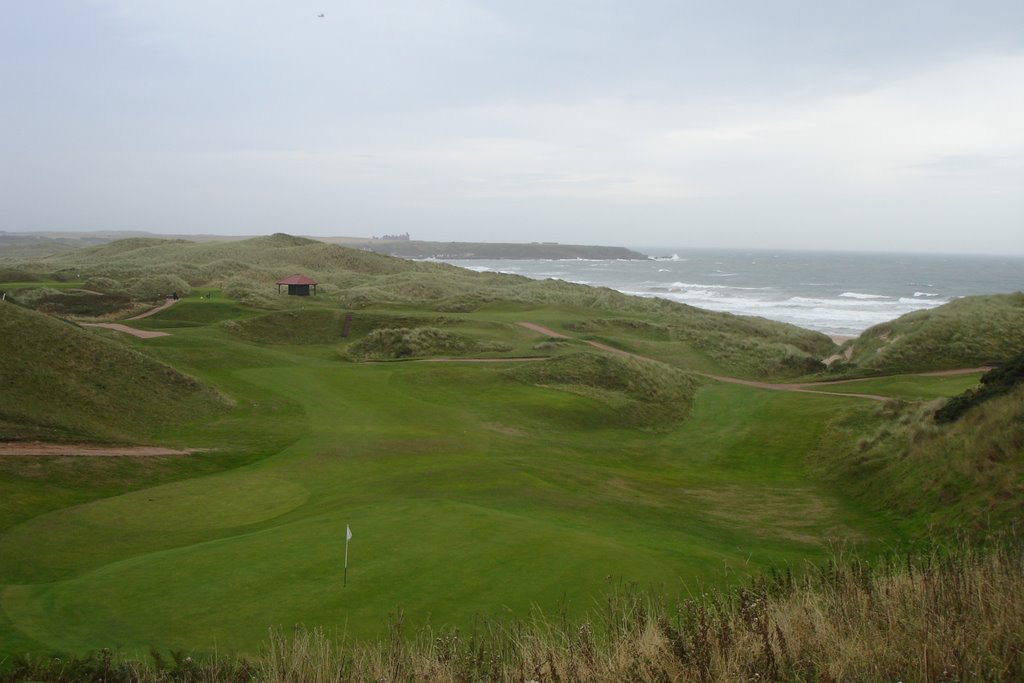
I have no illusion that somehow someway I can provide a tutorial that will explain to you the placement and depth of every bunker, but I will certainly do my best to help you gain some insight. After all some of the best bunkers simply "occurred" without ever being created and this in itself is a great place to begin.

A lot of the revered bunkers at the great links came to be by circumstance. Often they were small hollows created by sheep or blow-outs created by wind. Some were depressions that were almost natural bunkers right from the start while others were scars that are still there but just kept a lot more formally than they once were. Many of the greatest bunkers were natural.

I’ve been reading extensively about the Old Course once again and the quest for the origin of the Road Hole Bunker caught my attention. I had always assumed that the bunker was added by Allan Robertson when he made alterations to the 17th green. Well it seems that the bunker was in place already by his 17th birthday since it is shown on an early map of the course. It was originally thought that he added the bunker when he did his work to expand the 17th green, but now we know differently. The origin [as I understand it] is the people of the town apparently used to dig in many of the bunkers to get shells and this location was a particularly good spot close to the town. The bunkers depth came from the people’s quest for shells; which eventually was stopped when the golf course became to busy and popular to allow this activity to continue.


Notice the difference in bunker lips!


Even the Road Hole Bunker itself has evolved from its origins throughout the years. Think of the constant build up of sand on the lip and the regular replacement of the revetted bunker face that takes place now and you will understand how much this bunker changes on a regular basis. I have pictures from 1989 where the lip wasn’t near as high, the bunker was slightly smaller and the bottom was not near as deep. They have restored the bunker fairly frequently and usually now use old photos as direction. Each recent change has been well documented in golf magazines for each of the British Opens. The bunker is now so deep, with a lip so high, that recovery is nearly impossible for all but the most skilled. I often wonder how much of the bunkers greatness has to do with evolution.

Now think of what I have said so far, the bunker which I think is the best in the world was not placed by an architect, and the depth was determined by circumstance. Even evolution seems to have made the bunker even more of a factor than it initial was. The initial lesson is to go find the natural bunkers that nature has already provided right on the property.

Modern architects generally bulldoze everything and then build the bunkers into the locations that make the most sense by distance and intended strategy. This myopic view does not deal with mixed abilities or the constant changes in technology. Bunker placement needs to sometimes be more natural and happenstance to make the game interesting for everyone. It’s too bad so many architects don’t seem to see that the land often makes many of the best decisions for you by providing natural hollows and scars to be used in the routing of the course. The reason that Coore and Crenshaw are so respected by their peers is there ability to use the existing site. Just look at Sand Hills many of the holes are designed around a series of very impressive natural blowouts. Bill Coore explains why they routed many tee shots diagonally over the blow outs at Sand Hills when he states, “There is nothing more thrilling or appealing than skirting over an impressive or fearsome hazard.” Coore and Crenshaw found and used the natural hazards of the property at Sand Hills, as opposed to making them, and that is what makes that course more memorable than almost any other course in the world.

Find the natural bunkers first, then start adding new ones.

Next Why We Need Bunkers: http://thecaddyshack.blogspot.com/2006/10/bunker-week-part-2-why-we-need-bunkers.html

Thursday, October 05, 2006

Future Restoration of the Current Architects


The awesome Sand Hills by Coore and Crenshaw


This post begins with some interesting assumptions (by yours truly) on whose work will be seen to be very important down the road. Guessing who will be that important is a bit of a stab in the dark, but I think I have a body of support behind a few of the names.

I do not think that any of the biggest names, like Fazio, Jones and Nicklaus, will have their work actively restored. I see their architecture continual evolving in the Augusta National mode. I think part of my feeling comes from the fact they have controlled so much of the architecture that little has been left to chance and the courses are far less likely to evolve. While their work does not inspire me, this is not a knock on the architectural quality but more my feeling that they are the modern equivalent of Trent Jones and Dick Wilson whose work is considered solid but unspectacular. Every noticed there is nobody out there pushing Trent Jones restoration despite 500 potential courses.

So who will we preserve? My feeling is four guys stand out; Bill Coore, Tom Doak, Mike Stranz and Pete Dye. Bill Coore’s work is definitely the finest of our current generation and has raised the bar for future architects like myself. Interestingly, much of his work harkens back to the Golden Age with the excellence in details and the time spent on finding a routing. The next one is Tom Doak, who has built a series of excellent and very natural courses using vegetation and techniques that will surely evolve. His work again harkens to the Golden Age, but there is an exploration in ideas that will prove to make him a popular architect in the long run. The next guy will have the strongest following, the most detractors, and I feel the greatest following for restoration. Mike Stranz is my version of Tom Simpson in his ingenuity and risk taking. The guts to leave uncomfortable holes and pressure filled situations will encourage many to want to understand the man. If I were choosing one where restoration will need to take place because of alteration, it would be Mike’s work, since much of his work will be under pressure for softening. Pete Dye I will get to at the end because he’s the most interesting.

(There are many others who show the same promise and I’m watching them to see what there next work brings. Gil Hanse and Mike DeVries are too obvious candidates).


Tabacco Road will be preserved as a testiment to Mike


So how will it take place down the road? This is where everything will be different. Each of the three above are well written about and have taken the time to write articles. There courses are all widely photographed and well documented. There is likely as built due to modern irrigation practices available for each course. The owners at most of the courses have chosen to keep all their notes and plans because of the respect that is already out there. Restoration will be much easier looking out 50 years, just because of the technology that we currently live with and the amount of information available in seconds.

The fun part comes from the future decisions at very landmark courses and this is where Pete Dye springs to mind as the most fascinating of all the architects to restore in the future. Look at his work, but more interestingly look at the potential decisions!

1. has any architect changed their ideas as much as Pete Dye
2. Crooked Stick fundamentally changed architecture, and then he renovated it in a completely different style; and I’ve heard he thought it was better before! What do you do?
3. which TPC at Sawgrass do you restore to? The first one the players hated but was the course Pete intended, the most recent evolution that everyone grew to love, or the one that will be unveiled this spring.
4. Do you restore his most modern that was really done by his sons or apprentices?

As you can see there are lots to consider down the road for the next generation of restoration architects.

Wednesday, October 04, 2006

Badger Experts and Bird Psychologists


Castlestewart construction on a windy day.


When I went around the Castlestewart with Gil, we were walking up the 10th hole when he mentioned the badger den near by in the gorse of the sea cliff. This became the start of a very typical conversation between architects. “So what were the craziest environmental requirements on this project?”

Before I continue you will find that most current architects agree with the environmentalists that there are places where holes should not be built and there are locations where courses should never be proposed. I believe in the preservation of natural ecosystems and that we should work to fit our holes within the landscape rather than rebuild the entire site and destroy natural habitat. Generally I have a great deal of respect for the people whose job it is to protect the natural environment. What I don’t get is the ones that start any meeting with, “You realize I’m fundamentally opposed to golf because it destroys the environment” There is enough evidence through the monitoring programs that this is not the case and in fact golf courses have been proven to be a benefit in many cases as opposed to a source of harm.

I’ve had a few memorable experiences with approvals but my favorite took place with the new nine at Nobleton Lakes. A member of the Conservation Authority fought to protect a series of 16 foot diameter puddles in the middle of a (clay) farm field because it was a “potential pocket wetland that might support amphibians” This is was very amusing since I had photos showing the pocket wetland was completely empty two weeks ago before the rain. This was even more frustrating when you look at the adjacent Class 1 wetland (highest designation) 200 yards away and knew that it had proposed holes approved to go through it from another architect’s approved plan! I was only trying to alter the routing to keep the holes between the woodlots and out of the wetland because I thought it made for better holes, less disturbance and I didn’t like the idea of going near a wetland area.

Back to Castlestewart, the badger which is an extremely aggressive creature was nearly eradicated by farmers due to the nature of the animal. It is now endangered and there are badger experts who are brought in to protect any known badger dens in order to protect the species. Mark Parsinen was asked to bring in an expert and the council also hired their own. Now I best add these experts are not cheap! Well as it turns out the two experts could not agree what to do and fought constantly about how best to preserve the den (which nobody has ever seen active). Each time they met and disagreed you know somebody is left still paying the tab. Some argue that this would just be called a classic consulting tactic to increase the billable hours. So now there is protection around the den, too bad there seems to be no badgers.

The other thing they had to do a Castlestewart was to build a large, and I mean large, berm to block the view into the site. Makes sense, so the locals won’t have to look at the site right? No…. it blocks the view of the birds from their nesting area a mile or two down the coast. Apparently the site of construction drives the birds into being inadequate parents for their offspring (I guess). Just one thought, can’t birds fly?

If you wonder why we do this, this is just part of the approval process on may of our new projects. Protecting the environment is important; rationale thought would be even more helpful sometimes. I think they just forget we are all actually on the same side.

....and this concludes my writing on Scotland

Tuesday, October 03, 2006

Kingsbarns


Kingsbarns has been one of the most widely praised golf courses to be built in the last 50 years. This was considered the first great golf course to be built in Scotland since the Mackenzie Ross reconstruction of Turnberry. The course was a project that Kyle Phillips had looked to get built for quite a few years before finally linking up with Mark Parsinen. What Kyle had to begin with was a spectacular setting that sloped quite severely toward the ocean. It was not ideal for a lay of the land course but would be exceptional with lots of earthmoving. Instead of trying to route around some very difficult cross-slope Kyle and Mark simply shaped the entire site to bench a series of holes, which also means that every hole looks easily out towards the ocean. Why Kingsbarns works is because of the shaping. Where this could have been a very American style “faux links” golf course, it was not. Faux links usually feature repetitive looking with shaping but Kyle and Mark went to great pains to emulate the land found on the existing dunes courses, including using a dune expert. The shaping here is a model for all projects and may be some of the best ever on a course built with almost no natural contours.

The cool part about the shaping was that Kyle and Mark built literally 1000’s or irregular shapes including scars, ridges, straight lines, sharp slopes, sloughed faces, and small scale rumples until the whole site looked as if it existing like that in the first place. Even the land immediately in front of the 6th tees featured rumples a few small gorse bushes to providing a very “natural” appearance. It still looks shaped at times, but at other times the work is so good that you wouldn’t know. The best way I can describe the work is there was almost no detail missed no matter how seemly insignificant. That definitely teaches any golf architect is that once again it is the level of detail and the level of commitment to finishing everything off properly that is the difference between a great course and one that is worthy of discussion among the world’s best. This seems also to be further proof that the commitment and interest of the owner is very important to ensuring that everything is done well

Kingsbarns reinforces my belief about having an opening vision on what you want to build. If you want to build a links then you must spend the time observing and learning what a dune line is supposed to look like. You need to understand the irregularities of links land and the small features that also come with the much larger features. You need to be able to think through what erosion and rehabilitation look like. You also have to understand the hole concepts and style found on a links and not resort to more standard American style ideas, like raising all the greens. My favourite work at Kingsbarns was the many greens that come in on grade or others that fall with grade. Rather than having the greens always pitch from the traditional back to front he mixed up the variety which held far more interest. I think one of our biggest failings in North American golf architecture is not building enough greens that are extensions of the fairway. That is one of the ideas that I will certainly bring to my first solo course. This style of green play encourages the option between using the ground or flying it in, the traditional North America style green site almost always requires a ball in the air.

Does Kingsbarns deserve the praise and world attention it gets? Yes, they were able to create a modern course from scratch that appears like a links course. Considering what they started with, this is a testament to some very talented people and a fantastic imagination. It is one of the best four or five modern courses I have seen.

Saturday, September 30, 2006

Montrose


The tee shot on the wonderful par four forth


(click on the pictures to enlarge)

Robert and I finished up Cruden Bay and originally intended to make a run south to play Crail. I had loved the idea of playing this short par 68 that hugs the edge of the ocean. Traffic conspired to change or plans and send us to a closer course called Montrose which was half way between Cruden Bay and St. Andrew’s. I must admit that I wasn’t as excited to see Montrose, but Robert had told me he liked the course so I figured it was worth a try. I was also a little sore at this point and the thought of playing in another 3 club wind wasn’t very appealing.

First off Montrose turned out to be much better than I expected and I think even more solid that Nairn. Nairn had a few great holes that Montrose lacked but Montrose had no awkward holes that many of the secondary courses seem to have. The course essentially goes out the first seven holes along the coast the coast skipping in and out of the two coastal dune lines. Unfortunately other than a few holes at the beginning there are few ocean views due to the large coastal dune which is eroding very quickly right now. The famous tee at the 6th is gone through coastal erosion. Many of the holes play beautifully up the middle of the coastal dunes through fantastic valleys while other skip up and down the areas where the dunes join to form a more prominent wide but flatter section.


The memorable plateau par three third


An interesting generality that I realized about links golf is almost every links course begins on the ocean in the best golfing terrain before moving away from the ocean and returning inland. For the life of me I can’t understand why but this is the case from Nairn to Montrose to St. Andrew’s to Troon and on. It also explains why the golf in the UK rarely features great finishing holes since most like Royal County Down and Turnberry are over the least interesting land on the property. The North American approach seems to be to get the best to the last like the holes at Pebble Beach.

The turn at Montrose features tee shots off the secondary dune and onto the flatter land below. You would think that the best is left behind but the fall off in quality was very small because of some clever use of the gorse and good solid green sites. All holes set along the secondary dune (includes 9, 10,16 and 17) feature gorse banks along the left dune and out of bounds down the right. This makes for some more accurate golf but fortunately there is adequate room for these shots. Each of these holes features wonderful hummocky fairways and great green sites.


Playing "into town" at the short par four 14th


The course moves in from 11 through to 15 and uses gorse to separate the very flattish land through this stretch. What works well is most of these green sites are quite interesting and make up for thee flatter land. Montrose can be summed up as a very pleasant surprise that should be on any golfer’s itinerary who isn’t obsessed with playing only the most famous courses. I think in Scotland the quality of the average course is well above the normal course we would expect anywhere else. I think it would be worth going over to play all but the elite course on a trip because you would still get the full Links experience at a fraction of the price. Needless to say I was quite grateful for my stop at Montrose.

Friday, September 29, 2006

Cruden Bay


The land at Cruden Bay with 15 green below


When you get out of your car and look out from on high promontory where the clubhouse sits you can’t believe your eyes at the scene below. Cruden Bay has undoubtedly the best setting of any course in Scotland. What makes it fantastic is the course is not only set in among huge dunes, but also features a massive 100’ sea cliff that comes into play along the way. That’s an understatement when you consider the 8th plays into a huge bowl surrounded by the sea cliff and the 10th tees off the top back into the valley below!


The punchbowl at 14


Where Cruden Bay is great like the 4th, 5th, 6th, 7th, 10th and 13th it takes aback seat to no course in the world for both drama and quality of holes. Even others like the 4th, 8th and 17th are exceptional in there own right, but are overshadowed by the most dramatic holes on the course. If the rest wee as high a quality we would be talking about this being one of the 10 best in the world. So why is this not a top 10 or top 20 courses in the world? Mainly because of the couple of holes that vary from weird to awkward depending on whom you ask.

Some think the opening stretch are pretty average but I found the first two to be good solid holes. A few have suggested that the 3rd is an odd duck, but that’s because the green is tucked tight behind the large dune on the right. The hole is still short and relatively easy and the green is fairly receptive to the bounce of the hill if you don’t mind trying a little luck in your approach. The course picks up pace from 4 through to 8 with a very memorable stretch. The 9th atop the sea cliff is an ideal transition hole from the spectacular 8th to the dramatic 10th tee shot and I think people are crankier about the walk up from 8 than they are about the hole. The run in approach is a must for this fall away green so possibly it is more of a case of people not finding the strategy than there being any weakness in the hole. The course once again is pretty solid from the 10th to the 13th. It is 15 and 16 that cause all the complaints. This is also where the club is considering change, partially due to safety too.


The sea cliff at the 8th is 100' above the green!


The 15th hole plays up hill into a beautiful bowl shaped fairway. The next shot is over a rise to a green that is a full 20 feet below in a tight little bowl with all sides sloping sharply in accept the back of the green. This is a fun shot to hit and see where you ended up. It is also a fair shot since you can literally bounce the ball in from any side or fly it directly in to achieve your goal. I think removing this hole would take away one of the more fun and quirky holes I have ever had the pleasure to play.

The 16th has been called the blind dogleg par three because of its length and the massive dune that obscures all views to the green. The hole is fair since a short shot will be run towards the green and shots can be bounced into the green from the massive dune. The problem is more the tees are in full flight from the 14th, the tees on 16 are definitely in play from the 15th tee and you can’t see if play is through (if players forget to ring the bell). There is no question that this is a safety issue. I just think there aqre other alternative to what is currently proposed.


The awesome approach to 13, notice how small Rob is, the green extends to his location


The highlight of the day for me were the natural landforms in play and the roll in the front of the 13th green was the best feature I have seen in quite a while. It towers 20 feet above the grade short right of the green and features a very sharp slope down to the hollow. Anything hitting it falls will feed back into the hollowing leaving a nightmarish shot into the green. The green is actually set 6 feet below the roll and hides behind it creating a bit of punchbowl due to the huge sea cliff backing the green. The green falls right and away from play to create a reverse redan. This is definitely one of the finest green sites I have seen and one I will copy one day in my own solo work.

The other cool feature that I want to use in the right situation is the huge knoll in the centre of the 17th fairway. It is 15 feet high and steeply banked but also kept short. It is right where tee shots land and defends the hole without being unfair since most shots are playable from a lesser slope or simply find their way down to the fairway. The feature is more sheer fun than anything else, but that is what Cruden Bay and great golf are all about.

Thursday, September 28, 2006

The Catlestewart Project by Gil Hanse


Gil and the bunker detailing


I had the great pleasure of meeting up with my friend Gil Hanse and touring his new project called Castlestewart that he is building for Mark Parsinen. Mark Parsinen was the gentlemen who built Kingsbarns which was one of the most successful new projects to be done in recent times. It’s likely the reason there is now so many new projects taking place in Scotland after such a long drought of new work.

The site is just outside Inverness and overlooks the Firth of Moray. The site is spectacular with incredible views at the town of Inverness, the suspension bridge, down the length of the Firth of Moray, and the far headlands which has up to 500’ sea cliffs. The bulk of the site is up top about 100’ feet above the water, but there is a lower shelf wide enough for golf holes that will feature a spectacular opening run for both nines. Both opening holes play off the sea cliff and down onto the plateau above the ocean with the holes playing tight to the ocean itself.


Looking at the first below from the tee and the 9th to the left


My favorite part of the routing was the choice not to try finish below and face an awful walk up to the clubhouse. I also like the fact that there were not seven straight holes along the ocean; this was a good way to break up the nines. Both the finishing holes are instead set along the top of the sea cliff which still feels like the holes are right on the ocean, and in fact offer far superior views up and down the sea coast. The nice thing that Gil and Mark accomplished was that they had many of the landing areas away from the edge so that the approach looks diagonally down the coast. I really like the effect. What was also kind of cool was that they point to headlands or other prominent land marks intentionally.

The course was about six holes along, but the shaping was quite clear on a few holes (or at least it was for me). I must admit they were moving a lot more dirt than I would have expected, but after hearing and seeing why, they certainly were doing some very interesting things to the course. The bunker tests were probably the most interesting thing that Gil was doing. He was combining revetted bunkers with a technique called chunking to create the bunkers that you would see if you could find the old books by Hutcheson. The bunkers all seem to be eroding and revetted at the same time, and that is the look that Gil is going to use. These are truly the most unique bunkers I have seen anyone do and that is a credit to Gil’s imagination.


The uphill 12th, playing between the sea cliff and ocean


The other cool idea that he is using is a run or series of rumples that you would see at Baltray in Ireland or lots of courses where the ground have never been smoothed out before seeding. The rumples along with the unusual shaping will help make the holes appear more of nature and less of Gil. It takes a great imagination to pull this all of but I think Gil will be easily successful. I certainly can’t wait to see it done.

Wednesday, September 27, 2006

Nairn


The tee shot on the 3rd


Nairn is a very traditional links beginning hard up against the ocean and playing straight out before turning to come back. The opening stretch is easily the most memorable because of the proximity of the beautiful wide beach and Moray Firth beyond. The openers were very nice but the course really is at it’s finest from the 3rd through to the awesome 5th.

The feature that is most unique to Nairn is the revetted faced bunkers where the revetting appears to be a perfect moon shape. There is very little bunker below grade, in most cases, but the backs are built well up to create depth. The mounds behind are almost perfectly symmetrical at the top which makes the revetted face just as symmetrical. While this sounds too uniform, the effect is far more pleasant than I would have expected since you have all these steep moon shaped shadows along the fairways.

The third hole uses the moon shaped riveted bunkers for maximum impact. The faces are much higher than the surrounding approach and are very prominent because they are unusually high. The three bunkers that frame the fairway end up creating the most wonderful undulating bowl of an approach. Each bunker adds a beautiful twist to the roll of the approach since each is about 3 feet above grade. The effect is one I can easily emulate with any natural plateau green site.


The 370 yard 5th


The 5th hole is the jewel of the club. A brilliant 370 yard par four where the ocean protects the aggressive line and James Braid has added a bunker that is situated exactly where you would want to lay up. The green is the best on the course since it is well elevated and framed in by deep visible bunkers on the right, a strong false front and a diabolical bunker hidden on the left (where it appears you can bail to).

The 6th and 7th seem plain despite their proximity to the ocean and I must admit I wasn’t expecting much coming in at that point. Where I got a great surprise was at the 10th. The 10th and 12th play slightly downhill all the way and look directly out and down the coastline. These were both excellent examples of framing a view using the gorse to point the eye at the ocean beyond. The gorse used this was felt very similar to tree lined Parkland holes other than the fact you could occasionally look over the top. The two holes were also another excellent example of how running holes on a 45 to the ocean provides the best panoramic view of a coastline. The fact that both holes had no backdrop just made the views even more spectacular.

There was still one great hole to come and the downhill 15th was perhaps the next finest after the 5th. The hole is a downhill par three of around 200 yards with the ocean clearly visible as a panorama from the high tee. The bunkers all appear to be directly in front of the green, yet the prominent front bunker turned out to be well short with a hidden sunken fairway in behind. This was just like the fairway at the 17th at Merion and it made me wonder if Hugh Wilson had seen this before building Merion. The fairway then rises up into a magnificent false front which leads into a very wild green. The bulk of the green is a high front and right plateau, but what makes this one very memorable is the wildest back swale and pin position I have seen in a while. This all adds up to one excellent golf hole. The only question I would have is could you bounce in your approach in


The incredible downhill 15th


I mentioned to Robert that if I had this property I would have routed it differently. I would begin away from the ocean and taken you to and from the ocean multiple times. I would have tried to have at least one or two holes playing directly out at the ocean. In particular, at the far end of the course I would have turned to play directly at the ocean. I feel at Nairn, like many traditional links, having all the ocean holes at the start made the course the returning holes almost guaranteed to be less than the holes going out.

Tuesday, September 26, 2006

Royal Troon


The excellent small bunkers cut tight to the green on the 5th


First off I will tell you I played Troon with a 30 mph wind and driving rain for about 15 holes. This may or may not be a factor in my opinion. I will leave you to judge that for yourself.

Troon is by far the biggest disappointment on the trip. I had played the course before in 1989 and at that time suggested it to my Dad that it was the least interesting on our trip. The second time round the course left me even more flat than I was the first time. There were a few holes like the 5th or the 15th that were far better than I remembered but there were just as many holes like the 9th, 11th and 16th that were far less interesting. The opening stretch has little to no dunes and very little landform until you hit the par three 5th. The course really hits its stride at the awesome 7th followed by the Postage Stamp which remains one of the greatest par threes in golf. After that the famous stretch run around the large dunes is where Troon is considered to be at its best but the only holes that stood out to me were 10th (which is only good) and 12th (which is a favourite). Once again the golfer moves out into light dunes where the holes are average except for the excellent fairway contours found on the 13th and 15th. It struck me that there are far too many average holes for this to be considered one of the worlds 100 greatest.


The huge roll in front of the 15th and the sunken green


While I pick on the course there is one element that makes the course very interesting and also a course that holds up well for tournament play. The greens are fairly small and the bunkers are cut into the greens as tight as any bunkers are in any links course I have seen. It is the proximity to play combined with the small and deep nature of the bunkers that manages to ratchet up the difficulty. There are very few places where there is an easy approach because the bunkering at Troon seems to be well placed to challenge or collect and approach. I certainly can’t criticize the positioning or technique of the bunkers, in fact I think this is the courses greatest strength. I certainly have begun entertaining the idea of much smaller, tighter and deeper bunkering as a way to have an impact and keep the maintenance down at the same time.


The best short three in the world


I guess my issue with Troon is the routing and setting doesn’t seem to me to be as strong as the detailed work. I’m not convinced that Troon is either a great location or a great routing outside of a couple of holes. Some people would suggest that I’m looking too hard at the site and not enough at the detailed work and that by my standards a great course can’t occur without a good site. For those people I offer courses like Winged Foot, St. Andrew’s Muirfield and Pinehurst to prove that is not true. I still think Troon’s greatness has everything to do with hosting opens and its wonderful history and very little to do with the actually quality of golf it offers.

Monday, September 25, 2006

Prestwick


The tee shot over the Cardinal bunker on the Alps


If you asked me for a list of courses which I would recommend you go visit to go learn about golf architecture, I would include Prestwick as quickly as I would the Old Course at St. Andrew’s. The Old Course contains the foundation for most of the principles and strategies of golf course architecture. The lessons of the old course are well documented and well copied, but Prestwick is the course where an architect goes to learn that sometimes you need to ignore convention and push your boundaries in order to create a more interesting game. It’s the place where Pete Dye had the epiphany that lead to the greatest recent change in the way courses are designed.

It doesn’t take long for a golfer to realize that Prestwick is different from most golf courses. The first hole at Prestwick is very narrow and bordered on the entire right by a long wall that separates the golf course from the railway. Out of bounds is definitely a huge consideration on the first tee, and yet you need to be tight to the wall to get a view to the green site. Rather than have clear visibility of the green, the bunkers in front also hide the green. Play to the left off the tee and a large knoll blocks the view to the green and the surrounds.

The 3rd hole features a massive bunker complex called the Cardinal bunker. The tee shot involves judging your distance up to the full blind beginnings of the hazard. The second shot is over the massive expanse of sand and bulk heading that makes the shot completely blind to the fairway or the green. The fairway is full of moguls from one end to the other meaning the ball can bounce anywhere.

The 5th hole hits blindly over a 40’ dune, 210 yards away to a green surrounded on the sides by bunkers with the green falling hard to the left into a deep bunker. The 7th hole is 440 yards up hill down the narrowest fairway on the course. The 9th plays 440 yards into a green that falls at least 3 to 4 feet from left to right where a bounce in approach is the only chance of staying on this blind green. The 13th is a 460 yard par four to a very small green raised 4 feet above the surrounds and featuring a four foot false front. The real treat is the green features shaved banks around the sides making all but the finest shot not good enough. This is also proof that par is sometimes irrelevant to a great hole. The 15th fairway is completely blind and as narrow a fairway as I have ever seen surrounded by gorse, but somehow seems natural an. The approach is blind over a hill with the green dropping 4 to 5 feet from front left to back right. The 17th is the famous Alps with a shot over a 30 foot dune, over a five foot deep revetted bunker and to a green with wild undulations.


The false front at 13


By now you must be wondering how I find this course so charming, but it all magically fits together. Part of it is the history and our ability to accept quirkier work from the past and not from the present, but most of it has to do with the overwhelming number of fascinating details that are almost unmatched by any other course. The golf course is so full of brilliant little moments that the parts may exceed the whole in this rare case. As architects we are always looking for ideas and they are much easier to find in small bits rather than in entire courses or even holes. Often our epiphanies come from the subtle use of a roll or a small minor feature rather than an 18 hole visit. Prestwick is so full of little unusual and interesting ideas that I think one walk and one playing has likely only unraveled half the actual charm found at Prestwick. I’m quite certain I could go there year after year, enjoy each round a little more, and learn something new on every play. That is the definition of greatness in my book.

Sunday, September 24, 2006

Western Gailes


The amazing 5th at Western Gailes


Western Gailes turned out to be a big surprise since I had assumed the course to be a very wild and very quirky. It was probably the least quirky links course I have ever played. Most of the fairways are set in natural low and flattish land between the dunes with almost every shot being very easy to understand. If someone were to build a course on links land now this is what I would expect it to look like. The bunkering was excellent and almost all clearly visible from each shot. The greens had some interesting contour, but for the most part the contours were on the gentle side. The layout is very fair and very straightforward, so much so that I would recommend this as the best starting course for a trip through to play Scottish links golf.

The burns(creeks) were fascinating in particular the one at #15 since the far edge was intentionally picked up to make the locations very clear, but it also created a beautiful deep shadow lines and then ended with a run away slope on the back that could be used to kick the ball onto the green. At Western Gailes there were four crossings and most of them were used to front a green similar to the famous 16th at Turnberry. They make for some delicate approaches with front pins and a fascinating contrast to the dunes holes.

The bunkers were generally very small, deep and tough to get out of. The certainly make a great model for difficulty with minimal maintenance. What was really interesting was that some of the contour around them was kept tight and ran directly into the bunkers. It proves that bunkers do not need size to have an impact and that short grass still can have much more far reaching effects if used well. I want to use the idea of slopes that are short and banks that feed the ball into the bunker since the effective area of a bunker quite large without needing a lot of actual sand.
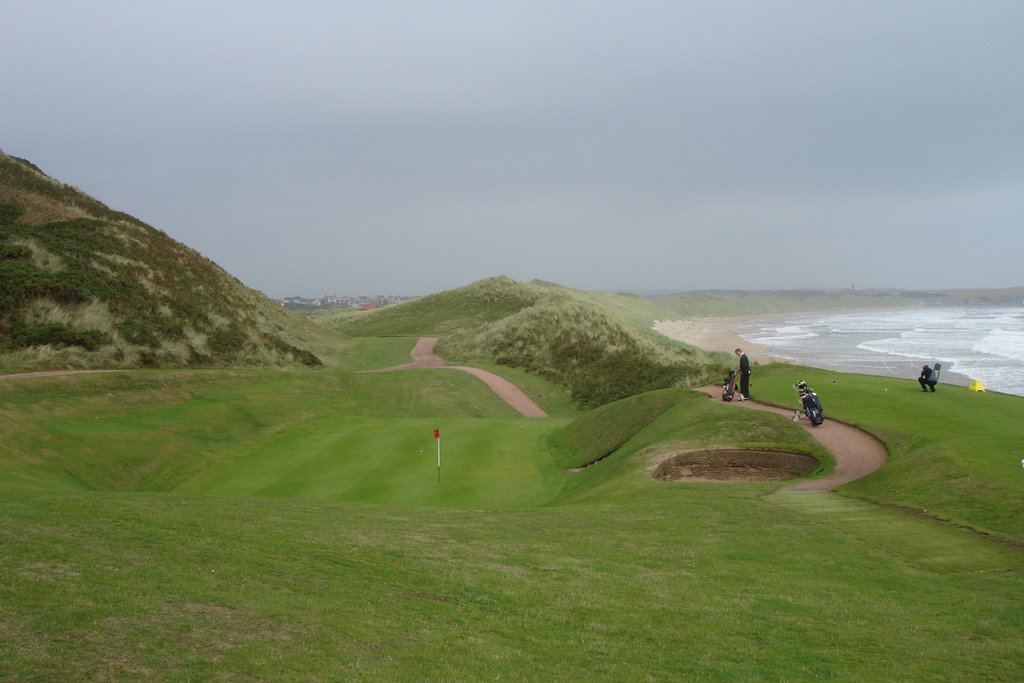
What I enjoyed the most about Western Gailes was the way the course offered so many fun options around the greens. There was a great deal of short grass, but also the rough was kept very light which invited the player to use the ground. The other cool thing they did was using an even shorter cut than the fairway immediately around the green which allowed for putting from almost all sides. This idea needs to come across the pond. I have only seen this done at Rustic Canyon and on the approaches at high end Philadelphia area courses.


The par three 6th down in the bowl


The last thing that struck me about the course was the color. The greens and fairways are similar to what we enjoy by where it gets so much better is in the rough. In the rough you have the fescue with its light brown wispy tops, interspersed with the deep brown of heather (which can bloom a dramatic purple), the purple leaved wild rose which is beautiful but tough to play out of, and of course the deep green of the gorse bush. Add in the taller and nastier looking sea grass and these contrasts do much more to frame a hole than trees can. I much prefer looking at the cant and roll of the land that a dull stand of trees any day.