Friday, June 09, 2006

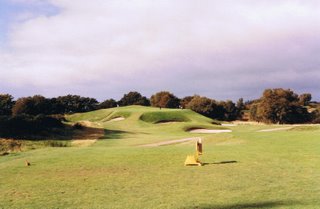
18 Holes – Day 6 – 9th at Cypress Point


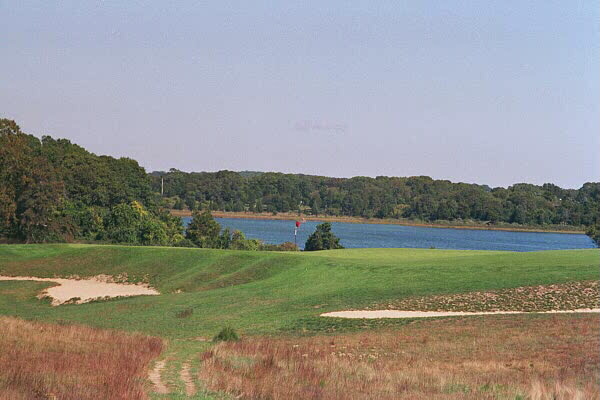
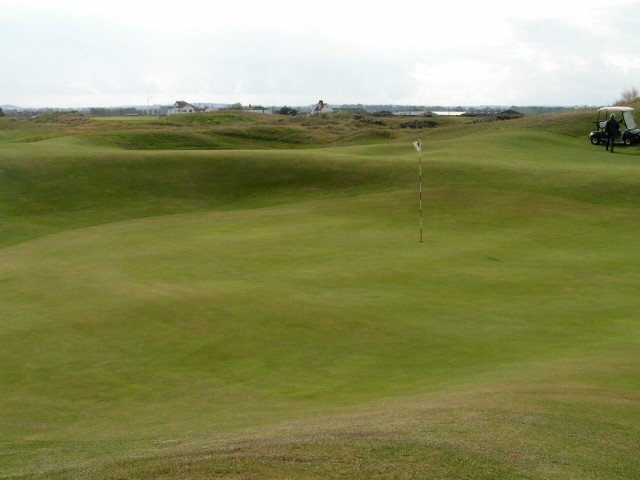
One of the most beautiful and inviting shots in golf.


I must tell a story on this one, my father and I were lucky enough to play Cypress Point together. On the ninth hole we waved up a group up to play through but instead they suggested they join us for a few holes. We eventually parted ways after some fun together but it was pretty cool for my father to play with his current favorite player Mark O’Meara

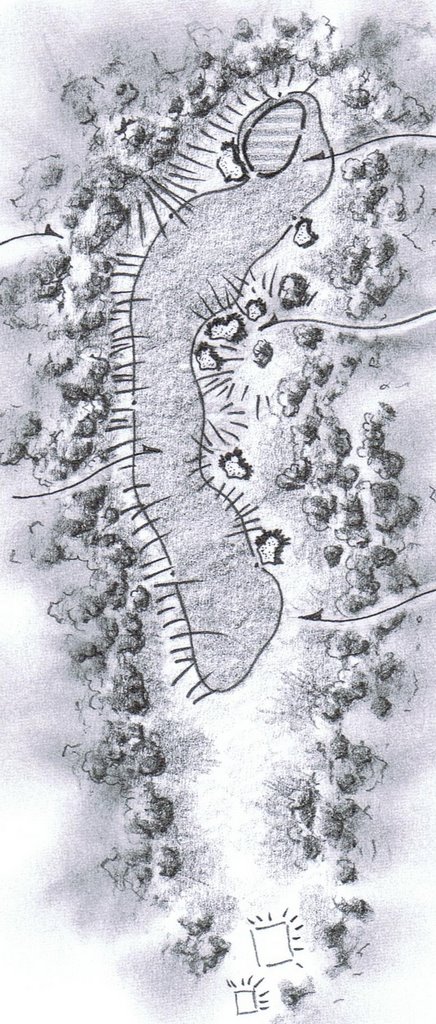
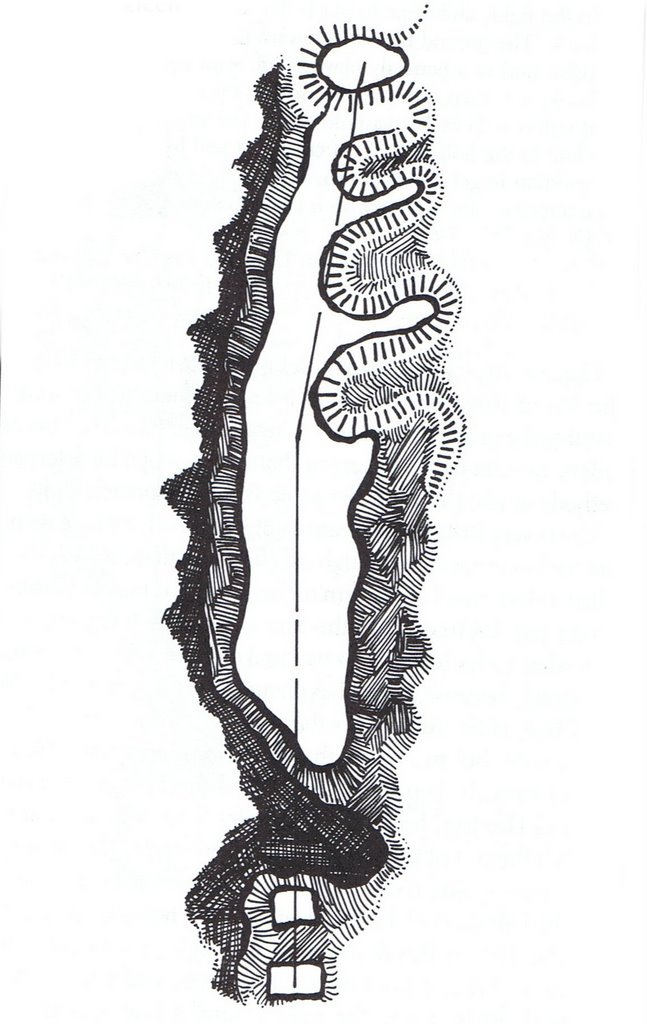
You stand on the tee and you feel compelled to have a go at the green, the same feeling you have on most great short holes. At just shy of 300 yards the green is very reachable, when you couple this with an inviting stretch of fairway all the way to the right front of the green, it is an invitation to be aggressive. Mackenzie does a beautiful job of tempting and teasing you with such an inviting target.

Mackenzie provides you with all the options, you can lay-up and then play a short iron approach, or risk the driver and be left with an easy pitch run straight up the green. Where he proved to be very clever was how he escalated the level of difficulty the closer you got. Have a go at the green and you could find yourself in either the 20’ deep front left bunker or miss right and risk deep trouble in the dune grass that pinches the landing area the closer you are to the green. Either way you must make one great shot.

The long narrow green is a key architectural feature; it is angled sharply left to reinforce his strategy perfectly. Additionally the green falls steeply from left to right and has a big impact on where you want to approach a pin from. If a player is willing to risk hitting the driver into the narrow throat in front of the green, he is rewarded with a very straightforward pitch into bowl shaped green. If the player chooses a lay-up from the tee he will face the daunting short iron over the fronting chasm to a very wide but very shallow green. Shots long and short are both in deep trouble. Now if the pin is in the front right, you have to have a go because the pitch into the front right pin is incredibly difficult considering how small the target it is and that it has no backstop to help you.

What can we learn from this par four? Mackenzie uses temptation as the key element of the hole; he invites an aggressive play through a clear and obvious reward. The way he placed the green on a diagonal reinforced the strategy of the hole. It is the perfect drivable par four, fraught with danger, full of options and stunningly beautiful.

Next Hole: http://thecaddyshack.blogspot.com/2006/06/18-holes-day-7-13-at-tobacco-road.html

Thursday, June 08, 2006

18 Holes – Day 5 – 13th at Royal County Down


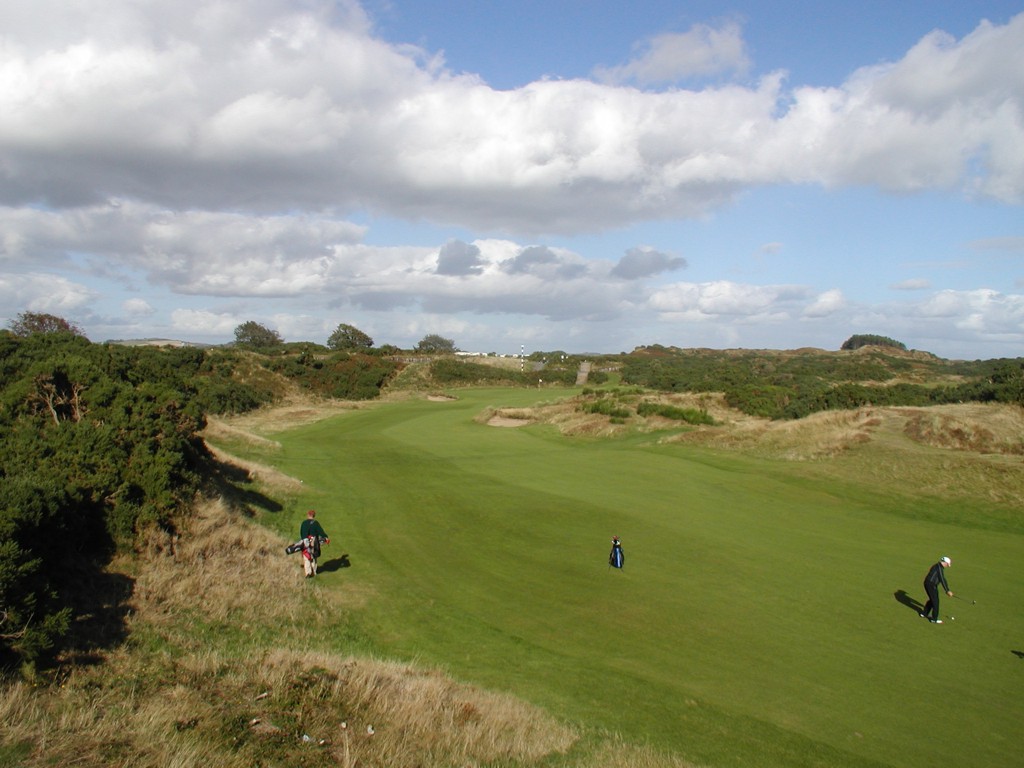
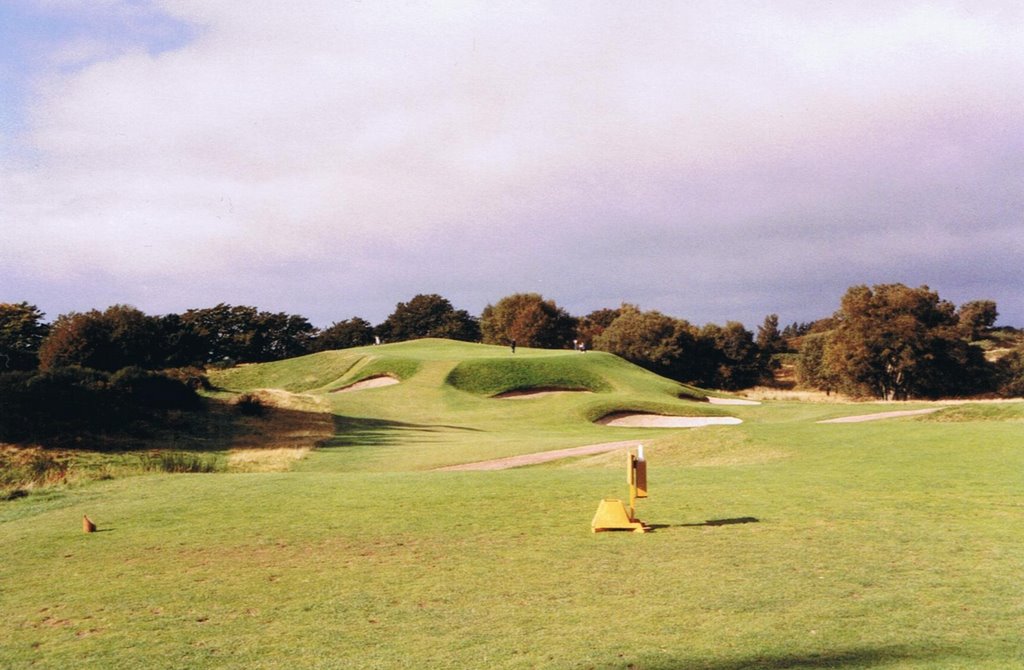
The 13th from up on the left dune, looking over the diagonal dune and bunkers at the green.


Royal County Down is the most remarkable golf course I have ever played. All the blindness and partial blindness somehow doesn’t interfere with the joy of playing the course. There are many great holes there, but the one that has the most interesting lessons is the par four 13th.

The tee shot is quite open compared to most holes and it is easy to assume a ball anywhere in the fairway is the correct play. But a key diagonal dune that begins in the right rough and extends all the way to the green is the key to the hole. A player hitting safely onto the right side of the fairway has a completely blind approach over the dune, which is covered in long grass, bunkers and even a little gorse. The play is actually to the far left side of the fairway where the green becomes “mostly” visible. From that point the hole can be attacked without crossing the main part of the dune or it’s bunkers, but getting to that position you must be careful to avoid the gorse in the hillside just left of the fairway.

My favorite part of the hole is the partially blind approach. Your eye says stay left - where the sole deep bunker awaits - yet the easy route is to use the hidden kicker slope short and right of the green to feed the ball in. Why don’t people hit it there, because most can’t get by the fact that they have to hit it blindly over the dune and trust their stroke to be accurate? It’s a mindset that mainly North American golfers struggle with since we’ve used to seeing everything well.

So what is to be learnt? Rewarding accuracy with visibility is an old technique that is largely ignored in the modern era of earthmoving and fairness. It is an excellent way to reward positional play. Blindness makes players uncomfortable and is a terrific way to get inside the player’s mind. Deception and intimidation still make a player uncomfortable and must be used to add challenge and interest to the game.


Next Hole: http://thecaddyshack.blogspot.com/2006/06/18-holes-day-6-9th-at-cypress-point.html

Wednesday, June 07, 2006

18 Holes – Day 4 – 4th at National Golf Links of America


A view from the tee, with everything in front of you.


Charles Blair Macdonald studied the classic holes of Great Britain and found the 15th at North Berwick to be one of the most superior holes he had ever come across. He mentions in his writings that there are only four or five great holes in golf and that the Redan was one of the finest concepts of them all.

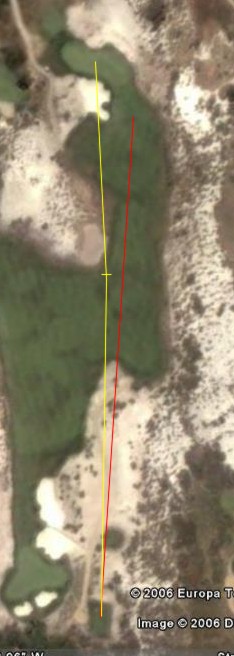
At the National Golf Links of America, Macdonald set out to find a natural site for his Redan. He had stated that every hole had room for improvement and the Redan was no exception. He was not fond of the blindness of the original and found a natural site for the green that was clearly visible from the tee. The joy of MacDonald’s version of the hole is that all the strategy and difficulty are clearly visible from the tee; what’s even more enjoyable is the opportunity for the player to watch the result from the tee.


The red line is the direct line, the yellow is the bounce in approach


MacDonald continued his improvements with the bunkering. While he copied most of the green’s shape, angle and contour understanding that was the key to the strategy, increased the depth of the “Redan” bunker and the back bunker, making the hole all the more perilous from the tee. While the hole was more visible and inviting, the penalty for missing the shot was much more severe. MacDonald’s version of the feels more of “an all or nothing shot” than the original does, which adds to the fun and the pressure of pulling off a great shot. The hole was so good that North Berwick’s famous head professional, Ben Sayers, called the Redan at the National superior to the original.

So what have I learned from this hole? How effective a defense it is to place a green on a diagonal line from play and defend it with a front bunker. This is the basis of the strategic school of design. But the biggest lesson is the green which places a player in a defensive mode. Rather than playing into a green pitched towards play that receives and favors the high shot, the fall away green requires more creativity and a running approach is the safer play. It favors the flight of the middle handicap more than the high aggressive flight of the great player because they won’t want to chance bouncing in the approach. Finally there is nothing better than providing an option. The player must make the decision to either play directly over the hazard with a precise shot or draw and approach around the fronting hazard using the land to feed the ball onto the green. This requires creative thinking rather than just swinging the correct club.


Next Hole: http://thecaddyshack.blogspot.com/2006/06/18-holes-day-5-13th-at-royal-county.html

Tuesday, June 06, 2006

18 Holes – Day 3 – 13th at Pine Valley


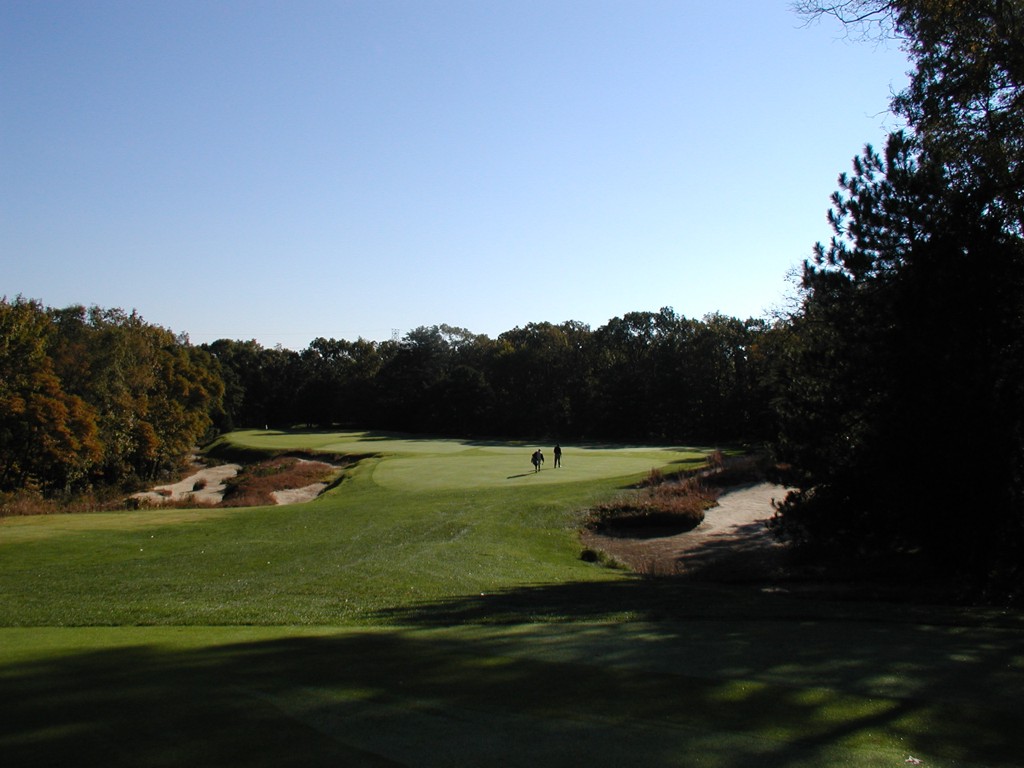
The fantastic approach to the 13th green, where everything feeds left


On a course full of great holes, this is the one that stands out above all. I have always been amused that A.W. Tillinghast claims to have designed this hole. I would bet that like everything at Pine Valley, it should still be attributed to Crump. I think Crumps’s strength was the ability to solicit all ideas from all his friends including Tillinghast, his brilliance was to use the best ideas and combine them all into one vision – his vision.

I had previously talked about the drive as being noteworthy. The drive is to the top of a high ridge that falls off in pretty much each direction. While a crown, the fairway is still wide enough to receive the tee shot, although great care should be taken from rolling off the left side where the player is stymied from going at the green. It is certainly one of the hardest drives on the course because of the crown shape to the land.

The beauty of the hole lies in the second shot. The long downhill approach is to a very large green that runs diagonally away to the right. Miss the green left or long and you are in deep trouble. The player is given two options; make the full carry over the wild exposed sandy waste to the large green, or to play a draw short and right and let the natural contours bring the ball down onto the green. The two choices work well, the green is large enough to receive a long iron, and the slopes are steep enough to feed the ball onto the surface. There are few holes that have such clear options that both work so well. The 13th remains one of the greatest models for a long par four that I know.

What I learnt from this hole was the routing aspect of the green site. Crump placed the green on a natural knoll on the end of a ridgeline. He used the formidable valley in front to create a wasteland of sand to force a carry and then took the natural side hill leading t the green and turned it into fairway so that the fairway banks around the waste area; because of this, the fairway can be used to feed the ball around the waste area and onto the green. Crump has allowed the player to play boldly over, or delicately around, depending on their confidence at the time. No matter which shot you play, it is as thrilling a shot as there is in golf.

Next Hole: http://thecaddyshack.blogspot.com/2006/06/18-holes-day-4-4th-at-national-golf.html

Monday, June 05, 2006

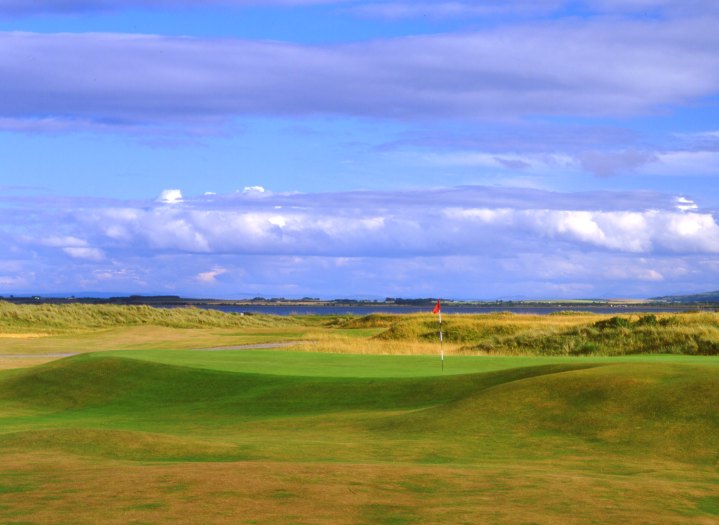
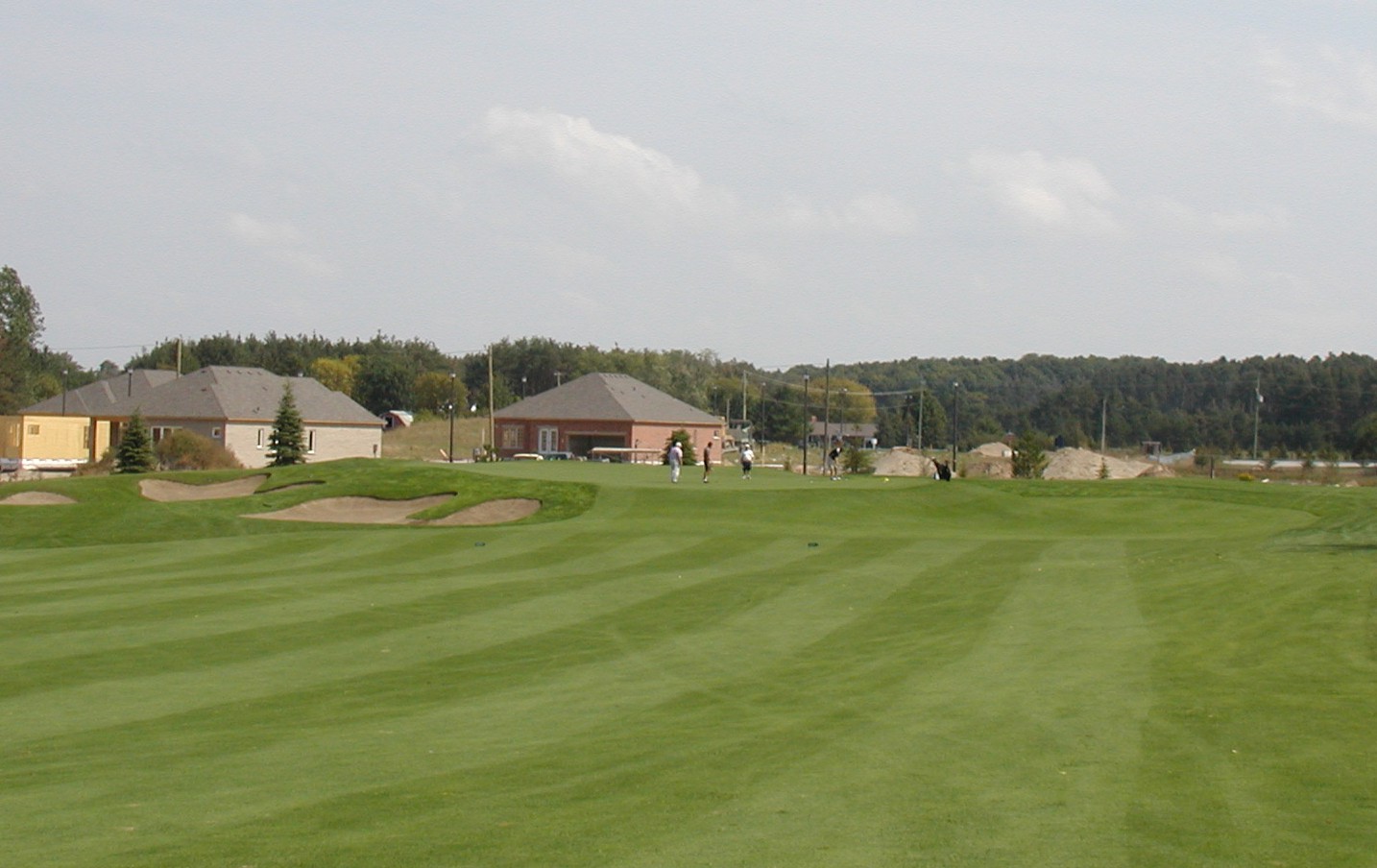
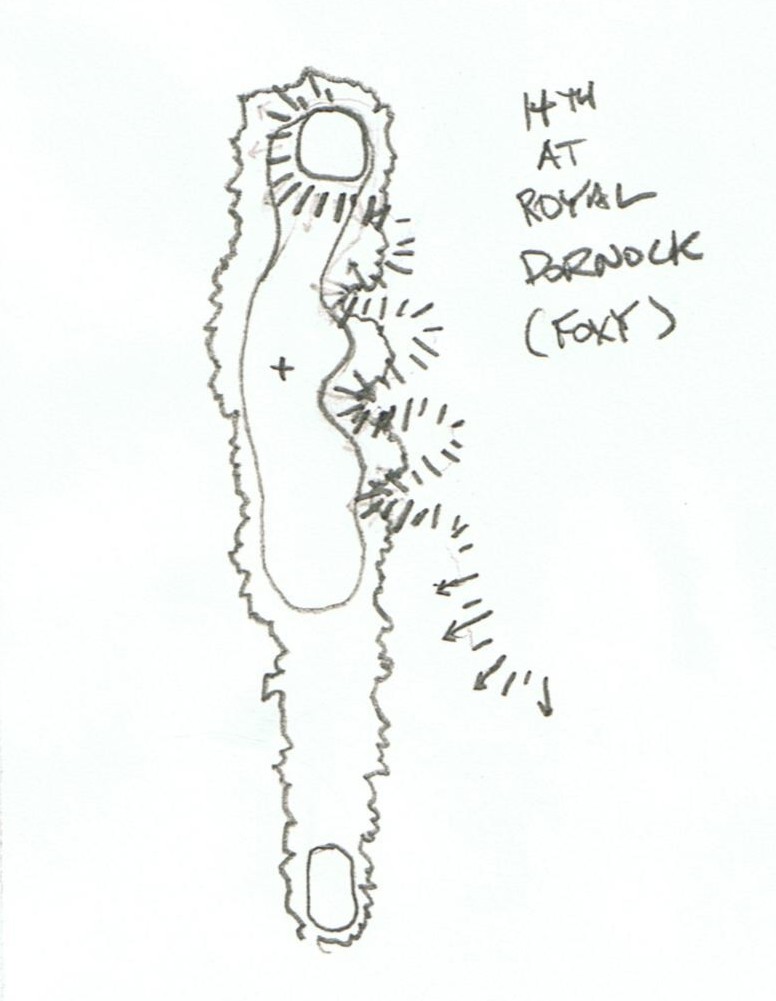
18 Holes – Day 2 – 14th at Royal Dornoch


The photo says more than I can try to


One of my favorite holes with one of the best hole names I know, “Foxy” remains a lesson in the value of selecting an using natural green sites to your advantage. The 14th at Royal Dornoch is placed on a modest plateau, which in itself is not an unusual choice for any green site. What makes it really fun is that the approach is with a long iron to the shallow green that will only accept the most exceptional shot. Anything coming up short is cast away by the slopes of the plateau. The fascinating aspect of the hole is that every approach is possible while none are really favored. Throw in the wind and you have one of the more ominous approaches in golf – and yet there isn’t a single hazard in your way!

The joy of the hole is not only on the approach but in the recovery shot, since it can be as difficult as the approach. It’s a great test of your creative abilities because there is still no standard shot for getting up and down, and the best alternative usually involves finding a creative route along the ground. If you are left, you get an opportunity to try any of the options you feel most comfortable with. If you played short rather than risk the direct approach to the green, the green sets up well from in front, but you still must contend with the shallow green. But if you went after the green and missed long or right, the pitch shot is close to impossible and you now have your hands full.

I did not begin with the tee shot initially because I’m still not sure what play is most prudent. The right flirts with the dunes and seems inviting, and yet the left seems to provide slightly more depth in the green to hit into, but I’m still not sure of the merits of either. I do know my father played left safely left and was successful by running a wood along the fairway and up the slope. This is most likely the best approach to the green. I played down the right for what I thought was an advantage, but my aggressive approach was easily cast aside by the crowned nature of the green. The recovery was tough and a shot was lost to par.

So what did I learn from this. Never underestimate the value of using a plateau to place a premium on the approach. That short grass is often a better defense than a bunker and is likely the most misunderstood and least used of the natural challenges available to an architect. It doesn’t hurt the average players but confounds the good player from the approach through to the recovery. Finally that if a green lacks the depth to receive the shot, then the approach is becomes very demanding - but if short or lay-up options exist that is a reasonable alternative (to going directly at the green) – the hole is very difficult but quite fair.

Next Hole: http://thecaddyshack.blogspot.com/2006/06/18-holes-day-3-13th-at-pine-valley.html

Sunday, June 04, 2006

18 holes/18 days - Day 1 - 10th at Riviera

I'm going to talk about the 18 holes that most influenced my thinking. I will touch on each hole and what I think makes them great and what I learnt from each one. I will stick to 18 holes from 18 courses by 18 architects.

Day 1 - 10th at Riviera


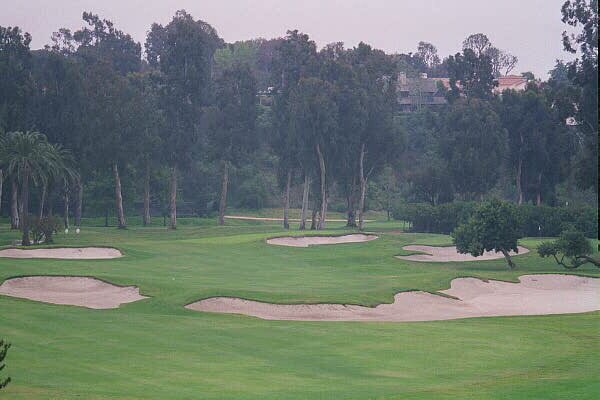
the smart line in red, the usual line in yellow


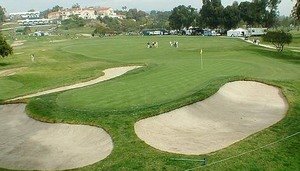
My favorite “designed” hole is undoubtedly the short par four 10th at Riviera. I love most short par fours since everybody has a chance on a short par four. For the average player, here lies the opportunity to make a par; and for the better player, a chance to make birdie.

The 10th hole at Riviera may be the most deceiving hole in all of golf, after all a 311 yard par four should be a push-over right? The hole is easily reachable from the tee which naturally entices a bold player to play for the green. One of the joys of the Nissan is watching how many players try to hit the green, and make five. Even though they know missing right is certain peril and most strokes are lost from missing right, they continue to look directly at the green. The true genius of the design lies in the green itself, it slopes sharply away unless you come in from well left. This is a very special hole, after all how many holes do you know where the longest way to the hole is the most efficient to make a score?


the green falls away to the right


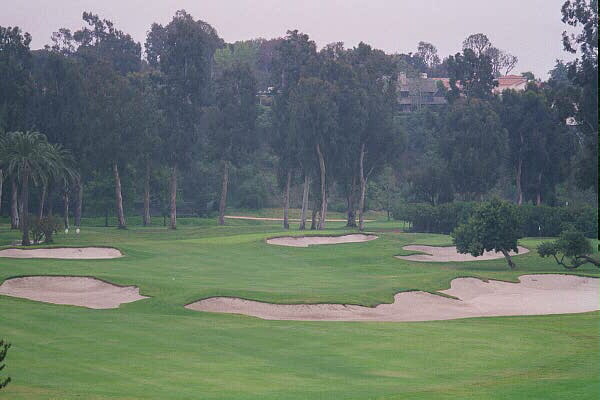
But is doesn’t stop with just the green. When you see the hole, you are surprised to find out it is built over a huge flat wide-open expanse. Thomas and Bell have added a series of bunkers that further add to the feeling of width. The other thing the bunkers do is perfectly frame the line directly to the green. The funny part is the left edge of the fairway, where the smart lay-up is played, looks like the worst option from the tee. How many holes do you know where the smart play is the least obvious and the riskiest play is the most understandable?


notice how the bunkers tell you to go at the green, and look at all the width


The player is left on the tee just brimming with confidence that they can knock it on, and the architect has gone well out of his way to encourage this. You may get lucky with your silly choice and make a birdie or a par through an excellent tee shot (as I did). But as my host, a regular member said, you won’t pull that off two days in a row. Once you make six from the right, you take the route to the left all but a few times a year – if you want to score.The hole has many options, needs a great deal of learning to play it well, and allows all level of players a good chance at a score. This is a perfect hole at only 311 yards. So please explain to me why we need 7500 yard courses?

So what did I learn from the 10th? I learnt that the tilt of the green can dictate position on the fairway. That deception still works in this day and age of yardage. That enticement done well, will usually win out of rationale thought because we just can help ourselves “from having a go” That 300 yards is still enough despite technology.

Next Hole: http://thecaddyshack.blogspot.com/2006/06/18-holes-day-2-14th-at-royal-dornoch.html

Friday, June 02, 2006

What Beyond the Scenery Made Pacific Dunes Great?


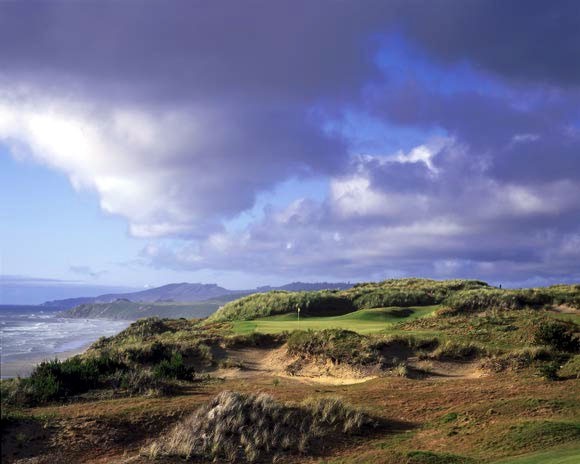
The second of the back to back par threes, the wonderful short 11th


There is no question the setting is unparalleled. The beautiful sand dunes and jaw dropping views up and down the coast make Pacific Dunes one of the most beautiful locations in golf. It bears a striking resemblance to the holes east of 17 Mile Drive at Cypress Point. It was undoubtedly one of the great sites to be given to any architect in recent memory. As Bill Coore said, “He was the right architect on the right site at the right time in his career”. He went on to suggest that he could not do a better job and since Bill Coore is the top architect in golf, this would be the ultimate compliment.

But it’s not just the site that makes the course great. The architecture is very provocative, and many of Tom’s decisions took courage to go against convention. While I really like Bandon Dunes, there is no question in my mind that Pacific Dunes is a superior golf course on an equal site. So why is that?

Well the best thing to do is give you a list of the unconventional ideas he used to make the course great. Number one is he designed a modest length golf course that would be called short by modern standards. Why would he do this you ask? Because that was what the best routing the site would yield according to Doak. He also pointed out that Bandon Dunes was plenty long so building a shorter course was not a big issue. So big deal it’s a little short. Well what this allowed Doak to do was build more short and interesting par fours than most modern courses. There are a couple of real classics in the 6th and 16th.


Looking down the coastline, over the blow out bunkers, on the spectacular 13th


Now I mentioned the routing, and that was where Tom took the largest risk and opened himself up to criticism by designing an unconventional distribution of holes. He used back to back par threes to open the back nine. They fit perfectly and placed two dramatic holes looking out and then along the ocean. These are two very memorable holes to play. He ended up with a routing on the back nine that had two (yes two!) par fours, since that was the best routing for the holes. Imagine a course with one three and one five on the front; then four threes, two fours and three fives on the back. Yet it was the right thing to do.

The final ideas are the details of the course. Tom also used alternate greens on the ninth and alternate tees on the tenth rather than choosing between two equally good options on the holes. Rather than bunkers he has blow outs that fit beautifully into the natural dune areas. He created very wide fairways for playability in high winds and then bunkered inside the fairway lines to preserve the width while providing some strategic challenge to each of the holes. He built wonderfully rolling greens that flow naturally out into the fairway of chipping areas so naturally that you don’t notice the transitions.

Finally Tom never worried about people finding the course not challenging enough and concentrated on making it the most beautiful and interesting place you may ever play. Playing it makes me think of my round at Cypress Point. What architect wouldn’t like that comparison?

Thursday, June 01, 2006

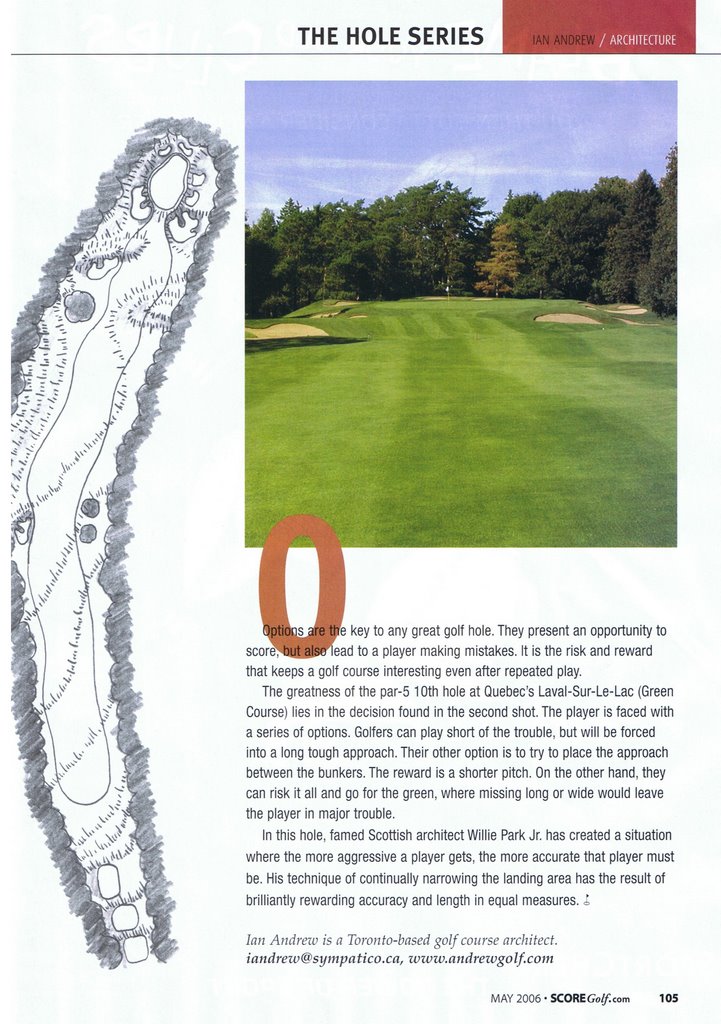
THe Hole Series in Score - #2


Click on the image to read full size page

Wednesday, May 31, 2006

Stepping Back in Time at Allandale


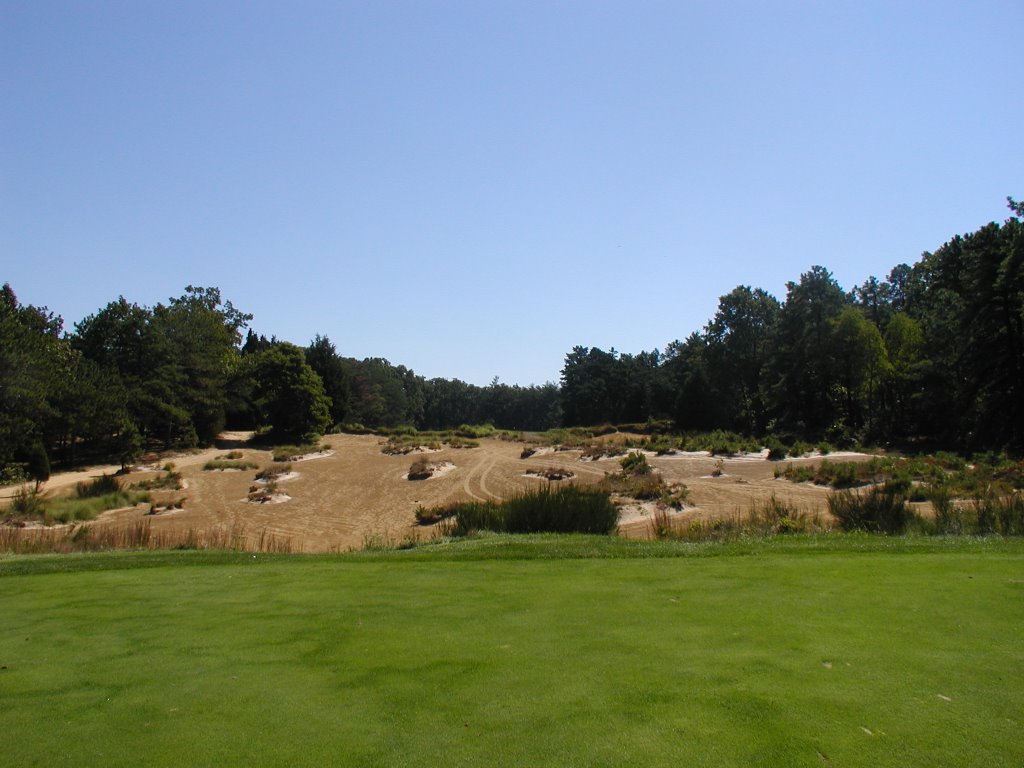
The amazing opening green site, as good as anything I've seen


On Monday I met up with two friends (and fellow Stanley Thompson enthusiasts) to play Allanadale Golf Club. For Thompson fans Allendale likely gets passed over because it is only 9 holes, and is one hour north of Toronto. But for anyone who hasn’t made the trip for those reasons has missed out on a unique experience. Allandale Golf Club is probably the most intact piece of Stanley Thompson in Ontario. When you begin to go through the best known Thompson courses in Ontario you’ll find they are all altered. St. George’s has four green sites that are not original, Westmount has three new holes, even Cataraqui has a couple of holes on the front nine that Stanley didn’t do, and a couple of greens that were rebuilt. Allandale is all there, still intact, like stepping back to 1927.

Now I will say up front that about seven greens need recapturing to find the original contours, but that really is nothing beyond a year or two getting the grass back to green height. The contours will add a lot to the already fascinating contours that bring memories of Highland Links for their charm. The greatest improvement would be to recapture the back tier on the fascinating 5th. That is almost as good as the back pin at the 2nd at Catarqui.

Many of the bunkers have lost there lines, but because of the way they have grown in the old lines are fairly clear on most of them. The rest of the bunkers are now grass, but once gain because of the way they were removed the bunker complexes are all 100% intact waiting to be brought back to life.


The carry bunker, short of the green, on the 5th


The charm of the place is you get to play the same routing, the original greens, essentially the original bunker placement and even the old tees (there are a couple of new tees, but even they are barely noticeable). You can’t beat that for getting to experience what Thompson laid out. The owner, Brian McCann said that he has only planted three trees in all the time he has owned and operated the course, so even the width that Thompson created has not been lost by silly planting schemes that ruin a lot of Stanley’s work.

Brian mentioned that a few people have come through, including a member of the Stanley Thompson Society, and told him to spend big money making fixing things and making changes. But I just can’t understand why. He only needs to slowly recapture what has shrunk or been grassed in - Nothing else! I will be back to play there with my son, a perfect place for us to enjoy the game as it is meant to be. Did I mention that nine holes in this incredible setting is only $21. during the week. Go! If you are a Stanley Thompson enthusiast and you haven’t been there…..go!

Tuesday, May 30, 2006

How to Restore With Limited Information


A possible future look at Scarboro


I just found out today that I am one of three architects who have been asked to research and produce a long range plan for Scarboro Golf & County Club. I have been given an amount of time and a budget to provide this to the club. I’m very excited about this opportunity for a couple of reasons. One, the course is a standout, and once well restored or renovated could likely make the top 10 in Canada. While it has a few quirky spots, there are many more moments of shear brilliance in the architecture. Two, the course is attributed to A.W. Tillinghast and this would be my first time working with one of his courses. This now puts me on a path to learn as much about Tillinghast and his architecture as I can. I really like getting to understand the architecture and thought process of a new architect; I find the process very inspiring. I have already read a series of books and contacted a few architects and authors with questions about Tillinghast. I have done much of the intellectual research needed to understand his philosophy and I feel I’m one trip to New York away from collecting all the background information that I need. Third this is my first chance to really do things the way I want to which includes allocating the proper time to do things the best I can. This last freedom is one that I needed if I wanted to do better work.

As I’ve likely stated before I like to restore or renovate through research. I know that some of the key items at Scarboro do exist, but other information still eludes me.

I thought I’d spend the remainder of the blog dealing with the typical problem I may eventually face on this project. What do you do with the architecture when you don’t have any old photos, when the plans and aerials don’t provide enough detail to be accurate, and the existing landforms have been altered? This is the hardest point in a restoration; almost every course has a blank spot or series of blank spots in the information you have to use.

When I have discovered a lost bunker by plan but the original landforms are missing I like to; use the aerials to ensure location, the plans or notes to follow the intent, use the other existing landforms to provide the basics of any new form, and finally draw on a collection of his best work to provide examples to be borrowed. The idea of this is if any new shapes or bunkers need to be created to replace lost ones, the work is essentially still Tillinghast. It has been simply borrowed from another one of his projects to keep his true to his style (and to avoid any hint of my own). As restorers and renovators we are often put in this position. What I aim to do is to try making my work as accurate to the style as possible so that anyone looking at a new bunker may mistake it for an original. If you can’t tell what I’ve done, then I have succeeded in my work.

Monday, May 29, 2006

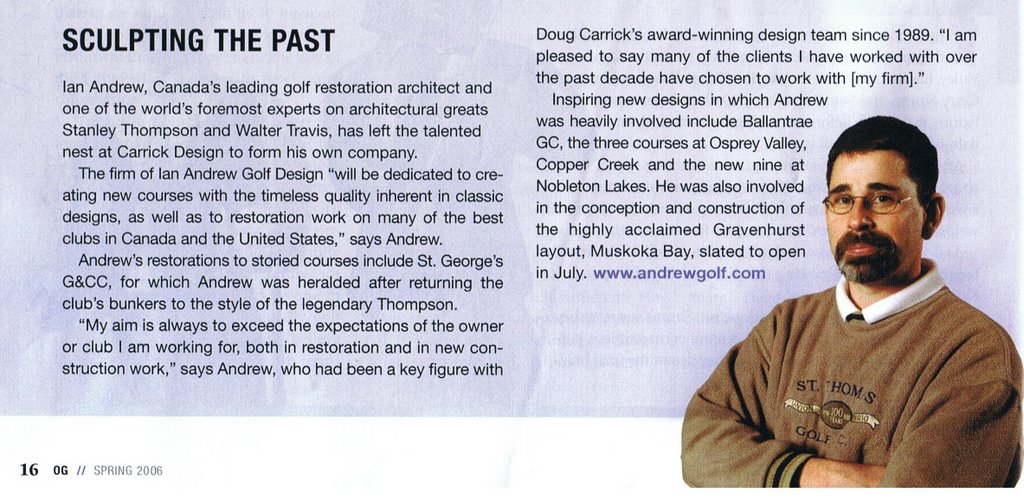
Article in Canada Golf – and A Thanks to Rob Thompson


Found on the last page of this months Canada Golf

Click on the image to read it


This may be an appropriate time to thank Robert Thompson. Robert encouraged me, not only to write the blog, but to begin to write about golf. He has been a huge help in letting me understand the basics of writing, the reasons why writing will help me with my career objectives, and how to go about getting my message out through what I write. He has been a huge help to me.

This article was the first thing I wrote after Rob had convinced me to begin to put my thoughts to page. I also thought Alison King did a marvelous job of cutting the piece down to fit. It took me a while to realize what was missing.

Life is good

So How Did I Become an Architect?


This may not be Pebble, but it's a mile away, and the middle guy won at Pebble four times.


Yesterday’s blog sort of spurred on the idea of telling my story.

I began watching golf during the Pebble Beach Pro Am when I was 12 years old. I remember watching this beautiful course and paying no attention to any of the players – I was in love with the holes. Dad reminded me a couple of years ago that I immediately grabbed paper and began drawing the holes in plan. Then the future architect took over and it lead to designing new holes. God I wish I still had those to post. Dad said a few months later I was still watching golf and drawing holes when I asked if this was somebody’s job to design courses.

He started me playing a year after that and I decided to write to the ASGCA for “help” They suggested I take Landscape Architecture and that course of action became set in stone. From day one I always wanted to be a golf architect so I went to both Ryerson and the University of Guelph for Landscape Architecture. While interning one at a large Landscape Architecture office, one of the designers suggested I call a really nice guy named Doug Carrick.

I called Doug and talked to him about my desire to be a golf architect and asked if I could go on site with him. He graciously invited me along to follow him around on site and I knew this is what I wanted to do; the only problem was he wasn’t busy enough to hire me. While he likely doesn’t remember that day, it was the best day I ever spent with Doug because he actually took the time to explain the design as we went. He finally did have an opening a year later but I would have had to quit with a couple of months left in school and I couldn’t bring myself to do that. I eventually interview with Tom McBroom after graduating but I found him so argumentative and arrogant during the interview that I actually got up and said I was not interested in working there and walked out. Our half an hour argument was over whether you should be able to run the ball up onto most greens, I was already talking Thompson and Ross at this point since Dad gave me a steady diet of books to read. Funny thing is we have met for lunch and get along fine; I think he has no idea that he interviewed me.

I found myself working as a Landscape Architect for a while until out of the blue Doug called with an opening. We had kept in contact through the years and he hired me to come join with him. Now the important part to this is I actually talked to Doug on a regular basis for almost three years before I ended up working for him. If there is one thing a budding architect must know - nobody is hired off a resume – most know the architect informally well before hand.

I worked for Doug for 17 years. You could call the initial years an apprenticeship, Doug provided the basic education in the office and I handled getting drawings and specifications out on time. When we were up to date I was invited to tag along on site to listen and learn. The next stage was taking the responsibility for small renovation projects where I met with clients, did all the design work and then ran the job in the field - this eventually lead to large renovation projects. This was a great education in all facets of the job and was a great preparation for the final stage - being in charge of new project. I learned to write specifications, tenders, create new details, produce an entire set of working drawings, administer the project, deal with consultants, sub-consultants, deal with owners, planners and all the issues that nobody realize exist until they actually build a course.

I stayed possibly longer than I should have but I felt some loyalty to Doug. Finally after a long tenure with Carrick Design, and being accepted as a member of the American Society of Golf Course Architects, I was left with one goal left unfulfilled. I want to build a course from beginning to end where I am able to use all the techniques and strategies that I believe make a better golf course. This is not a knock on Carrick’s work, but rather a desire to go somewhere completely different, and that is how I come to be on my own.

So why the blog? Partially to slowly collect all my ideas on paper, partially to communicate with others interested in architecture, partially because I needed to learn to write badly, but mainly to organize my thoughts on what I want to do. I hope to be able to continue blogging right through to my first completed project. I think the run through the design process and construction would be fascinating to write about.

Sunday, May 28, 2006

How to Start to become an Architect


From Megan's website


The tough part about blogging is finding an idea on what to write about. Often something has taken place, an email has arrived, or I have read something that sets me off writing. Most of this blog has been written spur of the moment when I sit down to blog. I will admit there are days where blogging feels like a job, fortunately most of the time I still enjoy the exercise. This morning I woke up to finish my article that I’m writing for a publication (more to come later). I knew after that I would likely write the blog, but today was a rare day where I was stumped. I turned on the computer and my subject was waiting. Thanks Megan.

"Megan Heckeroth writes, “I always wanted to get involved in this part of golf because I get design ideas and have no place to channel them. particularly as I play all over the world and see unique features not used elsewhere. Any advice on how a tour pro can get involved in course design?”

Megan by the way has an interesting blog of her own:
http://www.megangolf.com/index.asp

What I would recommend is that you take this golf season to read a series of books first.

My essential five architecture books are:

Golf Architecture In America by George Thomas
Some Essays on Golf Architecture by Colt and Allison
Anatomy of a Golf Course by Tom Doak
Golf Architecture by Alister MacKenzie
The Architectural Side of Golf by Wethered and Simpson

Here are some other suggested readings:

1. Golf Course Architecture, Design Construction and Restoration by Mike Hurdzan
2. Golf Architecture A Worldwide Perspective Vol. 1 – 3 by Paul Daley
3. The Links by Robert Hunter
4. Any book by Geoff Shackelford
5. The Evangelist of Golf by George Bahto

In Megan’s case I would recommend working with a golf course architect. If you really want to learn the business then you’re going to have to learn, particularly on how to actually build courses, from someone with more experience. If your young and reading this, go work on a golf construction crew, the education is invaluable for the rest of your career. The process is then to gain experience, get the background education and finally end up either working for a design firm or starting your own. You will have to work for someone in some capacity before you can work for yourself – we all have.

Tomorrow - my road to becoming an architect and finally on my own

Saturday, May 27, 2006

Design Credit


This is the 7th at ballantrae in it's original form. Ballantrae: routed by Doug, designed by me, two holes new holes by Cam Tyers.


There have always been a lot of questions about design credit. It is an issue for the associates within a firm. It is a much bigger issue when two architects go there separate ways. It is an issue after a major renovation. I thought today I would wade into the debate about design credit and provide some examples.

Let’s start with the idea of renovation and restoration. In any restoration, the restoring architect should never get credit for the work. The original architect should be the only one listed. I personally think that an architect must add at least a couple of holes before there is any credit given. A bunker job or rebuilding a few greens is not enough. Where it gets grey is rebuilding all 18 greens, and personally I think it would take all 18 greens to give design credit.

I have always believed that whoever routed the golf course should be given design credit for the course. Routing is so essential that even just a routing is enough to be listed as the designer or co-designer. I think if another architect picks up the rest of the project, they should get credit as a co-designer. On the other hand, I think if the architect is in the field on behalf of the firm, but did not have a hand in the conception of the holes; they probably should not get credit.

I think if an associate has laid out the course and taken it to completion on behalf of a company they should get design credit. Hurdzan Fry is a firm that handles this well, where they name themselves as the architects of record and then name the individual designer. I always thought this is a wonderful way of giving credit where credit is due. As a researcher and historian, I always want to find the architect who actually should be given credit rather than just listing the most popular architect as the architect of record.


One of the new nine holes at Nobleton Lakes


So why does this matter? Well to some it does not, whereas to others it does matter. Sometimes the credit issue can be the wedge that drives a company apart. I like to receive the credit for the work I do, whether it was for Carrick Design, or now on my own. I’m proud of what I do and I think it is important that people know what I have done so I get the proper consideration for future projects. Sometimes the desire for an associate to receive full credit leads to uncomfortable relationships between the principle of a firm and the associate. Many principles want to take all the credit even when there role was largely administrative because of the attention they receive (to make this clear - this was never the case at Carrick). Also, many seem to feel it is important not to recognize the associates to keep them for creating a reputation that may eventually exceed the principle.

When this tenuous relationship breaks down, we are left with the battles over credit after the associate leaves particularly if they did all the work. Doug and I seem to have done OK on this end, unfortunately it's the clients who usually list only Doug. To clear any misconception, I would like to point out that the Ontario Golf News piece suggested I may have been the lead on certain projects, whereas the reality is that I was at best co-designer on some but most often the man in the field. Doug is listed as the designer of record on all new projects and that is fine with me. At this point I don't want recognition for any of them, I just want it known that I got them built and that is where my experience comes from. It is the renovation and restoration work where credit is most important to me.

Thursday, May 25, 2006

A Philosophical Look at St. Andrew’s


St. Andrew's, the home of great architecture


St. Andrew’s does not conform to any set of rules. In fact it seems to contradict al the modern “rules” of design, like no blind shots, no crossovers, no featureless holes, only two par threes and par fives, a short easy finish, bunkers in the middle of the ideal line, penal hazards, houses in play etc.

Yet when you break down the course the strategies exceed almost any modern design by a great margin. Some lessons are subtle, like the value of ground contours and the idea of discovering ways to play the course. Others are clearer like the amazing mixture of lengths, the variety in size and difficulty of the hazards, the optional routes depending on pin, and the value of green contours.

I still get amazed when many of the leading architects and players dismiss the course as overrated. They talk weak holes such as 9 and 10, the blind tee shots, the poor definition, the ability “to hit it anywhere”. The funny part is often these comments are made on the first visit when the player or architect has not taken the time to really get to know the Old Course. The architects also try to justify their view when they talk about the criticism they would receive if they built holes like St. Andrew’s. I still think, in many cases, they are really trying to justify to themselves why there work is not held in higher regard when placed in comparison to this “cow pasture”.

So let’s look at what works well and see what we can draw from St. Andrew’s

1. Anyone can play this course, the wide fairways and large greens make this a course for all. This is a course that works as well for the dub as it does for the elite player. Sure they can go low without wind, but so what, how many days there don’t have wind. The weaker player can play safe towards the middle all day and likely not lose a ball. This makes the game fun for all.

2. The native ground contours dictate much of the strategy and influence almost all of the play. The golf course was found more than it was built. The uneven lies and wicked rolls and humps on the fairways and around the greens require creativity and imagination to solve St. Andrew’s. To play well means a mastery of the contours of the land and those wonderful rolls in the green. The green contours at St. Andrew’s defend the course from the great player; they require careful approaches to find the pin positions and a deft touch with the putter to score. The average player, in turn, enjoys the large greens and short grass beyond to get around in comfort.


Bobby Jones did not like the course at first, but it became his favourite in time.


3. The course does not rely on deep rough as its primary defense. The modern courses seems to be a series of targets surrounded by deep rough that is placed there as punishment for missing a single shot. It provides one look and one recovery option and removes much of the creativity. At St. Andrew’s the absence of rough provides an infinite amount of recovery options around the greens. It also allows the player to gamble and get themselves into much deeper or to make a miraculous shot to save a shot. Once again this adds more fun to the game.

4. The greens can be approached in any manner, whether up high or along the ground very few course give the player this many options when considering the type of approach and the conditions in which you are asked to hit the shot.

5. The golf course allows for the wind to be part of the game. The width of the fairways keeps the course playable in high winds and the style of the course allows for different shots depending on wind direction and severity.

6. The golf course requires far more imagination than it does courage. You are encouraged to try shots, invent approaches and think your way around. The route is there for you to choose and the challenge you want to take on is up to you. The modern course and designer would rather tell you what to do. So how is that fun in comparison to a round at the Old Course?

The Old Course is what golf is all about……fun

Wednesday, May 17, 2006

Defending without Length - Dealing with Technology- Part 3


Only a short par three "Het Girdle" shows length and difficulty have no direct connection


Sorry about the delay on Part 3, we decided to work on a different article instead. The first two threads are from a couple weeks ago if you need a reminder:

http://thecaddyshack.blogspot.com/2006/05/technology-overwhelming-architecture.html

http://thecaddyshack.blogspot.com/2006/05/technology-overwhelming-architecture_04.html

I spent Tuesday trying to convince a potential new client to build a course that was less than 6,800 yards. Not only would it make a better business model for him by keeping costs lower, it would fit better into the limited land he had to work with. I explained to him that length was only required to challenge 1% of all golfers, and that for the good of the course and business model we should simply ignore them. What we needed to do was meet the actual demand and make sure the course is interesting rather than trying to force a long course out of a small property.

He asked me the question that I knew was coming, if we remove the length, won’t it be too easy? Therein lays the biggest problem in architecture today; owners, players and architects have somehow come to believe that length is a key component in difficulty and greatness. The irony is that it length has been responsible for removing options, variety and interest – all key elements of a great course - while driving the cost of building a course continuously higher.

So if we remove length from our design palette, then we’re left with short courses that aren’t very good and can’t defend themselves right? Well until very recently Pine Valley, Merion, Myopia Hunt Crystal Downs, Fishers Island, and Cypress Point all were less than 6,600 yards. Merion and Pine Valley in particular are two of the hardest courses I have ever played, and length is not a key factor to the difficulty of either.

So how can an architect add difficulty without resorting to length, fescue, excessive water or heavy rough that all create 6 hour rounds?

Here are my suggestions:

1. Make the player think.
Alister Mackenzie said, “A first class hole must have the subtleties and strategic problems which are difficult to understand, and are therefore extremely likely to be condemned at first sight even by the best of players.” Providing the players with options and tempting situations keeps them off balance, even with the equipment they enjoy today. If the strategy is simple and straight forward they will play to their strengths, but if a hole is full of enticing options they will often entertain the most foolish line trying to gain an advantage on the course. The 10th at Riviera is the perfect example, where the smartest play is the least obvious, and the riskiest play is the most understandable. Players are drawn into hitting the driver despite the fact they know a lay-up produces more birdies.

2. Make them manufacture shots.
The shot that the professionals are most uncomfortable with is being forced to hit a fade from a draw lie, or a draw from a fade lie. They would rather take their natural swing than have to manufacture a shot. Using the natural cross-slope of the land to influence play is the least used and most effective method to add additional difficulty to a hole. The 15th at Garden City has both the fairway and green sloping hard to the right. No trees, no bunkers, but you still have to draw the tee shot to hold the slope and draw the approach from a fade lie to hold the green.

3. Place pressure on their expectations.
Short holes are wonderful things; they give the average player a chance to make a par, whereas the great player feels the pressure to “make” a birdie. At Merion on the short middle stretch the better player feels great pressure to score. Most become overly aggressive trying to make birdies through this stretch, but often drop shots through bad mismanagement. Many professionals have commented that the round is often lost on this stretch, rather than the difficult closing stretch, because they have thrown away the opportunity the holes offered them.

4. Intimidation.
Intimidation is one of the most efficient ways for an architect to add difficulty. Intimidation is created by reducing the dimension of the target they see, by making the penalty for missing seem even greater than it is, and by making a task seem impossible when it is actually much easier than it appears. Pine Valley and Tobacco Road offer generous fairways and large greens, but the visual aspect of the hole overwhelms the player into thinking they can’t make the shot. While the targets are no different than their own local course, the player swings with the dread of where the ball may end up, instead of thinking only of the target. As Pete Dye said, “When you get those dudes thinking, there in trouble”
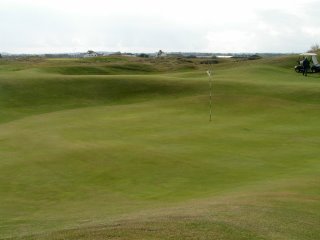


The approach to th 3rd at Deal shows contour is the greatest assest of a golf course


5. Bold undulations on the greens.
An extra two or three inches of fall on a green can be more diabolical than a huge roll in a fairway or a frighteningly deep bunker. Greens are the heart of the golf course and have the greatest impact on the game. If the contours of the green are bold and pin positions can only be accessed from one side of the fairway, positional play becomes very crucial. A great green like this will dictate the strategy of the hole all the way back to the tee. At St. Andrew’s the greens are mistakenly thought to be easy because they are so easy to hit, but if you find yourself on the wrong side of a prominent ridge or roll you will have trouble making par. Great greens, like St. Andrews, must be studied and learned in order to score.

6. Closely mown grass around greens.
When you surround a green with bluegrass the player ends up always playing a traditional flop shot recovery. The bluegrass usually contains the missed approach allowing a good player to play aggressively. However, if the green surrounds are closely mown, the near miss often gets propelled well away from the green. Now the player must decide whether to putt, bump and run, or to attempt a flop shot. Options present opportunities, but also lead to mistakes. The US Open at Pinehurst showed the difficulty created by short grass around greens, players had to manage their approach shots to avoid getting into areas where they would have trouble getting up and down. Rather than help with playability, like it does for the average player, the short grass increases the difficulty for the good player and makes them play more defensively. This has long been a staple of links courses throughout the world.

7. Return the penalty of being in a bunker.
When the player aims at the perfectly groomed bunker because it offers an advantage, the hazard ceases to be relevant. The bunker has devolved into the source of artistry rather than a source of strategy. Bunkers need to cost you a stroke, not reward you, for knocking it in them. Walter Travis sums it up best, "The primary idea of a hazard is to punish, to the extent of one stroke, a poorly played shot, and to make the recovery exceedingly difficult, and even by the virtue of the following shot being extraordinarily good. If this end is not attained, the existing hazard fails to fill its functions."

8. Blindness or partial blindness.
There is nothing more loathed or hated in North America than a blind shot (except may be for liability lawyers). When a player is confronted with a target that they can not see, they become immediately uncomfortable. Tour pros declare these holes as mistakes or unfair, because they lack the focus that they require to mentally visualize the shot. Even a blind green, where the flag is still visible, is often enough to bother a player since they lack the visual confirmation of distance and the clarity of their target. The average player simply chooses the rock, tree, spire or flag and swings away since they worry less about visualization. The blind shot is very controversial in this day and age of earth moving equipment, but used infrequently and in the right setting it can offers the architect a way to break the rhythm of a player and add variety.

The 10th at Rivera proves to us that at barely over 300 yards, there is more to difficulty than just length, I just hope my future clients understand you do not need a course over 6,800 yards to make them difficult.
Tuesday, May 16, 2006

Short Article from Ontario Golf

The Dead Architect Societies


In principle I’m a big supporter of the idea of promoting the life and works of great architects. It’s good for the game, it’s very good for historical preservation, and it helps clubs avoid foolish renovation schemes when a course is already quite good. If there were no politics or personal agendas involved Dead Architect Societies would be excellent. The only problem is many of the Societies are run or handled by people who put themselves before the society’s best interest.

Let’s take the Donald Ross Society, the granddaddy of them all. On the good side they have helped with the identification and authentication of many of his courses. They, or people involved, have help develop an accurate listing of his projects which alone is very admirable and important. They have helped to save some of his architecture and have got themselves actively involved with trying to prevent the loss of some of his projects. In general they have provided a great model for other societies to emulate. In general they are very good.

The darker side of this particular society is there heavy handed nature as an organization. The society takes many calls about there courses and about who should work on them. I have no issue with them making recommendations, but they almost always provide same list of favorites for all restoration work and quite often have been known to recommend an individual architect. While most of those architects are excellent, the society should not be promoting individual architects whom they do – it’s simply not fair to the others who have done great work too. Another practice that has recently immerged is their recent insistence in actively participating in the restoration process as an “ongoing” advisor. Why? Shouldn’t an architect with restoration experience, the photos and drawings be capable of doing the work? They do this more so when they did not recommend the architect, but were contacted by the course for some assistance. Regardless, this is all about power and control isn’t it. It gets worse with some of the members taking on work as the actual architect (they always use advisor – but what’s the difference), which is fine except that would also be using their position for personal gain – wouldn’t it? I have no issues with them becoming architects, just resign from the board. Where this gets to its worst is when one of the board members actively sought to be the club’s consultant at one of our projects while we were the consulting architect – something that I thought was very unethical on many different levels. Even the club was quite taken back by the gall of the member. I’m not against collaboration, and I have sought outside help when I’m taking on a new architect to restore. In fact I’m doing that right now, but that was simply an abuse of power. I think the Donald Ross Society is important, they need to clean up the problems or lose credibility.


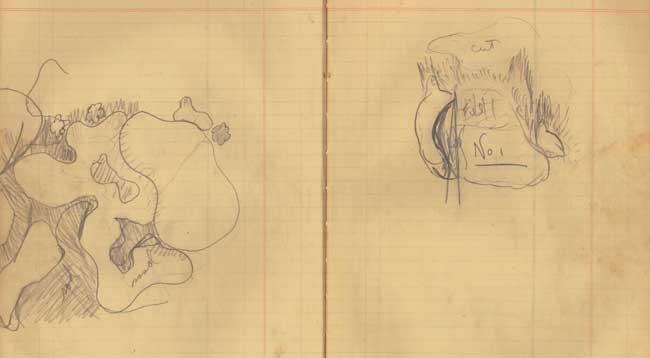
A Stanley sketch from the collection in Guelph Library


I am not a member of the Stanley Thompson Society which probably comes as a surprise to many. My issue with them has nothing to do with transgression like those above – although I think the architects sitting on the board do have the same conflicts of interest. I like many of them a great deal, but I can’t get by two issues. One is the unwillingness of the society to remove any course that is not actually designed by Stanley Thompson course in order to get a truly accurate list on his life’s work. This above all is my primary interest in the Society. The other issue I have is with one of the founders and the difficulties I have had dealing with him. When someone has buried you publicly, it is hard to have any respect or willingness to work with them. The problem is politics and personalities.

Monday, May 15, 2006

Restoration Takes Research


Augusta national 1941


Restoration takes research. Simply showing up on site and painting lines where you think things might have gone is not restoration. There are very few architects that really do restoration. Restoration is all about accuracy and having the conviction and the belief that returning the architecture is more important that borrowing from the style and putting your own little spin on the work. Relocating original features to “return shot values” is not restoration. While restoration may be a case of semantics, these are very important semantics if we are going to teach future architects accurately about the works of the past masters. Most architects use the word “restoration” as a sales tool to get a renovation program going at a club. Their ego tells them that they can improve on any previous architects work. Well I can tell you that most of these architects can not hold the original architect’s pencils, let alone do work that is comparably, yet they renovate great original works with mediocre architecture (and then someone like me has to come along and correct their blunders).


San Francisco early photos


To do a restoration, you need all the available documents you can get your hands on. Nothing beats photographs from around the opening date of the course. They provide us with a fairly clear vision of what the architecture looked like. Some architects, liked Donald Ross, left detailed working drawings. These are very helpful for recapturing lost greens and lost features. Depending on them as the sole or final decision is dangerous since every architect made field adaptations and field fits to make their ideas work. On everything I have worked on, nothing was built 100% to the drawings, so what are the odds the past masters would have built everything accurately to their drawings.

Aerial photos are available for almost every course in an urban center. For example Toronto was flown in the late 30’s. The aerials are very helpful for layout but limited in feature recreation since you can’t get details on heights or shapes. Everything is a two dimensional overhead form, which is great for tree lines, tee location, bunker location, fairway contours, green shapes, chipping area, etc.. They can be great for recapturing and locating lost holes or features which are often hidden in trees. Writings and sketches offer a terrific insight into the strategic or artistic intent, but usually provide little beyond historical knowledge. You must be careful of the architects or writers prose, often they tell a tale that turns out to be hype – just like some of the articles written today. A good restoration comes from multiple sources, used carefully together like the pieces of a puzzle to create an accurate assessment of what was actually there. To restore, you must know what was there first.

The last step is to go have a look at what is left on the ground. You are left to use all the available historical information to decide what features are still in place, what can be returned with minimal work, and what will need complete recreation to return the architecture. Restoration only happens when everyone involved cares.

Tommorow - Dead Architect Societies

Saturday, May 13, 2006

The Three Schools of Design - and where I sit


Hell's half Acre - unquestionably penal (but great)


I was asked once my opinion on heroic, strategic and penal schools of architecture.

The penal school of design revolves around punishing a golfer for a missed shot. Whether a hook, a slice or a miss hit tee shot, they all end up penalized if the golfer does not find the target. Pine Valley, the greatest course in the world, is primarily penal in design. Their strength is that they reward accuracy above all else and that courses like are ideal for championship golf, but they unfortunately punish the average player so severely that they make the game too difficult for the average player. This would be the first school of design since the earliest changes by man seemed to follow this philosophy.


The 9th at Riviera, one of the most strategic courses in the World.


As the first architects appeared, their study of architecture brought new ideas about of golf design, and the strategic school grew as a reaction to the penal school of design. They felt that the penal architecture was too hard on the “dub” and that the game should challenge the great player without discouraging the poor player. The new architects started to look at positional play and rewarding a player for making a tough shot. If they provided a risky line from the tee, they would then reward the player with an easier approach to the green. They began to place hazards along the best route to defend holes while leaving the rest of the hole undefended for playability. The work of Tillinghast, Colt, Thomas and Mackenzie would be described as primarily strategic in nature.


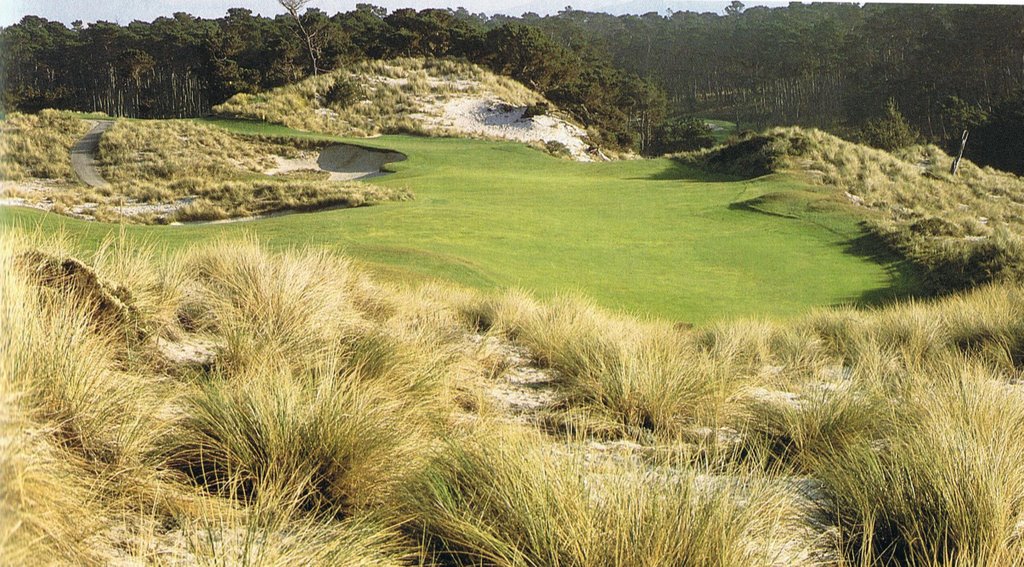
The 16th at Cypress Point, certainly heroic, thank Merion Hollins for the hole.


The final style is well identified with Robert Trent Jones, but has origins with Charles Blair MacDonald and Stanley Thompson to name two other earlier architects. The final school was the heroic, where golfers are given either forced carries or very dangerous diagonal carries over hazards. The island green at the TPC at Sawgrass could be called the ultimate heroic hole, but the 18th is likely the best example of the course. Golfers are invited to dare as much as they can for ideal position, but the penalty is a return to the tee for missing the shot. As you can see this is actually a blending of penal and strategic into a new school. The work of Pete Dye has evolved into heroic through his evolutions.
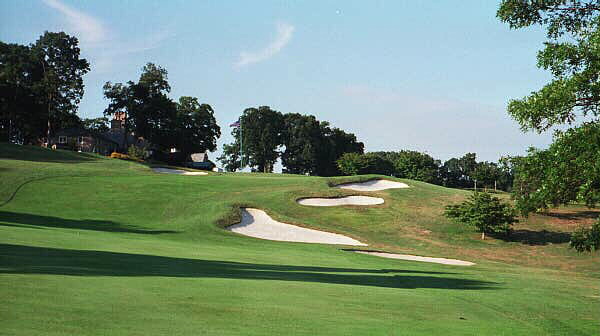
So where do I stand on this? Penal all by itself will discourage all but the greatest players and even then would be fairly daunting as a daily diet. Heroic is fun on occasion, but there are far too many course where the player faces one carry after another to the point where they can’t distinguish one course from another or even one hole from another on the same course. This strategy is so overused by modern architecture that it is dull through repetition. So that leaves me as a strategic designer right?

Sort of, but I believe the only way to design is to let the land dictate the holes and the strategy. That means there should be no set style. If a natural heroic carry appears, or a hole is surrounded by trouble (that would be penal) then that becomes part of the course. I’m mostly sitting in the strategic school of design because I definitely like to defend the ideal line to a hole and I strongly believe in some playability, but limiting myself to one school of design would limit the creativity and the variety of my golf courses. I do know I believe in a little more penal and a lot less heroic architecture than the modern designers, but generally yes I would sit in the school of the strategic.

One footnote to this is that I very strongly believe in penal hazards (bunkers), which is different from penal design. There is no question in my mind that a great hazard like the Road Hole Bunker can make for fascinating holes while providing lots of room for the weaker player to avoid them. Whether that is strategic, penal or heroic architecture, it is still great architecture and that matters more that a label.

Thursday, May 11, 2006

Fairways Interview


The following is a question and answer interview I did with John Tenpenny, editor of Fairways magazine. The magazine is out now if you want to get a copy from your local course. You will see a lot of the ideas in my blog coming together in one place.

What elements are missing in golf courses designed today?

The game of golf is supposed to be fun. Natural rolls, rumples, ridges and slopes, left completely untouched, add a huge amount of interest to a course. The joy of the game is trying to figure out how to play over, along or around these natural features. The game originated with chance as one of the elements of the game and that has been sadly replaced by fairness.

Almost all the great courses have awe-inspiring green contours. Take St. Andrew’s for example, it has some of the boldest undulations on any golf course, and positional play is important to accessing many of the pins. It shows how great greens can dictate strategy right back to the tee. The wonderful knolls, knuckles, rolls, humps, and hollows found around the greens require additional creativity to deal with. They take a player’s full imagination to overcome and there is nothing more fun than that.

Almost all the current bunkering lacks the character and charm of the bunkers created in the Golden Age (1900-1930). I have spent a lot of time restoring courses from this period, and I needed to learn all the old construction techniques in order to recreate the original features. I came to realize these hand-made bunkers are always a lot better than anything built by a machine. Think of brush strokes on a canvas versus using a roller, "hand-made" features add the detail and character that a machine can never match.

What kind of golf courses should we be building?

As crazy as this may sound, we need to build shorter courses, to return the variation in lengths of holes. Courses should have two or three short par fours, most now have none to keep the yardage as long as possible, yet these are the holes that golfers love the most. There is also an abundance of unnecessary bunkering dotting the landscape; the road hole proves that one well placed bunker can be enough to dictate how a hole is played. We still need lots of width for playability, but all the natural rumples and rolls should be left intact for charm. The final key is the return of the undulating greens. A great green will influence strategy right from the tee. This will all return the fun to the game, and bring people out to play the course.

And Why aren’t these kinds of courses being built?

I don’t know why, because it’s certainly cheaper to build this style of course. I assume it has more to do with the architect’s style. This is the era where golfers no longer play against nature, but instead they play against the architect. The architect usually sets up a very specific set of shots, and shapes the land to fit their strategic intent. The architects are also very conscious of fairness, so they shape every last foot, to avoid a player getting a bad bounce or unfair result. Nothing is left to chance in the round – too bad.

It will change - initially through simple economics. There are a lot of high end clubs all competing for the same group of players, many of those courses can only survive if they maintain that high green fee. That green fee structure is currently under a great deal of pressure. Owners will see that my method not only delivers a great course, it does it for a lot less money.

Why are courses built before WWII so much better and more highly acclaimed than so-called modern courses?

There is good architecture and bad architecture in every era.

Courses from the Golden Age have the advantage of maturity, evolution and natural selection to help them become the classics we recognize. I also think they are founded on a great set of design principles. These provide a template for all architects to follow, the ones that do, produce the best courses in this era.

Describe you favourite kinds of golf hole.

My favorite hole is undoubtedly the short par four. Everybody has a chance on a short par four. For the average player, here lies the opportunity to make a par; and for the better player, a chance to make birdie.

The short par four offers more options than any other type of hole. On a well designed short four, an aggressive player will be enticed to try the driver to set up an easy pitch or approach to the green. Another player may choose an iron for position, so that they can have a full shot into that same target for control. If the hole is very well designed, the risk and reward will increase the closer to the green, and the player will be faced with a myriad of routes to the green.

The greatest “designed” hole in the world is the 10th hole at Riviera. Easily reachable from the tee it entices a bold player to play for the green. Missing right is certain peril and few pars are made from missing right. The genius is in the green itself, it slopes away strongly unless you come in from well left. The smart play is the least obvious and the riskiest play is the most understandable; truly a moment of inspired genius.

For a player, options equal interest. The measure of a great golf course is not how tough it is but how interesting it is to play. Short fours make the game interesting for everyone..

Wednesday, May 10, 2006

The Architecture of William Flynn


The 2nd shot to the 18th at Huntingdon Valley


Why is William Flynn not held up in the same standing as other elite architects of the Golden Age?

His best work, Shinnecock Hills, is considered by many the best course they have ever played. His body of work includes Rolling Green, Huntington Valley, Indian Creek, Cherry Hills, Lancaster and Lehigh to name a few great courses. Put his work up against Colt, Mackenzie and Ross and his quality holds up well.

Critics say that Flynn was a good, but his work all looks the same. I think this is where our modern outlook of golf course architecture lets us down. We are in an era where the average player thinks a golf course should be friendly to play and beautiful to the eye. It’s no longer about excellent shot values; it’s now about shots from the camera. Today’s popular architecture is all about marketing. The problem for an architect like William Flynn is how do you market great shot values? Fortunately time always brings the best work to prominence, subtle greatness such as Pinehurst #2, gets realized through play. William Flynn’s work is the same, to understand how good a strategist and architect he was, you need to play his courses.

Let’s take a look at Huntingdon Valley to understand how he thought. Huntingdon Valley is set in a wonderful steep sided valley with a beautiful brook running through the property. The routing of the course breaks convention by running along the slopes as it works its way around the valley. Think of a Nascar track with steep sided banks as the routing for the front nine. The result is a series of holes where cross-slope becomes the dominant factor on how each hole is played. Conventional wisdom would have had more holes going up and down the slopes and particularly more doglegs going with the natural terrain. This approach would have made the course “fairer” and would have offered flatter lies to the player. Flynn’s reason to take a different approach was because he was instructed by the membership to build a true championship golf course. What Flynn envisioned was a test of shot making to create the best players, so he created situations where unless the player was going to work the ball into the natural cross-slope, they would not hit fairways. He then took it one step further by applying the pressure of having the holes dogleg against the slope. The only way to hit this fairway is to work the ball into the slope to hold the hill. What made this style of hole even more challenging was the second shot. The player was in a situation where he had to draw a ball from a fade lie or fade a ball from a draw lie just to hold the green. Now this added a great deal of pressure to the skills of a player and only rewards a skilled shot maker able to craft the correct approach. Flynn did not always call for this, often there were options to use the hill as a feeder slope into the green with a bounced in approach; but what made his courses challenging and interesting was his occasionally insistence on the player meeting a specific challenge. Some of the holes at Huntingdon Valley are unpopular to the “fair play” crowd, but they make an excellent test to player’s ability without always resorting to the uncreative option of simply adding length.


The 2nd shot to the 10th at Shinnecok Hills


Another great example of his cunning is the 10th at Shinnecock Hills. The tee shot plays down hill and the player is left with a downhill approach to a raised green. The back of the green is shaved to shed the ball and the front of the green is a huge slope that will back the ball all the way to the bottom if the approach is too timid. As Johnny Miller said in the broadcast, I have played this hole dozens of times, I still have no idea what to do, but for some reason I look forward to playing each and every time.

His main influence must have been Wilson’s masterpiece of Merion. The course is a perfect test of shot making; due mostly to the use of all of the subtle slopes to influence positioning. Anyone visiting Merion is taken by how efficiently and effectively the land is used on each hole. Merion’s bunker placement is stunning, both directional and strategic bunkers are used to define each set of shots. They help set off the angles of greens and fairways so that the strategic placement of shots is easily visible to the player. Finally, the green contouring is bold enough to challenge putting and to dictate play from the tee.

Like Merion, he used the slope of the land to dictate how the course should be played; and like Merion he used well placed directional and strategic bunkering to define where the ideal line was into each hole. Whether the bunker was placed to indicate a useful slope or even a kicker to get more distance, a carry line where the player was rewarded with a better angle into the green, or as a warning bunker to show where to play away from, each bunker was important. Since the strategic value of his bunkering was so important; he would rarely place any extra bunkers just for framing or to simply add beauty. Detractors may have said this makes Flynn’s bunker work a little dull, but I would counter that this makes his architecture extremely honest. Flynn’s bunkers were much understated. They are open fronted for easy viewing, and flashed high for clear visibility. The Flynn look had more to do with clarity than visual stimulation. While not the fancy shapes of Thomas or Mackenzie, they still have their own subtle charm.
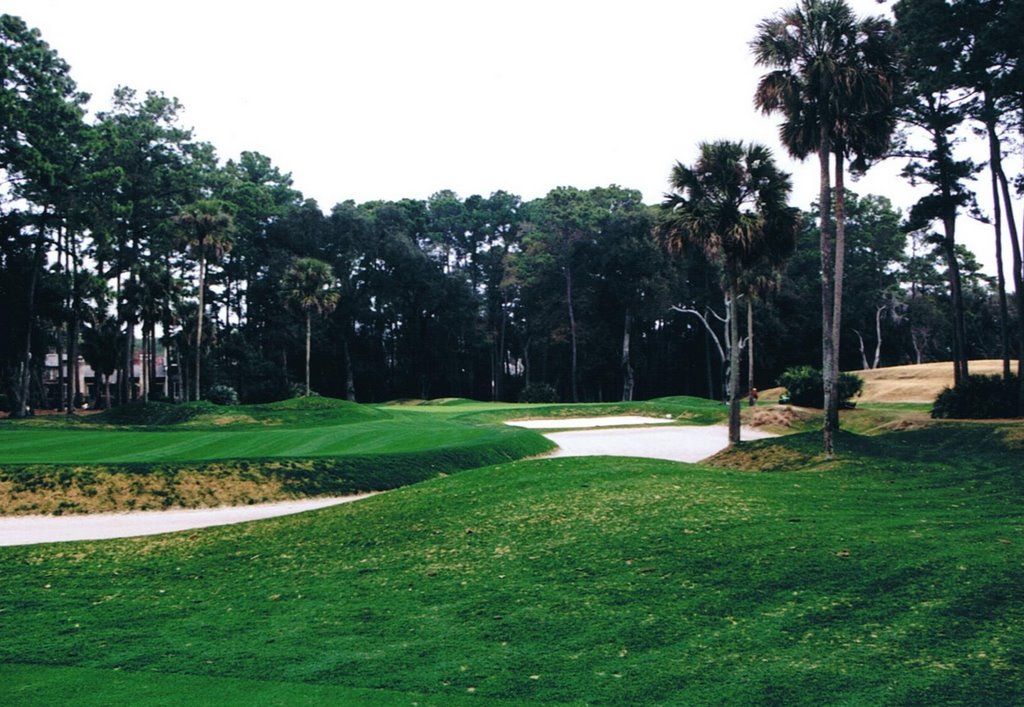
William Flynn greatest strength as an architect was his strategic vision. He demands that you focus on each and ever task throughout the entire round. He challenges you create shots from all sorts of different stances. He insists on courage and precision when attacking the course. To play well; you must use the land to make shots, understand the ideal angle for each approach, and position yourself on the greens, and of course putt well. He may not get the national attention of a Donald Ross, but Flynn is every bit the equal of the elite of Golf Architecture.

Tuesday, May 09, 2006

The Importance of the Insurmountable Hole


The 6th at Kawartha 235 yards to a high plateau


I wrote a long time ago about the need for a “breather hole” on a course dominated by a series of exceptionally challenging holes or through challenging terrain. Today I want to talk about the importance of the Insurmountable hole, in this case set among a series of easier holes.

Yesterday I played golf at Kawartha Golf & Country Club, a great Stanley Thompson layout that has been profiled on this blog before. The first five holes at Kawartha are a nice slow introduction into the course, a selection of medium par fours with one very short par five (a hole I would love to see play as a long par four with just a few shorter tees for playability). After the first five, the player runs smack into the teeth of the course, the first of the long par threes. The 6th hole is a very long and very uphill par three of around 235 yards. What makes the hole tough is that it plays at least one if not two clubs uphill. The green sits atop a diagonal ridge to the left that is severely sloped, with a rambling deep bunker cut in the face of the slope. Long right is a directional bunker that is impossible to recover from because of the slope of the green. The green is also set up a few feet higher on an additional slight rise, like the 15th at Catarqui (another insurmountable hole). Only the very best shot will find the surface and the slope turns the rest od the approach shots around and back down the slope. Oh yes, and then there is the green, nothing fancy just a severe pitch directly at the bunker on the left. You must be underneath the pin to make a putt. The green is not ridiculous enough to roll the ball off, but a putt from the sides is pretty much impossible. That, my friends, is an insurmountable hole. You would remember a birdie there for a long time, a par is a victory to be savored (it probably won you money) and a bogie is clearly an acceptable result. The members say the average group finishes out in 20!

My playing partner called the hole goofy. I in turn said after 5 short holes where Thompson allowed you lots of opportunity to score, the hole is ideal. Golf needs changes of pace to be interesting, and it is at its best when holes contrast the previous in length or difficulty. What I like about the 6th at Kawartha is if you haven’t got your game together yet, it’s time for Thompson to start taking strokes back. He’s telling you that it’s time for you to show what kind of player you are.

I’ve often talked about flow in a round of golf. This is a course where Thompson was building for the employees of GE (originally owned by GE) and he made the decision to build a golf course that was playable. There are almost no fairway bunkers on the entire course and there are lots of middle length holes to enjoy where good players have ample opportunity to score. What Thompson did is ramp up the difficulty in a few select holes to test the player. Remember it is nearly impossible to lose a ball on our insurmountable hole, he just used the land to say you’ve had your fun, now can you play a little.

Great holes like the Road Hole at the Old Course are practically impossible to make par on for all but the greatest players. Overcoming one of these “par and a half” holes means a lot more to the average player than making a par on a on a simple par four. The insurmountable hole is important to providing interest and contrast in the collection of holes. It often provides memories too, make a birdie on the Road Hole and you can tell that story for a lifetime!

Monday, May 08, 2006

Dealing With Flat Sites


The TPC at Sawgrass was one of the best courses ever built on a por site. Dye lifted the fairways and used bunkering as transition.


Greg asked, “How you would work with a flat piece of land. Is this a golf architect's worst nightmare, or something better? Does a flat piece of land provide more options, or fewer? What are the main things that drive a flat design? What would you do with a wooded lot vs. a clear lot?”

The good is that you have almost complete artistic freedom to create exactly what you want. The bad is that no matter how hard you try, you will always be limited by the flatness of the site.

The key to handling it becomes making a decision on how to provide some relief to the holes to make the course interesting. The old standard of placing containment mounds around the outside of holes makes for a horrible and unnatural golf course. The key is to create a natural feature like a sand quarry or a ridgeline to add at least one prominent landscape element from which you work from. The pit can be used to create the fill needed to lift areas such as tees and green – even fairways too. The ridgeline running through the middle allows you to use it for backdrops and to provide views out over the property to situate tees greens and even fairways.

A flat site is not an architect’s worst nightmare, but it presents a very complicated build for drainage and a very average starting point which usually doesn’t lead to a great golf course – unless an architect has an immense imagination and a good solid budget to work with. Built on the cheap, there is very little an architect can do to overcome the site.

The architecture for a flat property can have the most options since it is limited only to the imagination and the earthmoving budget. You are left to create it all, which suits someone like Pete Dye, whereas to many others this task is far to large for them. You have a blank canvas; the problem is if you have no natural features to work with, you also have to manufacture all those too. It’s a lot to create and very taxing on the imagination.

The things that drives a flat design is getting fill to make features and finding a way to drain the golf course effectively. You have to brilliant with drainage to build flat courses, it suits the engineering side of the golf architects mind more than the seat of the pants designer. It is also hard not to fall into using large bodies of water that come into play – that provide you with lots of fill to work with. This is used so often that you can probably picture these types of holes everywhere. Here in Toronto it describes almost every new 18th hole built in the last 25 years!


Ballantrae is a housing roject built on a flat site, where the golf course deals with all drainage and storm run-off.


The only thing I would do different with a wooded site is to not place fill up against the trees. The key to creating a natural looking course is to disguise the fills so they look like they are natural and nothing is more obvious than mounds or a big fill against a tree line. The best example of working with flat site in the trees is the TPC at Sawgrass. That was a horrible site, but Pete managed to make a magnificent natural looking course by raising the playing areas up in the middle and then using ponds, rough areas and waste areas against the trees to hide the fill placed on the fairway. I would definitely borrow my approach from Pete. He borrowed his from Raynor and Banks. I might even consider a course based on the template holes of Raynor and MacDonald as my method of dealing with a perfectly flat site.

Sunday, May 07, 2006

Routing to Add Difficulty Part 2

In routing to add difficulty I wanted to discuss four (possibly more) different ways to make a hole more difficult by the way you place holes on the land. So far I have touched on using crowns and using cross-slopes to add difficulty in a routing. The lesson at Garden City is one of the best and easiest to use because the situation exists on almost every property right down to the gently sloping ones. The rest usually require natural undulation to exist.

The third method is the placement of strong topography right in the landing zone, so that the landing zone is in fact much tighter and much more challenging than the fairway width. I have two different examples of this, one is using a valley style hole that has the placement of the rolls of the hills make the tee shot tough to negotiate, the other uses huge bowls eating into a huge plateau to make placement important.


The first example is the 11th hole at Oakland Hills. The large roll on the left extends right across the fairway and deflects any tee shots to the right side of the hole. What makes this extra tough is the right side roll is where the bunkers are cut. The difficulty lies in trying to thread the tee shot by the bunkers by playing a draw, having to try take it down the left and risk a downhill lie in the rough, or having to lay short of them and having a brutally long approach into an elevated green. Convention would have had the fairway go further right creating a natural bowl shaped fairway, but when Ross kept the fairway left he made one of the better driving holes in golf.


The second example is the 16th at the National Golf Links of America. The tee shot is played to a huge plateau starting 180 yards out. What makes the shot fun is that three 30 foot deep bowls that eat into the plateau. The first one on the front right has a large bunker cut into it and it frames the tee shot. The one on the left is 240 yards from the tee and collects a tentative tee shot. The last one on the right behind the first one is 300 yards and collects the longest player playing too aggressive. The fairway runs the ball all the way to the bottom into the left bowl and far bowl and the player is left with a difficult and very blind approach to the punchbowl green. The alternating bowls make accuracy off the tee important on this hole.

The second type of hole is the use of the plateau. My examples involve green sites, but landing areas can also be a plateau and usually involve an elevated tee shot over a valley played to a plateau on the other side. But it is the plateau green that adds the most difficulty when used in a routing. The plateau green can come in two styles, the green that is set above the grade but is still visible to the player on the approach, or it can be much higher and not visible from the landing area. When there are no trees immediately behind these are often called skyline greens, because that is all you can see. The difficulty comes first from gauging the club required and then from having the ball repelled away from the green if the green is missed. If you take the extreme case at Pinehurst, sometimes the ball is repelled off the green even when you the hit green itself, but now we are heading more into the detailing than the routing of a hole.


The first example is sometimes called the volcano green site, because of its appearance. The 2nd at Pine Valley involves an uphill approach to a green that falls off in all directions. The green is fronted by deep and intimidating front hazards putting pressure on the approach, but missing wide or long leaves the ball well down a slope with the green running severely away. This is not a long hole, but is still one of the toughest in golf.


The second example is the finest par four I know, the 14th at Royal Dornock called Foxy. The green is about 10 feet above the fairway. The difficulty is in finding this green with your approach. In this instance the approach and sides are all cut short which means only a great approach will stay on the green, the rest are left to run off the slope and stay down in the valley leaving a touch chip back up the slope to try save par. The front and side slopes work to create almost a crown effect with the front of the green adding further difficulty to the approach, this is an extremely challenging hole with no bunkers.

There are others, like leaving uneven or rumpled land in the landing areas, and running greens with the natural slope which is away from play, but I think many of these examples cross over into detailed design. So I’ll leave this subject there…..for now